Introduction
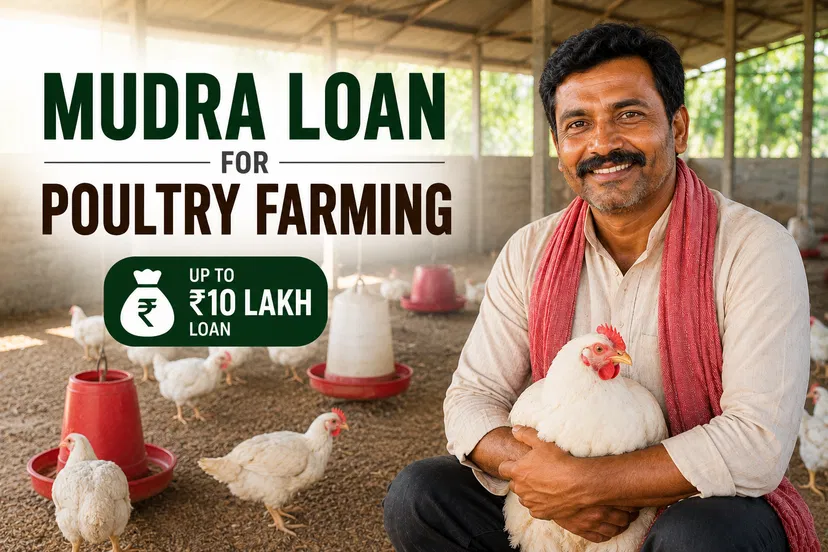
The Pradhan Mantri Mudra Yojana (PMMY), commonly called the MUDRA loan scheme, was launched in April 2015 to give small and micro enterprises collateral-free credit without needing a guarantor. It's worth being clear upfront about scope: MUDRA is a Ministry of Finance scheme for non-farm micro enterprises, and it explicitly excludes direct crop loans and land improvement work like irrigation, wells, or canals — those are covered by separate agricultural credit schemes such as the Kisan Credit Card. What MUDRA does cover, and where it's genuinely useful for a farming household, is allied agricultural activity run as a micro enterprise — dairy, poultry, fishery, beekeeping, food and agro-processing, agri-clinics, and similar income-generating ventures.
MUDRA Loan Scheme Overview
- Scheme Name — Pradhan Mantri Mudra Yojana (PMMY), launched 8 April 2015
- Implementing Ministry — Department of Financial Services, Ministry of Finance, through MUDRA Ltd. and lending institutions
- Loan Categories — Shishu (up to ₹50,000), Kishore (₹50,001–₹5 lakh), Tarun (₹5,00,001–₹10 lakh), and Tarun Plus (above ₹10 lakh up to ₹20 lakh, introduced in the 2024-25 Budget)
- Collateral — None required; loans are collateral-free and backed by the Credit Guarantee Fund for Micro Units (CGFMU), now extended to cover loans up to ₹20 lakh
- Lending Institutions — Scheduled commercial banks, RRBs, small finance banks, NBFCs, and MFIs
- Scale — Over 40 crore loans worth more than ₹23 lakh crore sanctioned since 2015
Objectives of MUDRA for Rural and Agri Borrowers
- Extend formal, collateral-free credit to micro entrepreneurs who fall outside typical bank lending criteria.
- Support income diversification for farming households through allied activities like dairy, poultry, and fishery.
- Encourage first-time and women entrepreneurs in rural and semi-urban areas.
- Build a formal credit history for borrowers through structured, trackable loan accounts and the MUDRA Card.
- Fund small transport, processing, and trading activities that support the wider agricultural value chain.
Key Features of MUDRA Loans for Farmers
- Eligible allied-agriculture activities include dairy farming, poultry, pisciculture (fish farming), beekeeping, livestock rearing, grading and sorting, agro-processing, agri-clinics and agribusiness centres, and food processing units.
- Not eligible: direct crop cultivation, crop loans, and land development works such as irrigation, wells, or canals — these fall under separate agricultural credit schemes.
- Tractors, power tillers, and two-wheelers used strictly for commercial purposes can be financed under MUDRA, alongside small transport vehicles for moving goods and produce.
- Working capital portion of the loan can be managed through a MUDRA Card, a debit card linked to the loan account for flexible drawals and repayments.
- Interest rates are not fixed centrally — each lender sets its own rate, typically in the range of 10–16% per annum depending on the loan category and borrower profile.
- Repayment tenure generally runs from 1 year (Shishu) up to 5–7 years for larger Tarun and Tarun Plus loans, with EMIs starting after any moratorium.
Benefits of MUDRA Loans to Farmers
- No collateral or third-party guarantee needed, removing the biggest barrier most small rural entrepreneurs face with traditional bank loans.
- A useful complement to agricultural credit — while crop loans and land development stay outside MUDRA, dairy, poultry, and fishery income diversification can be funded through it.
- Faster processing for smaller loans — Shishu-category loans can often be approved within 7–10 working days given minimal documentation.
- Flexible loan sizing across four tiers, letting a borrower start small (Shishu) and graduate to larger Kishore, Tarun, or Tarun Plus loans as the business grows and repays well.
- No CIBIL score requirement for Shishu loans up to ₹50,000, widening access for first-time borrowers with no credit history.
Limitations of MUDRA for Farmers
- Direct crop loans, land improvement, irrigation, and well construction are explicitly excluded — MUDRA is not a substitute for a Kisan Credit Card or crop loan.
- Tarun Plus (₹10–20 lakh) is available only to borrowers who have already taken and successfully repaid a loan in the Tarun category, so it isn't accessible on a first loan.
- Interest rates vary by lender since there's no centrally fixed rate, so the effective cost can differ significantly between banks and NBFCs.
- A poor repayment record on any existing loan disqualifies an applicant, and undocumented or informal businesses may struggle to meet even MUDRA's relatively light documentation requirements.
- As a general-purpose micro-enterprise scheme, MUDRA doesn't offer the sector-specific subsidy or interest subvention that dedicated schemes like AHIDF (dairy) or the KCC (crops) provide.
Documents Required
- Identity proof: Aadhaar Card, PAN Card, Voter ID, Passport, or Driving Licence (any one)
- Address proof: Aadhaar Card, recent electricity/telephone bill, or similar
- Business proof: registration certificate, Udyam Registration (recommended), and GST returns where applicable
- Passport-size photographs of the applicant
- Bank account statements for the last 6 months, for Kishore/Tarun/Tarun Plus applications
- Quotation for machinery/equipment to be purchased, where relevant to the business plan
How to Apply for a MUDRA Loan
- Decide the loan category (Shishu, Kishore, Tarun, or Tarun Plus) based on the funding need and, for Tarun Plus, prior repayment history.
- Apply online through the Udyamimitra portal or the Jan Samarth portal, or approach a scheduled bank, RRB, small finance bank, MFI, or NBFC branch directly.
- Submit identity, address, and business proof along with a brief business plan describing the allied-agriculture activity.
- The lender assesses the application and, on approval, disburses the loan; a MUDRA Card may be issued for managing the working capital portion.
- Track the loan account and repayment through the lending institution; consistent repayment can support graduation to a higher loan category later.
Conclusion
MUDRA loans won't fund a crop cycle or a new well, but for the dairy shed, poultry unit, fish pond enterprise, or small agro-processing setup that runs alongside farming, they offer genuinely useful, collateral-free credit with relatively simple documentation. The key is matching the right credit tool to the right need — MUDRA for allied micro-enterprise activity, and dedicated agricultural schemes like the Kisan Credit Card or AHIDF for crop finance and larger dairy infrastructure respectively.
Disclaimer: Loan limits, interest rates, and eligibility criteria are set individually by lending institutions and are subject to periodic revision by the Government of India. MUDRA does not cover direct crop loans or land improvement works. Readers are advised to verify current details on the official MUDRA website (mudra.org.in), the Udyamimitra/Jan Samarth portals, or with their nearest bank branch before applying or making any financial decision.