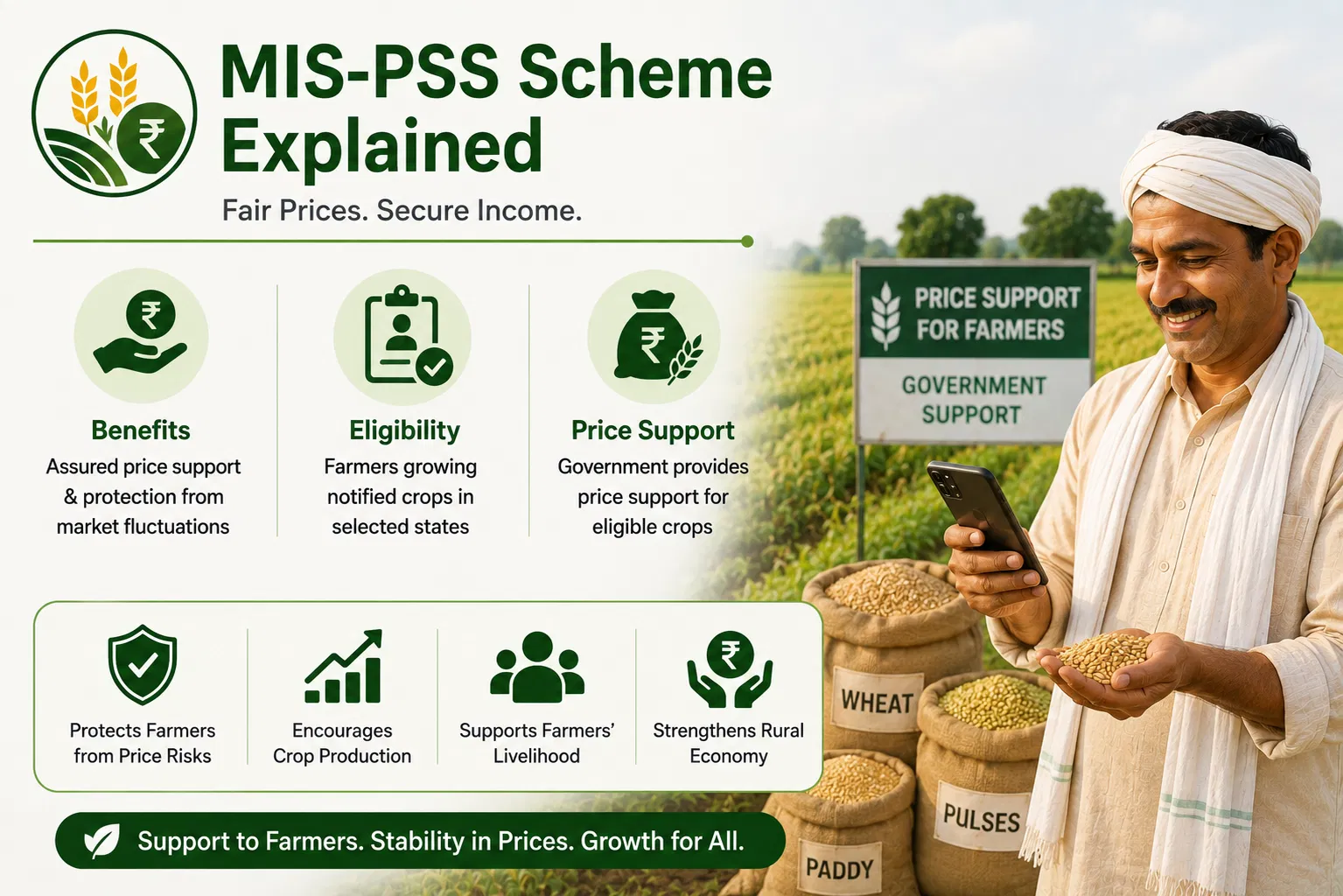
The Market Intervention Scheme and Price Support Scheme, together known as MIS-PSS, are two of the oldest and most important price-protection tools run by the Government of India for farmers. They were brought together under the umbrella of the Pradhan Mantri Annadata Aay Sanrakshan Abhiyan (PM-AASHA) to ensure farmers are not forced into distress sales whenever a bumper harvest or a market crash pushes prices below a fair level. PSS covers pulses, oilseeds, and copra at the Minimum Support Price (MSP), while MIS steps in for perishable crops like tomatoes, onions, and potatoes that don't have an MSP of their own. Together, they act as a safety net so a good harvest doesn't turn into a financial loss for the farmer who grew it.
MIS-PSS Scheme Overview
- Scheme Name – Market Intervention Scheme and Price Support Scheme (MIS-PSS), implemented as components of Pradhan Mantri Annadata Aay Sanrakshan Abhiyan (PM-AASHA)
- Scheme Modification Date – MIS guidelines revised to encourage more states to implement it; PSS procurement approvals for pulses and oilseeds continue to be issued season-wise, with fresh approvals made in mid-2026 for the Summer 2026 and Rabi Marketing Season 2025-26 cycles
- Scheme Fund Allocated – Losses under MIS are shared between Centre and states — the state bears 50% of any loss (25% for North-Eastern states), with the Central share released based on specific state proposals; under PSS, procurement is done at MSP with the Centre bearing the primary cost, subject to a cap of 25% of total harvest for pulses and copra
- Type of Scheme – Central Government scheme (PM-AASHA umbrella), implemented in partnership with State/UT Governments and central agencies like NAFED and FCI
- Helpline No – Kisan Call Centre, 1800-180-1551; farmers can also contact their state's Agriculture Marketing Department or the nearest NAFED procurement centre
- States Covered – MIS is implemented only in the state that requests it for a specific commodity and season; PSS procurement for pulses and oilseeds is approved state-by-state each season, with recent approvals covering states including Uttar Pradesh
Objectives of the Scheme
- Protect farmers from distress sales during bumper harvests when market prices crash
- Ensure remunerative prices for crops not covered under the standard MSP mechanism, particularly perishables
- Guarantee Minimum Support Price procurement for pulses, oilseeds, and copra to encourage their domestic production
- Maintain price stability and market confidence across agricultural and horticultural commodities
- Provide a financial safety net that secures farmer income against sudden price fluctuations
Key Features of MIS-PSS
- Market Intervention Scheme (MIS) – Covers perishable agricultural and horticultural commodities like tomato, onion, and potato that don't have a notified MSP; implemented only at the request of a State/UT Government, and triggered when market prices fall by at least 10% compared to the previous normal season
- Under MIS, a designated agency procures a pre-determined quantity at a fixed Market Intervention Price (MIP) for a set period, or until prices stabilise above the MIP, whichever comes first
- Price Support Scheme (PSS) – Covers pulses, oilseeds, and copra at MSP; NAFED and FCI, as central nodal agencies, procure directly whenever market rates fall below MSP, up to a maximum of 25% of total harvest for pulses and copra
- For oilseeds specifically, states can choose among three procurement models: PSS (physical procurement), Price Deficiency Payment Scheme (PDPS, where the government pays the difference between MSP and market rate directly into farmers' accounts), or Private Procurement and Stockist Scheme (PPSS, using authorised private agencies paid a service charge of up to 15% of the notified MSP)
- The government has approved 100% procurement of tur, urad, and masoor under PM-AASHA through 2028-29 to further reduce distress sales of these key pulses
- Losses under MIS are shared: the state bears 50% (25% for North-Eastern states), with the Centre's share released based on specific proposals submitted by the state
MIS-PSS Benefits to Farmers
- Guaranteed Minimum Support Price for pulses, oilseeds, and copra, ensuring a remunerative floor price regardless of market conditions
- Protection for perishable crop growers (tomato, onion, potato, and similar produce) during bumper-harvest price crashes, even though these crops have no notified MSP
- Reduced pressure to sell produce immediately at whatever price is offered, since procurement centres offer an assured price alternative
- Direct bank transfer of price-difference payments under PDPS in states that adopt this model for oilseeds
- Encourages farmers to continue growing pulses and oilseeds domestically, supporting India's self-sufficiency goals in these crops
- Strengthens overall market confidence, since farmers know a safety net exists if prices fall sharply
Limitations of the Scheme
- MIS is implemented only when a State/UT Government specifically requests it for a commodity — it is not automatically available everywhere
- Procurement under PSS for pulses and copra is capped at 25% of total harvest, so surplus beyond this limit does not get MSP protection
- MIS activation requires at least a 10% fall in prices compared to the previous normal season, so smaller price dips don't trigger intervention
- States must share the financial burden of MIS losses (50%, or 25% for North-Eastern states), which can affect how readily some states request the scheme
- Procurement operations are confined to the concerned state and depend on functioning designated agencies and notified markets, which can vary in accessibility across regions
Documents Required
- Aadhaar Card
- Land ownership or cultivation proof
- Bank account passbook (mandatory for PDPS or DBT-based payments)
- Crop/produce details as required by the procuring agency
- Farmer registration with the procurement agency (NAFED or the designated state agency)
How to Access MIS-PSS Benefits
- Check whether your crop and state currently have an active MIS or PSS procurement window through your state's Agriculture Marketing Department or NAFED.
- Register with the designated procurement agency, providing your Aadhaar, land, and bank account details.
- Complete the application form online or at a designated facilitation centre, as specified for the season.
- Bring your produce to the notified procurement centre or market during the active procurement window.
- Sell through the transparent process specified for your crop — direct procurement at MSP/MIP, or auction-based sale with a price-difference payment under PDPS, depending on the model your state has adopted.
- Payment is credited to your registered bank account, either as the full procurement value or the MSP-market price difference, depending on the scheme component used.
Conclusion
MIS-PSS remains one of the most direct ways the government protects farmer income when markets turn unfavourable — whether it's a bumper tomato harvest crashing local prices or pulses falling below their guaranteed MSP. By combining assured procurement under PSS with need-based intervention under MIS, and offering flexible models like PDPS and PPSS for oilseeds, the scheme gives farmers a genuine cushion against the kind of price crashes that would otherwise wipe out a season's hard work. Farmers growing pulses, oilseeds, copra, or notified perishable crops should stay in touch with their state Agriculture Marketing Department to know when procurement windows open each season.
Disclaimer: This article is for informational purposes only. Scheme details, interest rates, and subvention amounts are subject to periodic revision by the Government of India, RBI, and NABARD. Farmers are advised to verify the latest terms and eligibility criteria with their bank, NABARD, or official government sources before applying.