
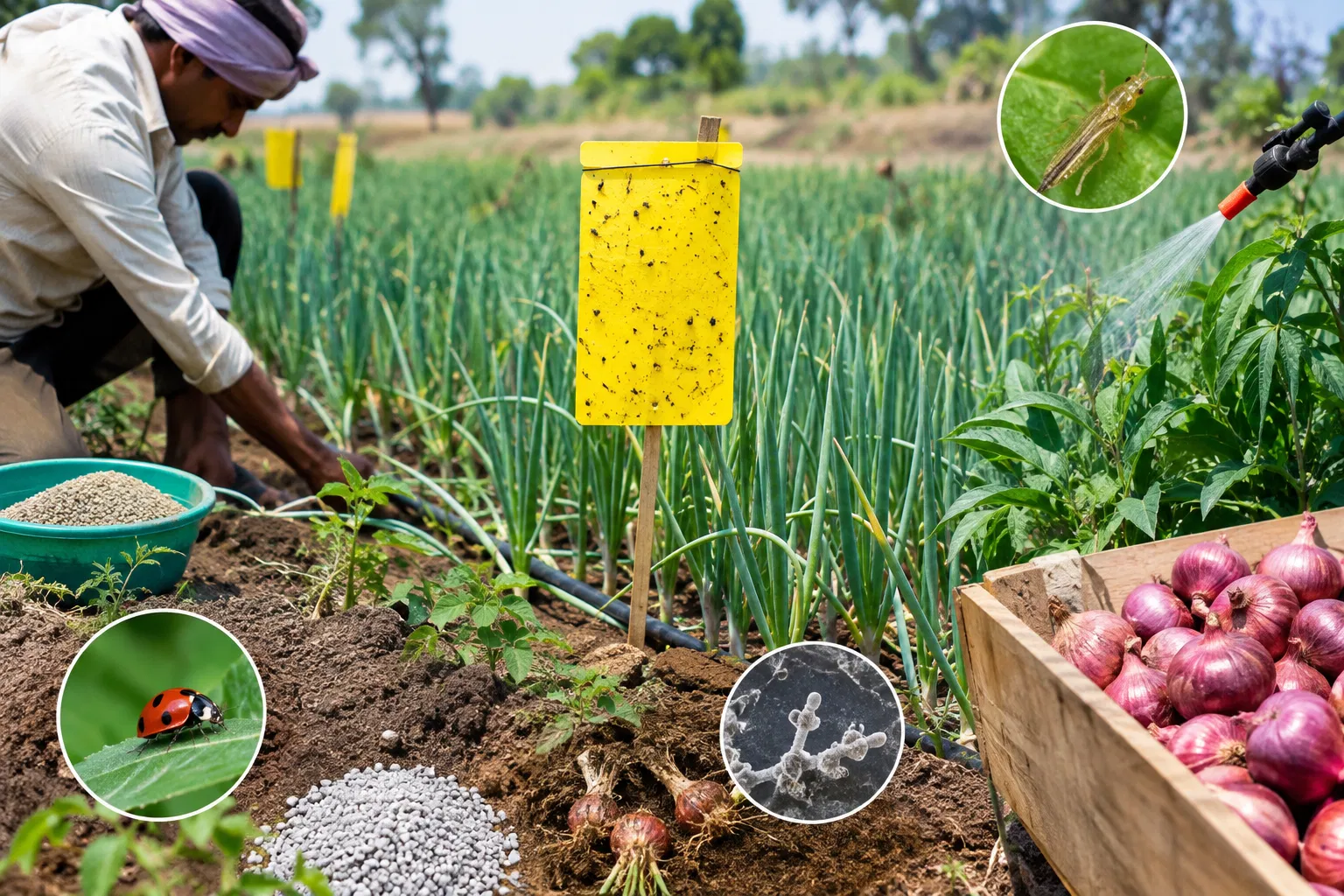
Onion gets attacked from two sides, thrips above the ground and root grubs below it. Spraying the same insecticide again and again generally costs more each season and gives less result. Integrated Pest Management (IPM) is a simpler way: keep pests low with field practices, catch them early with traps, hold them down with bio-agents, and spray only when damage crosses a limit. This guide gives farmers an easy IPM plan for onion, with the products that can be used at each step.
Major Pests of Onion
- Onion thrips (Thrips tabaci): Tiny insects inside the leaf fold; leaves show silvery streaks, curl and dry from the tip, generally worst in dry weather. Read our guide on how to manage thrips in onion.
- Root grub (Holotrichia spp.): White, C-shaped grubs chew roots; plants wilt in patches and pull out easily. Beetles emerge after the first monsoon showers.
- Cutworm (Agrotis ipsilon): Cuts seedlings at the base at night in the nursery and after transplanting.
- Leaf-eating caterpillars (Spodoptera litura, Helicoverpa armigera): Feed on leaves and may bore into the bulb neck.
- Onion maggot (Delia antiqua) and bulb/eriophyid mites: Maggots tunnel into the bulb base; mites cause twisted leaves and rotting bulbs in the field and storage.
Also read about the 2 major pests affecting onion crop.
Cultural Practices for IPM in Onion
- Deep summer ploughing exposes grubs and cutworm larvae to sun and birds.
- Solarise nursery beds with transparent polythene for 3 to 4 weeks before sowing.
- Avoid onion after onion, garlic or cole crops; rotate with maize, sorghum or pulses.
- Use well-decomposed FYM only, as raw FYM can attract grub beetles to lay eggs.
- Plant 2 to 4 border rows of maize or sorghum; coriander or cowpea borders support natural enemies.
- Avoid close spacing and excess nitrogen, which generally favour thrips.
- Sprinkler irrigation may reduce thrips; light flooding can bring down grubs and mites. Destroy crop residue and weeds.
For sowing dates, spacing and nutrition, see our onion cultivation guide.
Mechanical Practices and Traps
Traps show when a pest is arriving, so sprays are timed by need, not by calendar. Hand-collect cutworms near cut seedlings in the morning and fix bird perches (about 20 per acre).
Blue Sticky Traps for Thrips
Install 4 to 5 per acre, 15 cm above the canopy, for monitoring and mass-trapping.
Pheromone Traps for Caterpillars
Install 4 to 5 per acre for Spodoptera litura; replace lures every 2 to 3 weeks.
Light Traps for Grub Beetles and Moths
One per acre, run from 6 pm to 10 pm, to collect grub beetles after the first rains and moths of cutworm and caterpillars.
Learn placement tips in our guide on using yellow and blue sticky traps.
Biological and Botanical Control
Bio-agents work best when applied early, in the evening, with enough water, and may help delay resistance. Also conserve natural enemies such as anthocorid bugs, lacewings, syrphids and ladybird beetles, which feed on thrips, by avoiding broad-spectrum sprays when they are active.
Verticillium (Lecanicillium) lecanii for Thrips
Recommended for onion thrips as a foliar spray.
Beauveria bassiana for Thrips and Grubs
Spray for thrips; apply to soil for grubs.
Metarhizium anisopliae for Root Grub
Mix with FYM and apply to soil before transplanting.
Neem (Azadirachtin)
Reduces thrips and caterpillar feeding at low pest levels.
Chemical Control: Recommended Insecticides for Onion
Spray only when thrips keep rising despite the above steps. Direct the nozzle into the leaf fold, add a sticker, rotate chemical groups and follow the waiting period.
Onion Thrips
Fipronil 80% WG (30 g/acre)
More options are in the Fipronil range.
Tolfenpyrad 15% EC (400 ml/acre)
Lambda-cyhalothrin 5% EC (120 ml/acre)
Deltamethrin 11% w/w EC (60 ml/acre)
Profenofos 50% EC (400 ml/acre; long waiting period, so use early in the crop)
Browse all insecticides for thrips in one place.
Root Grub
Chlorpyrifos 20% EC (2 L/acre as a soil drench along the rows)
Pests often go together with diseases such as purple blotch, so also see top onion diseases and their management.
Conclusion
IPM in onion is not about avoiding insecticides. It is about using them at the right time, after cultural, trap and biological steps have done their work. Farmers who scout weekly, keep traps in the field and rotate chemical groups generally see fewer sprays, healthier bulbs and better returns.
FAQs on IPM in Onion
1. What is the most damaging pest of onion?
Thrips, generally, followed by root grub in rainy-season crops.
2. How many blue sticky traps are needed per acre?
About 4 to 5 per acre, 15 cm above the canopy, are generally enough.
3. Can neem oil alone control thrips in onion?
Neem may hold low populations; once leaves show heavy silvering, a recommended insecticide is usually needed.
4. When should chlorpyrifos be applied for root grub?
As a soil drench soon after transplanting, or at the first sign of patchy wilting.
5. Why rotate insecticide groups?
Repeating one group can make thrips stop responding; alternating fipronil, tolfenpyrad and pyrethroids may keep sprays effective.
Disclaimer: The pest management practices and products mentioned here are for general guidance on IPM in onion. Pest pressure varies by region, season and variety. Always read the product label for dose and waiting period, and consult a local agricultural expert before application.