Fruit borer attacks chilli at the worst possible moment, when the crop is flowering and setting fruit, and it attacks the part of the plant that is actually sold. The larva feeds for a few days on the surface and then bores into the fruit, and from that point onward no spray reaches it. Everything that matters in controlling this pest therefore happens before the hole appears: catching the egg-laying flight, spotting the young larvae while they are still exposed, and spraying then rather than after the damage is visible. A field sprayed at the first sign of bored fruit has already lost that picking.
Symptoms
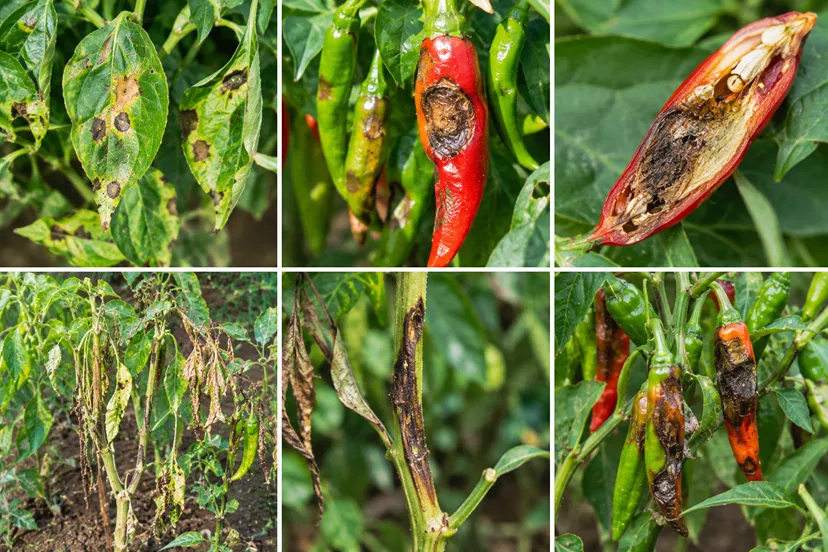
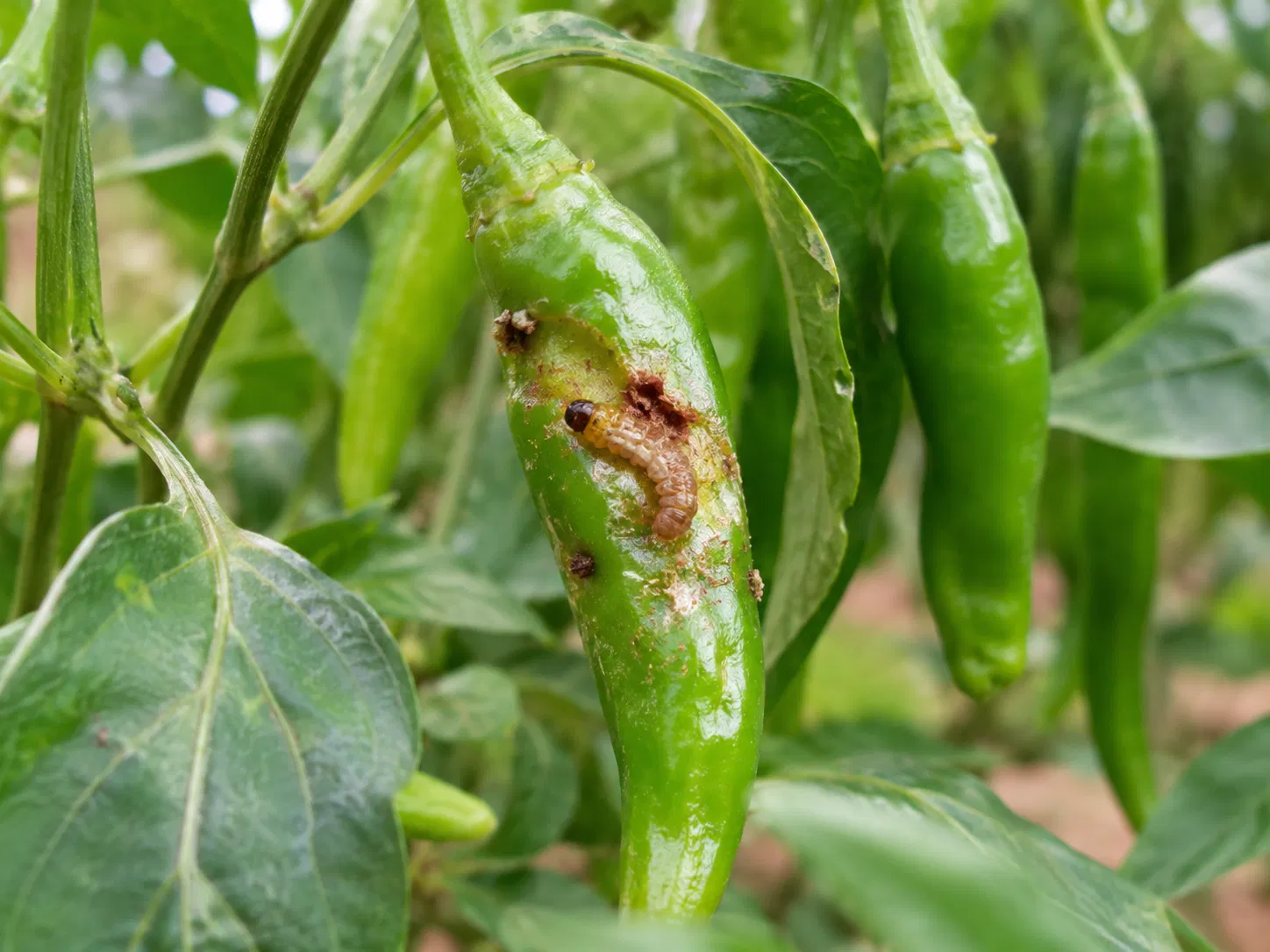
- Circular entry holes on the fruit, usually near the calyx, often with dark frass packed around the opening
- Fruits rotting from inside, turning pale or straw-coloured, and dropping prematurely once the larva has fed within
- Hollowed-out fruit with the seeds eaten and a feeding tunnel running through the flesh when the fruit is cut open
- Large caterpillars, pale green to brown with dark wavy lines along the body, found part-buried in a fruit with the rear end protruding
- Damage to flower buds and young fruits before the main fruiting flush, causing them to shrivel and drop
- Irregular holes chewed in leaves and tender shoots by young larvae before they move to the fruit
- Several fruits damaged in sequence along a branch, since a single larva moves from fruit to fruit as it grows
Causes
- Helicoverpa armigera, the American bollworm, which is the main fruit borer of chilli, alongside Spodoptera litura, the tobacco caterpillar, which feeds on foliage and fruit alike
- Moth flights coinciding with flowering and early fruit set, when egg-laying peaks on buds, flowers and tender growth
- A single female laying several hundred eggs, so one undetected flight produces an infestation across the field
- A larva that feeds openly for only a few days before boring in, which is a very short window in which any spray can work
- An extremely wide host range covering cotton, tomato, pigeon pea, chickpea, maize and many weeds, which keeps a population moving between crops all year
- Repeated use of the same insecticide groups, which has produced well-documented resistance in Indian Helicoverpa populations, particularly to the older pyrethroids and organophosphates
- Broad-spectrum sprays that remove the parasitoids and predators, including Trichogramma egg parasitoids, which otherwise destroy a large share of the eggs
- Warm weather during fruit development, which shortens the life cycle and allows generations to overlap
- Pupation in the soil, which means part of the population is beyond the reach of any foliar spray at any given time
- Excess nitrogen, producing dense soft growth that shelters larvae and shields them from spray
How to Identify
The entry hole is the confirming sign, but by then it is too late to act on that fruit. Look for a neat circular hole near the calyx with dark frass around it, and cut the fruit open to find the tunnel and the eaten seeds. A fully grown larva is 35 to 40 mm long, pale green through brown to almost black, with dark wavy lines running lengthwise along the body and a lighter stripe down each side. It typically feeds with its head and forebody inside the fruit and the rear half hanging out, which is a distinctive sight.
Scouting that actually helps starts earlier than that. From the flower bud stage, examine buds, flowers and tender shoots for eggs, which are laid singly, are about half a millimetre across, round and ribbed, and change from creamy white to brown as they mature. Young larvae are a few millimetres long and feed on the outside of buds and fruits, and this is the stage a spray can still kill. Check 10 plants at 5 random spots per acre twice a week from flowering, and inspect fallen buds and fruits, since a dropped fruit often means a larva has already moved on to the next one.
Pheromone traps make the timing far more reliable than any calendar. Install them from the flower bud stage and watch the catch: a sudden rise in male moths means eggs are being laid now, and a spray timed to that rise catches the larvae while they are still exposed rather than after they have bored in.
Control Methods
Chemical Control
1. Chlorantraniliprole 18.5% SC
Chlorantraniliprole is the standard against this pest and the most widely used product on chilli for good reason. It binds to ryanodine receptors in the larva and drains the muscle cells of calcium, which stops feeding within hours and leads to paralysis and death. It moves systemically within the plant, has strong residual activity of two to three weeks, and is comparatively safe for pollinators and natural enemies at label dose, so the parasitoids working on the eggs are left alone.
Product Recommendation
2. Cyantraniliprole 10.26% OD
Cyantraniliprole works on the same ryanodine receptor target and stops feeding within hours, but the oil dispersion formulation spreads and sticks better on waxy chilli foliage and moves systemically to protect new growth and developing fruit formed after the spray. It also covers thrips and whitefly, which are usually active in the same crop at the same stage.
Product Recommendation
3. Flubendiamide 39.35% w/w SC
Flubendiamide is a diamide with very high specific activity against caterpillars and almost none against other insect groups, which makes it one of the softest options on the beneficial insects in the field. Larvae stop feeding almost immediately on ingestion, and control is achieved at a low dose per acre.
Product Recommendation
4. Broflanilide 300 g/l SC
Broflanilide belongs to a newer class that acts on GABA-gated chloride channels at a binding site unrelated to the diamides, the spinosyns or anything older. That matters where diamide performance has started slipping, because there is no cross-resistance. It stops feeding rapidly, kills across larval stages, and holds residual activity for two to three weeks.
Product Recommendation
5. Isocycloseram 9.2% w/w DC
Isocycloseram is the newest chemistry available for chilli and acts as a modulator of GABA-gated chloride channels, again with no cross-resistance to the groups that came before it. Feeding stops within a few hours, it moves translaminarly to reach larvae sheltering under leaves, and it controls the borer along with thrips and mites in the same pass, which is useful during the fruiting stage when several pests overlap.
Product Recommendation
6. Fluxametamide 10% w/w EC
Fluxametamide blocks GABA-gated chloride channels through a distinct binding mechanism, causing rapid overexcitation of the nervous system and death. It acts quickly on young larvae and covers both Helicoverpa and Spodoptera, and studies of resistance risk have found it slow to lose effectiveness, which makes it a dependable alternative to the diamides.
Product Recommendation
7. Spinetoram 11.70% SC
Spinetoram is a semi-synthetic spinosyn that overstimulates nicotinic acetylcholine receptors at a site no other insecticide group uses. Feeding stops within minutes and death follows within a day, and its translaminar movement carries it into the tissue where young larvae shelter. It is soft on pollinators and natural enemies at label dose and also controls thrips, which is a practical advantage on chilli.
Product Recommendation
8. Spinosad 45% SC
Spinosad comes from fermentation of the soil bacterium Saccharopolyspora spinosa and acts on the same receptor site as spinetoram, through contact and ingestion. It gives fast feeding cessation, controls caterpillars within about two days of application, and is a long-established option for resistant Helicoverpa. Since it shares a mode of action with spinetoram, treat the two as one group rather than as alternatives to each other.
Product Recommendation
9. Emamectin benzoate 5% SG
Emamectin benzoate is an avermectin that activates chloride channels in the nerve and muscle, causing irreversible paralysis; larvae stop feeding almost at once even though death takes a few days. It has translaminar movement and works well on young larvae, and it is an economical option to bring into the programme alongside the newer chemistries.
Product Recommendation
Three Products, One Mode of Action
Worth knowing before planning a season's sprays: chlorantraniliprole, cyantraniliprole and flubendiamide are all diamides acting on the same ryanodine receptor, so a farmer moving from one to another is using the same chemistry each time, not changing it. Indian Helicoverpa populations have already shown reduced sensitivity to this group in places. Where two well-timed diamide sprays produce no visible drop in larval numbers, the answer is a genuinely different group such as broflanilide, isocycloseram, fluxametamide or a spinosyn. The same applies to spinetoram and spinosad, which share a binding site with each other.
Timing the Spray
With this pest the timing is worth more than the product. A larva is exposed for only a few days before it bores into the fruit, so spray at the egg-laying and early larval stage, guided by a rise in pheromone trap catches or by the first young larvae found on buds, and not after entry holes appear. Direct the spray into the flowering zone and the fruiting canopy where eggs are laid rather than over the top of the plant, use full water volume, and spray in the early morning or late evening when larvae are active on the surface.
Cultural Control
- Collect and destroy bored and dropped fruits at every picking, since each one carries a larva that will otherwise complete its cycle in the field
- Plough deeply after harvest to expose soil-dwelling pupae, and destroy crop residue rather than leaving it standing
- Rotate with a non-host crop where borer pressure has been high, and avoid planting beside cotton, tomato or pigeon pea, which share the same pest
- Sow two rows of marigold for every 15 to 20 rows of chilli as a trap crop, since the moth prefers to lay on marigold, then destroy the colonised flower heads
- Keep nitrogen at the recommended dose and split it, as dense soft growth shelters larvae from spray
- Clear weed hosts from bunds and field borders, which carry the pest between crops
- Keep spacing wide enough for spray to penetrate the fruiting canopy rather than sitting on the top of a closed crop
- Protect natural enemies by avoiding calendar sprays; Trichogramma egg parasitoids and general predators destroy a large share of eggs and young larvae when left undisturbed
- Time sowing so that flowering does not coincide with the peak moth flight in your area where that is known locally
Mechanical Control
Pheromone traps are the most useful single tool here, and they serve two purposes. At 4 to 5 traps per acre they monitor moth activity so sprays can be timed to an actual flight instead of a calendar date, which is the difference between killing exposed larvae and spraying a field of already-bored fruit. At 15 to 20 traps per acre they also reduce mating success and suppress the following generation. Install them from the flower bud stage and change the lures as directed.
Alongside traps, set up bird perches at 10 to 12 per acre, since birds take a significant number of larvae from an open crop. Hand-pick and destroy large larvae during routine scouting on smaller holdings, and use light traps to draw down adult moth numbers. Remove and destroy affected fruit rather than dropping it between the rows.
Conclusion
Fruit borer damage in chilli cannot be undone, so the whole approach rests on acting inside a narrow window. Put up pheromone traps from the flower bud stage, scout buds and flowers twice a week for eggs and young larvae, and spray on the rise in trap catches rather than on the appearance of entry holes. Choose from genuinely different chemical groups across the season rather than moving between three products that share a mode of action. Then add the measures that cost almost nothing: picking up bored fruit at every harvest, a marigold trap row, bird perches, and deep ploughing once the crop is out.
Disclaimer: Always confirm current label registration, approved dosage, water volume, and pre-harvest interval (PHI) for your state before using any product, since labels are periodically revised by regulatory authorities.
This guide is a general advisory. Do your own research and verification before using any product. Always confirm suitability for your crop stage, region, and field conditions before making any purchase, spray, or crop-management decision.