Citrus psyllid is a small insect with an outsized consequence. The direct damage it does by sucking sap on tender shoots is real but survivable. What makes it the most serious pest in citrus is that it carries the bacterium responsible for citrus greening, and greening has no cure. A tree that becomes infected declines year after year, yields lopsided bitter fruit, and eventually has to be cut out. No spray, no nutrient programme and no amount of care reverses it. That single fact changes the whole approach: the work is not to reduce psyllid damage to an acceptable level but to keep the insect off the tree in the first place, flush by flush.
Symptoms
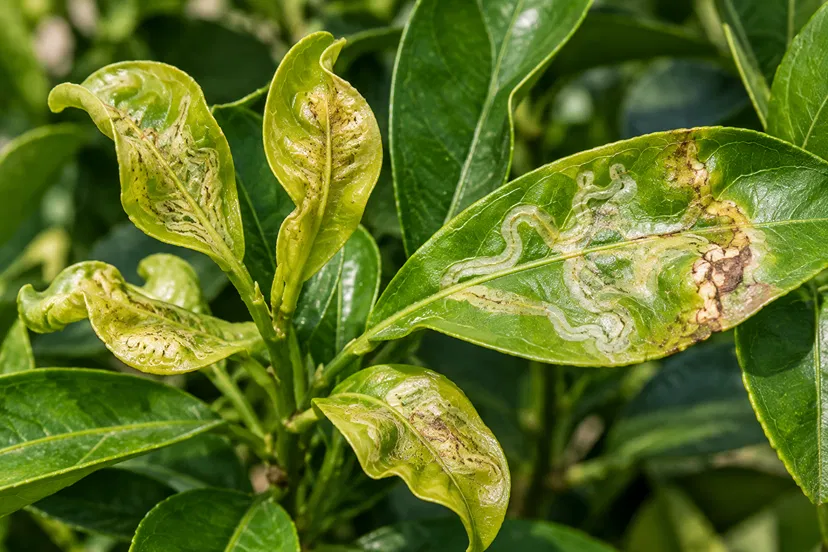
Psyllid feeding damage
- Small brown adults with mottled wings on tender shoots, sitting with the head down and the body raised at a sharp angle to the leaf surface, which is unlike any other citrus pest
- Flat, oval, yellowish-orange nymphs packed on the growing tip, surrounded by white waxy threads and curled tubules they excrete
- Twisted, curled and distorted young leaves, with shoots stunted and the growing tip dying back
- Sticky honeydew on leaves followed by black sooty mould, which blackens foliage and blocks light
- Heavy flower and young fruit drop where the psyllid has attacked the flush hard
Citrus greening
- Blotchy yellow mottling on leaves that is clearly asymmetric, with the pattern on one side of the midrib not matching the other, which is the defining sign of this disease
- Individual yellow shoots standing out in an otherwise green canopy, the symptom the disease is named for
- Thickened, corky, prominently raised veins on affected leaves
- Small, lopsided fruit with a curved central core, staying green at the stylar end even when ripe, and tasting bitter and off
- Dark, aborted, shrivelled seeds inside affected fruit
- Progressive twig dieback, thinning canopy, sparse off-season flowering and steadily falling yield over successive years
Causes
- Diaphorina citri, the Asian citrus psyllid, which feeds only on citrus and a few close relatives and lays its eggs exclusively on tender, unopened flush
- Candidatus Liberibacter asiaticus, the bacterium that causes greening, which the psyllid picks up while feeding on an infected tree and then transmits to every healthy tree it feeds on afterwards, carrying it for the rest of its life
- A single infected psyllid being enough to infect a tree, which is why a low insect count is not a safe count in an orchard where greening is present
- Tender flush, which is the only tissue on which the psyllid can breed; without new flush the population cannot multiply
- Off-season and scattered flushing, often driven by irregular irrigation or excess nitrogen, which gives the psyllid breeding sites through the year instead of a few predictable windows
- Infected planting material and budwood brought in from an unreliable nursery, which introduces the disease directly into a new orchard
- Infected trees left standing in or near the orchard, which act as a reservoir the psyllid keeps returning to
- Warm weather between roughly 25 and 30 degrees Celsius, which shortens the life cycle to two or three weeks and allows generations to overlap
- Broad-spectrum sprays that remove the parasitoid Tamarixia radiata along with ladybird beetles and lacewings, which together account for substantial psyllid mortality
- Curry leaf plants and ornamental Murraya hedges near the orchard, which host the psyllid and are often overlooked
How to Identify
The adult psyllid gives itself away by its posture. It is only three to four millimetres long, brown with mottled wings, and it feeds with its head pressed down and its abdomen tilted up at roughly 45 degrees, standing almost on end. Nothing else on citrus sits like that. Disturb the shoot and the adults jump and fly rather than crawling away.
Look at the growing tip for the immature stages, because that is where the population lives. Nymphs are flat, oval and yellowish-orange, clustered on the unopened flush, and they excrete distinctive white waxy tubules that curl away from the body. Those waxy threads on a tender shoot are a reliable sign even when the insects themselves are hard to see. Remember that the psyllid breeds only on tender flush, so an inspection of hardened leaves tells you very little; the flush is where to look.
For greening, one test matters more than any other. Hold up a mottled leaf and compare the two sides of the midrib. In greening the blotchy yellow pattern is asymmetric, so the mottle on one side does not mirror the other. Zinc and manganese deficiency, which looks similar at a glance and is the commonest misdiagnosis, produces a symmetric pattern that matches across the midrib. That single comparison separates a nutrient problem, which can be corrected, from a disease that cannot. Corky raised veins, lopsided fruit and dark shrivelled seeds confirm the diagnosis.
Inspect every new flush as it emerges, checking the tips for nymphs and waxy threads and tapping shoots over a white sheet to dislodge adults. Put up yellow sticky traps to catch adults and to signal when a fresh flight has arrived.
Control Methods
Chemical Control
1. Thiamethoxam 25% WG
Thiamethoxam is a systemic neonicotinoid that binds nicotinic acetylcholine receptors in the insect nervous system and disrupts nerve signalling. It is taken up and moved through the plant, which is what makes it effective here: the psyllid feeds on the tender flush, and a systemic product concentrated in that new growth reaches both adults and nymphs. It can be applied as a foliar spray on the flush or as a soil drench, which gives longer protection of successive flushes in young trees.
Product Recommendation
- Syngenta Actara Insecticide
- Dhanuka Areva Insecticide
- Katyayani Thioxam Insecticide
- EBS Thiomax Insecticide
2. Imidacloprid 17.8% SL
Imidacloprid is a systemic neonicotinoid working on the same receptor target, absorbed and translocated through the plant to reach insects feeding on new growth. It is the most economical systemic option available for this pest, works as a foliar spray on the flush or as a soil application, and is widely used on young trees where protecting every flush matters most.
Product Recommendation
3. Cyantraniliprole 10.26% OD
Cyantraniliprole is a diamide that binds ryanodine receptors and drains the muscle cells of calcium, stopping feeding within hours and causing paralysis. Because it acts on a completely different target from the neonicotinoids, it is the group to bring in where thiamethoxam or imidacloprid have been used repeatedly. The oil dispersion formulation spreads and adheres well on waxy citrus leaves, and it moves systemically into growth formed after the spray.
Product Recommendation
4. Spirotetramat 15.31% OD
Spirotetramat inhibits lipid biosynthesis, starving the insect of the fats it needs to develop, so nymphs fail to mature and adult females produce far fewer viable young. Its distinguishing feature is two-way systemic movement, travelling both upward into new shoots and downward to the roots, which reaches psyllids on parts of the tree a spray never touched. It suppresses a population over time rather than knocking it down today, so apply it as a flush begins rather than at peak numbers.
Product Recommendation
Spray the Flush, Not the Calendar
Every one of the products above works best when it is timed to the flush rather than to a date. The psyllid can only breed on tender unopened growth, so each flush is both the opportunity for the pest and the window for control. Watch for the flush emerging and treat it then, before the nymphs establish, and keep the spray directed into the growing tips rather than over the whole canopy. Between flushes, when the leaves have hardened, there is little for the pest and little point in spraying.
Where an orchard has trees at different stages, aim for a coordinated spray across the block rather than tree by tree, since adults simply move from an untreated tree to a treated one. In areas where greening is established, growers commonly organise area-wide sprays across neighbouring orchards for the same reason.
Cultural Control
- Plant only certified disease-free nursery stock and budwood, ideally raised under insect-proof net, since this is how greening most often enters a clean orchard
- Remove and destroy confirmed greening-infected trees, spraying them first so the psyllids present do not disperse to healthy trees
- Manage irrigation and nitrogen to produce fewer, more uniform flushes instead of scattered off-season growth, which removes the breeding sites the psyllid depends on
- Remove curry leaf plants and ornamental Murraya hedges from around the orchard, as both host the psyllid and are commonly missed
- Remove water shoots and suckers, which push out tender flush at odd times and bridge the psyllid between main flushes
- Inspect and treat new plantings especially carefully, since young trees flush frequently and are the most vulnerable to infection
- Coordinate management with neighbouring orchards where possible, because psyllids move freely between blocks and an untreated orchard nearby undoes the work
- Protect natural enemies by avoiding unnecessary broad-spectrum sprays; Tamarixia radiata, ladybird beetles and lacewings suppress a meaningful share of the population when left undisturbed
- Keep trees in good vigour with balanced nutrition, which will not prevent infection but helps a healthy tree tolerate pressure better
Mechanical Control
Yellow sticky traps set just above the canopy catch adults and, more usefully, signal when a fresh flight has arrived so the flush spray can be timed to the pest rather than the calendar. Check them at every inspection round.
Tap shoots over a white sheet or tray at each scouting visit, which dislodges adults and gives a far better count than looking alone. Pinch out and destroy heavily infested flush shoots on young trees where the flush is limited and removal is practical. Where new plantings are being established, raise and hold the young trees under insect-proof net until they are large enough to plant out, which keeps them clear of infection through the stage when they are most at risk.
Conclusion
Citrus psyllid is worth treating as a disease problem rather than an insect problem. The insect itself does modest damage; the bacterium it carries ends the productive life of the tree. So the plan is to keep the psyllid off healthy trees, and everything follows from that: plant certified clean stock, watch every flush and treat it as it emerges, manage irrigation and nitrogen so flushes are few and predictable, clear out curry leaf and Murraya from the boundary, and remove infected trees instead of nursing them. And when you see blotchy yellow leaves, compare the two sides of the midrib before doing anything else — a symmetric pattern is a nutrient deficiency you can fix, while an asymmetric one is a tree you will have to take out.
Disclaimer: Always confirm current label registration, approved dosage, water volume, and pre-harvest interval (PHI) for your state before using any product, since labels are periodically revised by regulatory authorities.
This guide is a general advisory. Do your own research and verification before using any product. Always confirm suitability for your crop stage, region, and field conditions before making any purchase, spray, or crop-management decision.