Introduction
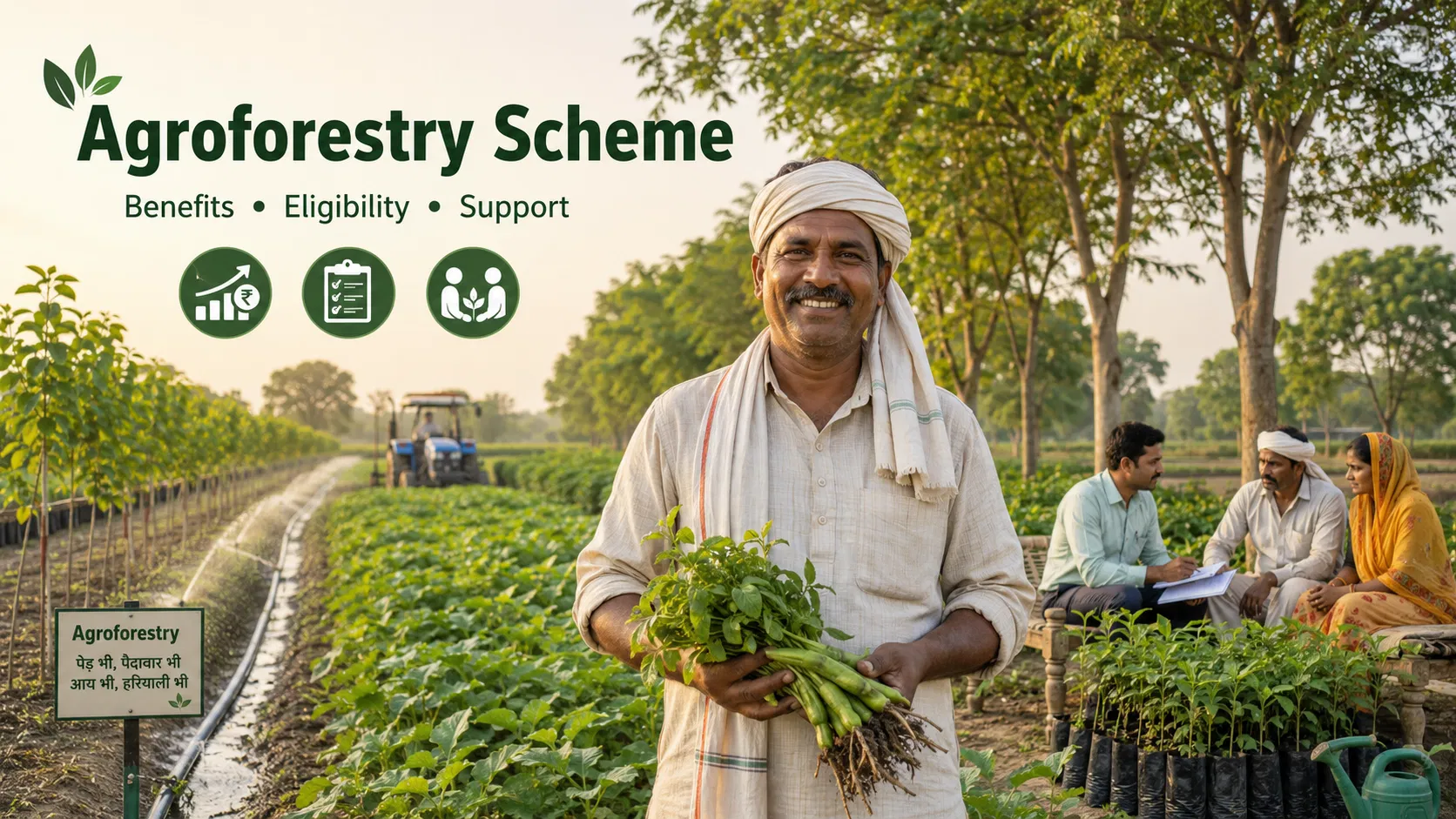
The Sub-Mission on Agroforestry (SMAF) has been implemented by the Department of Agriculture, Cooperation and Farmers Welfare since 2016-17, following the recommendations of India's National Agroforestry Policy 2014 — the first comprehensive policy of its kind in the world, launched at the World Agroforestry Congress held in Delhi in February 2014. The scheme was introduced because farmland across India was facing declining soil health, water scarcity, and stagnant incomes, while farmers had few structured incentives to plant trees alongside their regular crops. SMAF, a sub-mission under the National Mission for Sustainable Agriculture (NMSA), changes this by supporting farmers who integrate tree plantation with crops and livestock on the same land, giving them an additional, longer-term income source alongside their regular harvest.
Sub-Mission on Agroforestry (SMAF) Overview
- Scheme Name – Sub-Mission on Agroforestry (SMAF), under the National Mission for Sustainable Agriculture (NMSA)
- Scheme Modification Date – Implemented since 2016-17, following the National Agroforestry Policy 2014; MoU signed with the Central Silk Board for a sericulture-based agroforestry convergence model
- Scheme Fund Allocated – Funded on a Centrally Sponsored basis, mostly in a 60:40 (Centre:State) split for most states; exact yearly outlay is fixed through Annual Action Plans approved at the state level
- Type of Scheme – Central Government (Centrally Sponsored Scheme), implemented by State Agriculture Departments under the Ministry of Agriculture & Farmers Welfare
- Helpline No – Kisan Call Centre, 1800-180-1551; farmers can also contact their District Agriculture Office or State Forest/Agriculture Department
- States Covered – Currently implemented in 20 States and 2 Union Territories that have liberalised transit regulations for timber transport; it will extend to other states as and when they notify similar relaxations
Objectives of the Scheme
- Encourage and expand tree plantation in a complementary, integrated manner with crops and livestock
- Improve productivity, employment opportunities, income generation, and rural livelihoods, especially for small farmers
- Ensure the availability of quality planting material — seeds, seedlings, clones, hybrids, and improved varieties
- Popularise agroforestry practices and models suited to different agro-ecological regions and land-use conditions
- Build a database, knowledge, and extension support system for the agroforestry sector
Key Features of the Agroforestry Scheme
- Promotes multiple agroforestry systems, including Agrisilviculture, Silvipasture, Agrisilvopasture, Apiculture with Trees, and Aqua-forestry, tailored to different agro-ecological zones
- Prioritises endemic tree species and species with medicinal value; exotic species are not promoted under the scheme
- Implemented only in states with liberalised transit regulations, since farmers need to be able to harvest and transport their planted timber without excessive regulatory hurdles
- Financial support generally covers up to 50% of eligible expenses for planting trees and related activities, based on approved government cost norms
- Special funding provisions exist for small, marginal, and other priority categories of farmers, subject to state-specific guidelines
- Eligible applicants include individual farmers, Self-Help Groups (SHGs), Farmer Producer Organisations (FPOs), and rural entrepreneurs
- Includes a sericulture convergence model with the Central Silk Board, encouraging mulberry and other silk-yielding tree plantation as part of agroforestry, supporting India's silk production ecosystem
- Extension and capacity-building support is provided to help farmers adopt the right agroforestry model for their land and region
Benefits to Farmers
- Additional, longer-term income source from timber, fruit, medicinal, or fodder trees, alongside regular crop income
- Improved soil fertility and water conservation through mixed land use
- Greater climate resilience for the farm, since diversified tree-crop systems are less vulnerable to a single season's weather shocks
- Access to quality planting material and improved tree varieties suited to the local agro-ecological zone
- Enhanced feedstock supply for wood-based and herbal industries, opening market linkages for farmers
- Sericulture-linked agroforestry models offer a faster-return income stream for farmers who take up silk-based plantation
Limitations of the Scheme
- Available only in states that have liberalised timber transit regulations — farmers in states without such relaxations cannot currently access SMAF
- Exotic tree species are not supported; the scheme is restricted to endemic and medicinally valuable species
- Financial assistance is generally capped at around 50% of eligible costs, based on notified cost norms, so farmers must bear the remaining expense
- Benefit amounts and specific components can vary by state, since implementation is largely state-led within the central framework
- Trees take years to mature, so the additional income from agroforestry is a longer-term gain rather than an immediate one
Documents Required
- Aadhaar Card
- Land ownership or cultivation proof
- Bank account passbook
- Passport-size photograph
- Registration proof, if applying as an SHG, FPO, or rural enterprise
How to Apply for Agroforestry Scheme Support
- Check with your District Agriculture Office or State Agriculture Department whether SMAF is currently implemented in your state, since coverage depends on liberalised timber transit rules.
- Identify the agroforestry model best suited to your land — Agrisilviculture, Silvipasture, or another system — with guidance from local extension staff or a Krishi Vigyan Kendra (KVK).
- Submit the required documents, including Aadhaar, land records, and bank passbook, along with your application to the district or state implementing agency.
- Obtain quality planting material — seeds, seedlings, or clones — as recommended under the scheme's approved varieties list.
- Plant and maintain the trees as per the approved plan; financial assistance is typically released based on approved cost norms and verified progress.
- Stay in touch with the local agriculture department for extension support and updates on any additional sericulture or allied-sector convergence benefits available in your state.
Conclusion
The Sub-Mission on Agroforestry gives farmers a practical way to build long-term resilience into their land — combining the steady returns of traditional cropping with the added value of timber, fruit, medicinal, or silk-yielding trees. With support covering up to half of eligible planting costs and structured guidance on suitable species and systems, SMAF helps farmers diversify their income while improving soil health and climate resilience. As more states liberalise their timber transit rules, the scheme is expected to reach even more of India's farming communities in the years ahead.
Disclaimer: This article is for informational purposes only. Scheme details, interest rates, and subvention amounts are subject to periodic revision by the Government of India, RBI, and NABARD. Farmers are advised to verify the latest terms and eligibility criteria with their bank, NABARD, or official government sources before applying.