Sugarcane spends close to a year in the field, which gives insect pests plenty of time to establish themselves at every stage of the crop, from planting to the standing cane. Borers, soil grubs, and termites all attack the plant from different angles, and left unmanaged they can cut into germination, tonnage, and juice quality well before harvest.
This guide covers the four insect pests that most commonly affect sugarcane, how to identify each one in the field, and the insecticide solutions available to manage them.
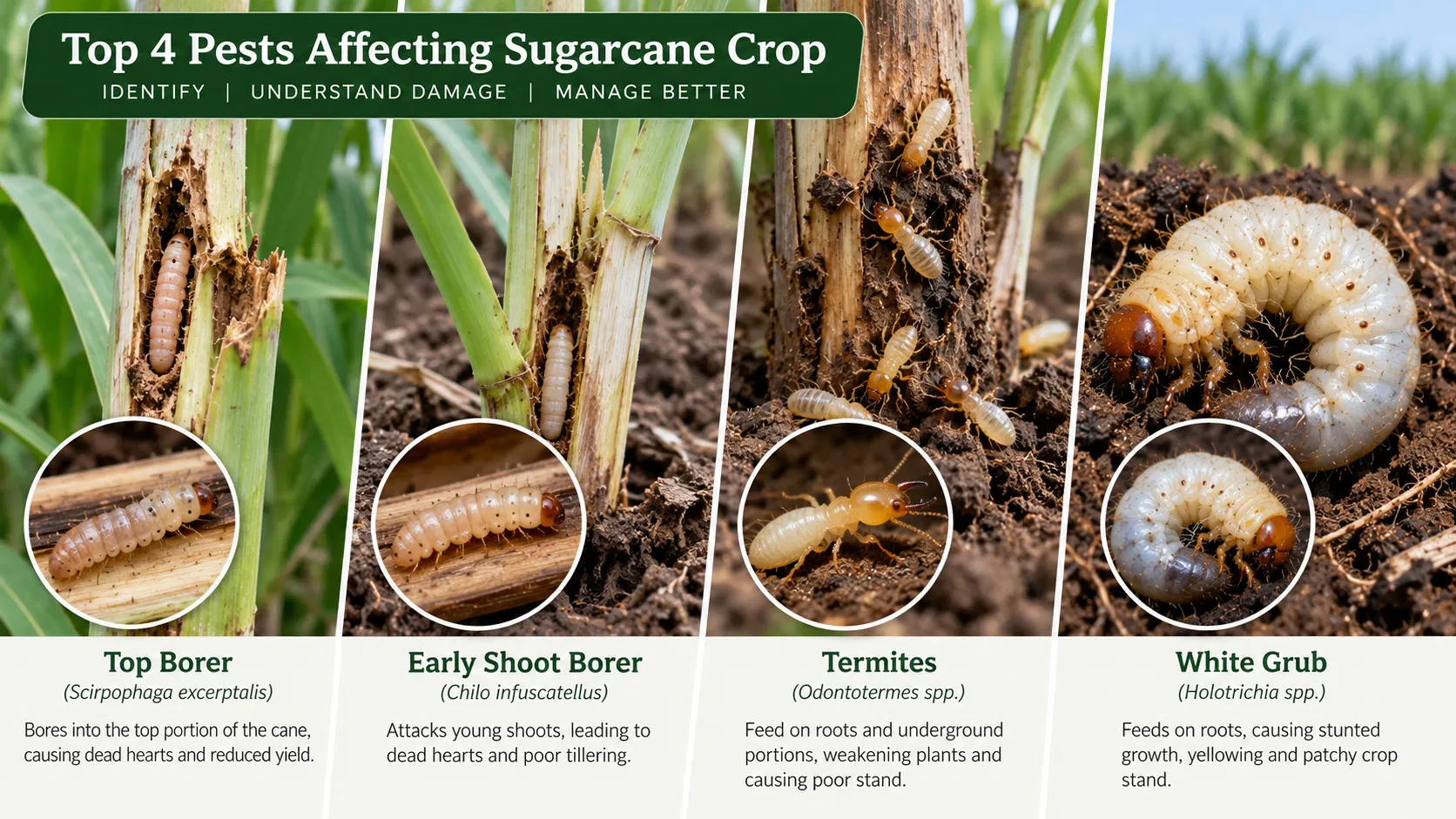
1. Top Borer (Scirpophaga excerptalis)
Top borer attacks grown canes by boring into the apical growing point, destroying the central shoot. This forces the plant to push out a cluster of side shoots instead of growing upward, giving infested clumps a distinctive bunchy, tufted appearance and reducing usable cane length.
How to Spot It
Look for parallel rows of small shot holes on the unfurling top leaves, and red, frass-lined tunnels running through the leaf midrib. As the growing point dies, the central spindle leaf dries and reddens, and the clump develops a bunchy top from side shoots replacing the destroyed main shoot.
Solutions to Manage/Control It
| Product | Active Ingredient |
|---|---|
| FMC Coragen Insecticide | Chlorantraniliprole 18.5% SC |
| FMC Ferterra Insecticide | Chlorantraniliprole 0.4% w/w GR |
| Crystal Furadan 3G Insecticide | Carbofuran 3% CG |
2. Early Shoot Borer (Chilo infuscatellus)
Early shoot borer targets young canes during germination and early tillering, boring into the central shoot and killing the growing point. This produces the classic ""dead heart"" symptom, and heavy attack can wipe out a large share of the tiller stand before the crop is even established.
How to Spot It
The central whorl leaf turns yellow, wilts, and dries out while the outer leaves stay green. The dead central shoot pulls out easily with a light tug and gives off a distinct foul smell, and small frass-marked holes are visible near the base of the affected shoot.
Solutions to Manage/Control It
| Product | Active Ingredient |
|---|---|
| FMC Coragen Insecticide | Chlorantraniliprole 18.5% SC |
| FMC Ferterra Insecticide | Chlorantraniliprole 0.4% w/w GR |
| Bayer Regent Ultra Insecticide | Fipronil 0.60% w/w GR |
3. White Grub (Holotrichia spp.)
White grubs live in the soil and feed on the root system of sugarcane, weakening or killing young canes from below ground. Damage typically shows up as scattered patches of stunted, yellowing, or wilting clumps rather than uniform crop stress across the field.
How to Spot It
Look for irregular patches of stunted, yellowing, or wilting cane clumps in an otherwise healthy field. Affected clumps can be uprooted with very little effort because the root system has been chewed away, and digging around the base often reveals white, C-shaped grubs in the soil.
Solutions to Manage/Control It
| Product | Active Ingredient |
|---|---|
| IFFCO Shirasagi Insecticide | Fipronil 40% + Imidacloprid 40% WG |
| UPL Lancer Gold Insecticide | Acephate 50% + Imidacloprid 1.8% SP |
4. Termites (Odontotermes obesus)
Termites hollow out planted setts before they can germinate and also bore into the base of standing canes, feeding on internal tissue and roots. This leads to poor germination in new plantings, dead hearts in young canes, and weakened, easily lodged stalks in a mature crop.
How to Spot It
Watch for poor or patchy germination after planting, and dead heart symptoms in young shoots, but check inside the hollowed stem for packed mud or soil, which distinguishes termite damage from shoot borer attack. In standing canes, look for hollowed internodes near the base, stalks that snap or lodge easily, and earthen mud tubes on the stalk or soil surface near affected clumps.
Solutions to Manage/Control It
| Product | Active Ingredient |
|---|---|
| Bayer Confidor Insecticide | Imidacloprid 17.8% SL |
| Bayer Regent Ultra Insecticide | Fipronil 0.60% w/w GR |
| FMC Talstar Insecticide | Bifenthrin 10% EC |
Frequently Asked Questions
How do I tell early shoot borer damage apart from termite damage in young sugarcane?
Both cause a dead heart in the central shoot, but termite-damaged shoots have mud or soil packed inside the hollowed stem, while shoot borer damage does not and instead shows small frass-marked exit holes.
What causes the ""bunchy top"" appearance in sugarcane?
A bunchy, tufted top is caused by top borer, which destroys the main growing point and forces the plant to push out a cluster of side shoots instead of growing upward normally.
Can white grub damage be spotted before the crop shows visible symptoms?
It's difficult, since the damage happens underground on the root system. Digging around the base of any patch showing early wilting or yellowing is the most reliable way to confirm white grub before it spreads further.
Can one insecticide control both early shoot borer and top borer?
Yes, certain broad-spectrum granular and systemic insecticides are registered for both early shoot borer and top borer on sugarcane, so one product and application schedule can cover both.
- Always confirm the current label registration, approved dosage, and pre-harvest interval (PHI) for your state before using any product, as labels are periodically revised by regulatory authorities.
- This is general advisory content. Please do your own research and verify with a local agronomist or dealer before making any purchase, spray, or crop-management decision.