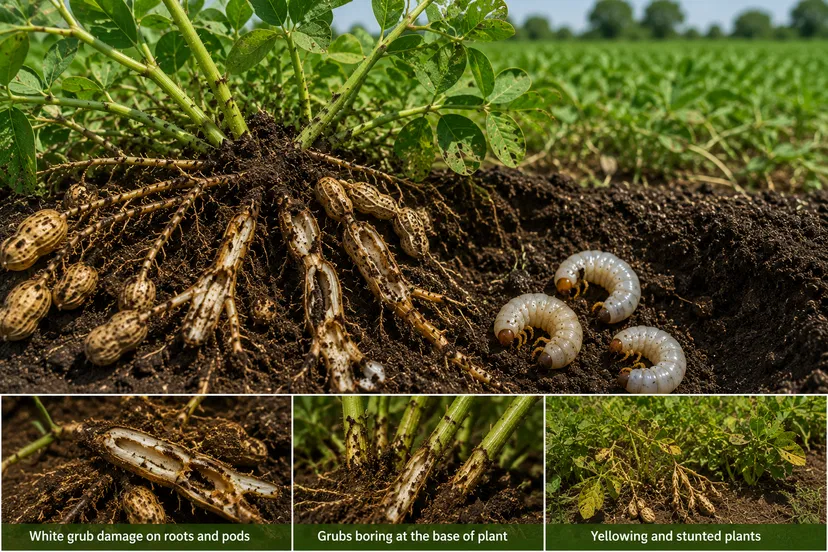
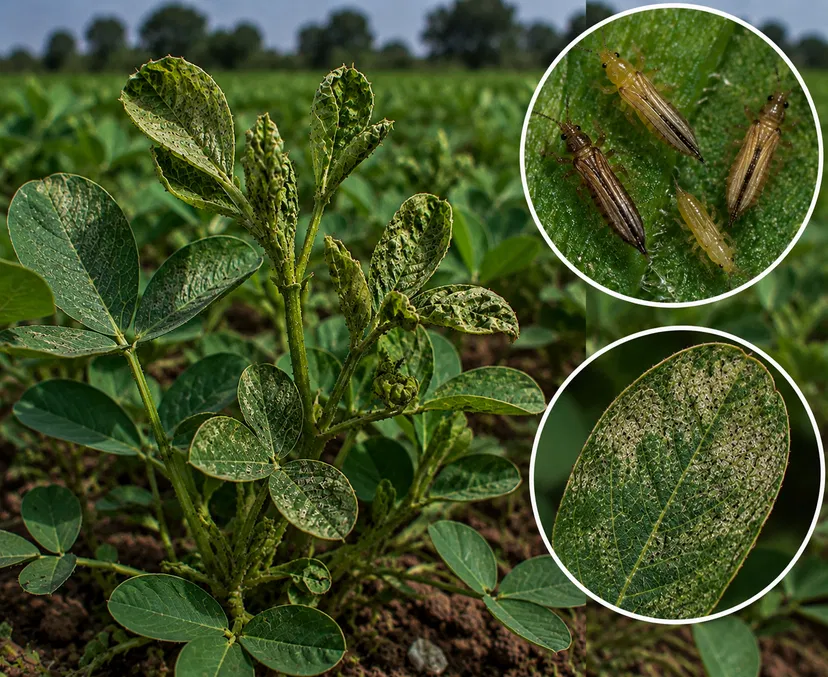
White grub is one of the few pests that attacks groundnut where you can't see it, feeding on roots and pods underground while the plant above ground quietly wilts and dies. Because the damage is hidden, many growers only notice it once patches of the field have already collapsed.
Signs of White Grub Damage in Groundnut
- Sudden wilting or yellowing of plants, often in patches across the field
- Plants that pull out of the soil easily, with roots and pods chewed or missing
- Curved, cream-coloured grubs with a brown head visible when you dig near affected plants
- Adult beetles active around dusk near trees or field edges before the season's attack
- Poor pod fill or missing pods at harvest in previously affected patches
Conditions That Favour White Grub Attack
- Light, sandy soils that grubs can move through easily
- Fields near trees where adult beetles feed and shelter during the day
- Continuous groundnut cultivation without rotation, letting the population build up year on year
- Well-timed rain after a dry spell, which triggers adult beetle emergence and egg-laying
- Undecomposed farmyard manure, which can attract egg-laying females
Field Practices to Reduce White Grub Risk
- Deep summer ploughing to expose grubs and pupae to birds and sunlight
- Use only well-decomposed farmyard manure, not fresh or partially rotted manure
- Collect and destroy adult beetles by shaking host trees at dusk during the emergence period
- Set up light traps to catch and monitor adult beetle activity
- Rotate groundnut with a non-host crop in fields with a history of heavy grub attack
Solutions for White Grub in Groundnut
1. Fipronil 40% + Imidacloprid 40% WG
This combination pairs two systemic and contact insecticides, giving groundnut strong, long-lasting protection against white grub in the soil. Because it binds well to soil particles, it stays active around the root zone for weeks after application.
2. Carbofuran 3% CG
Carbofuran is an older, well-established granular insecticide that is broadcast into the soil, where it is taken up by the roots and also acts directly on grubs feeding nearby. It remains a reliable, affordable option against white grub in groundnut.
3. Pyraclostrobin 3.5% + Thiram 15% + Clothianidin 22.5% FS
This seed treatment combines two fungicides with an insecticide, protecting the germinating seed from soil-borne disease while clothianidin gives systemic protection against white grub and termites right from sowing.
4. Bifenthrin 8% + Clothianidin 10% SC
This combination pairs a contact pyrethroid with a systemic neonicotinoid, applied as a soil drench to form a long-lasting barrier against white grub and termites around the root zone.
5. White Grub Pheromone Lure
Pheromone lures attract adult white grub beetles before they mate and lay eggs in the soil, helping bring down next season's grub population without any chemical spray.
6. Light Trap
Adult white grub beetles fly out and become active at dusk, and a light trap set up during this period can catch large numbers of them before they mate and lay eggs, cutting down next season's grub load in the field.
Note: Soil insecticides work best when applied at or just after sowing, before grub numbers build up, rather than after wilting is already visible. Combining a chemical soil treatment with summer ploughing and manure management gives more reliable control than spraying alone.
Disclaimer: Always confirm current label registration, approved dosage, water volume, and pre-harvest interval (PHI) for your state before using any product, since labels are periodically revised by regulatory authorities.
This guide is a general advisory. Do your own research and verification before using any product. Always confirm suitability for your crop stage, region, and field conditions before making any purchase, spray, or crop-management decision.