Cauliflower Cultivation: Planting and Package of Practices
Cauliflower pays well when the right variety is sown in the right month and the seedlings are moved to the field at the right age. A wrong sowing window, old seedlings or uneven moisture can lead to buttons, loose curds or yellow heads that fetch a low price. This guide brings together recommendations on sowing time, varieties, seed rate, spacing, fertilizer dose per acre, irrigation, pest, disease and disorder care and harvest, so farmers can plan the crop from nursery to market. Recommendations differ between regions, so ranges are shown where they do.
Climate and Soil for Cauliflower
Cauliflower is a cool season crop that likes moist, mild weather, and curds form best when temperatures suit the variety. Early types tolerate warmer weather and longer days, while late types need cold weather to form good curds.
Deep loamy soil rich in organic matter and with good drainage suits the crop, with a pH of about 5.5 to 7.0. Early crops do well on sandy loam, and mid and late crops on loam to clay loam. In acidic soils, lime may be applied based on a soil test, at least 30 days before planting. Fields with a club root history are best avoided.
Cauliflower Sowing Time in India
Sowing time is decided by the maturity group, because each group needs a different temperature to form curds. Pick the group first and then match it to your region.
RegionTypeNursery SowingTransplanting or Maturity
North Indian plainsExtra earlyEnd of FebruaryMarch
North Indian plainsEarlyMid May to end of JuneEarly to mid July
North Indian plainsMid earlyEnd of JulyEarly September
North Indian plainsMid lateEnd of AugustEnd of September
North Indian plainsLateEnd of September to mid OctoberEnd of October to mid November
South Indian plainsAll typesSeptember to FebruaryAs per seedling age
Eastern IndiaEarlyMid July to first week of AugustMatures by October
Eastern IndiaMidFirst week of September to last week of OctoberMatures December to January
Eastern IndiaLateUp to first week of NovemberMatures February to March
Low hillsEarly / Mid / LateJune to July / August to September / October to NovemberSeedlings of 4 to 5 weeks
Mid hillsEarly / Mid / LateApril to May / July to August / SeptemberSeedlings of 4 to 5 weeks
High hillsLateApril to MaySeedlings of 4 to 5 weeks
Cauliflower Varieties and Hybrids
Choose a variety that matches your sowing month, since an early variety sown late or a late variety sown early may fail to form good curds. You can compare the available cauliflower seeds and their listed traits before you buy.
Maturity GroupVarieties and HybridsPoints to Note
EarlyEarly Kunwari, Pusa Early Synthetic, Pant Gobhi 3, Pusa Deepali, Kashi KunwariEarly types tolerate warmer weather and longer days. Kashi Kunwari gives compact white curds of about 300 to 450 g
Mid earlyImproved Japanese, Pusa Hybrid 2, Pusa Sharad, Pant Gobhi 4Suit the early winter crop
Mid latePusa Synthetic, Pant Shubhra, Pusa Shubhra, Pusa Himjyoti, Punjab Giant 35, Kashi AgahaniMain season crop for the cool months
LatePusa Snowball 1, Pusa Snowball K 1, Ooty 1Need cold weather for good curd formation
Katki (November maturity)Kashi Gobhi 25Marketable curds of about 450 to 650 g, ready about 60 to 70 days after transplanting
Seed Rate and Seed Treatment
Seed rate depends on the maturity group, and hybrids may need less seed than open pollinated types. Please use the rate printed on the seed packet or advised by your local horticulture office.
Maturity GroupSeed Rate (per hectare)Per Acre
Early600 to 750 g250 to 300 g
Mid early500 g200 g
Mid late400 g160 g
Late300 g120 g
Seed treatment with Pseudomonas fluorescens at 10 g per kg of seed may help protect seedlings from club root.
Nursery and Transplanting
Raise seedlings on well drained raised beds mixed with farmyard manure, and sow in rows about 10 cm apart
Protect beds from heavy rain in July and August, since too much water can harm young seedlings
Protrays filled with cocopeat can give uniform seedlings in about 25 days
Transplant seedlings of 4 to 5 weeks that are 10 to 12 cm tall, because seedlings older than 6 weeks may form buttons
Dip the roots in a Pseudomonas fluorescens solution before planting if club root is a concern
Transplant in the evening and irrigate immediately
Maturity GroupSpacing (row × plant)Plants per Acre (about)
Early45 × 30 cm30,000
Mid and late60 × 45 cm15,000
Land Preparation
Plough the field to a fine tilth and form ridges and furrows about 60 cm apart. In the rainy season, plant on ridges with good drainage so that water does not stand around the roots. Mix farmyard manure into the soil before planting.
Cauliflower Fertilizer Dose Per Acre
Per acre values are rounded, so please use them as a guide, and a soil test gives a more accurate dose.
NutrientDose (per hectare)About (per acre)When to Apply
Farmyard manure15 tonnes6 tonnesBasal, during land preparation
Nitrogen (N)50 kg20 kgBasal
Phosphorus (P2O5)100 kg40 kgBasal
Potassium (K2O)50 kg20 kgBasal
Nitrogen (N)50 kg20 kgTop dressing at 45 days after transplanting
Hybrids grown under drip fertigation are given about 200:125:125 kg of N, P2O5 and K2O per hectare (about 80:50:50 kg per acre) in small doses every three days over about 70 days. Your local horticulture office can give the exact schedule. For more on feeding and curd size, you can also read the cauliflower yield guide.
Irrigation
Irrigate immediately after transplanting
Water about once every 7 to 10 days, adjusting for weather, soil type and variety
Keep moisture even during growth and curd development, since moisture stress can cause buttoning
Early and mid season crops need fewer irrigations because of rain
In rainy areas, use furrow irrigation on ridges and keep drainage open
Weeding, Earthing Up and Blanching
Fill gaps about 20 days after planting
Weed and hoe at about 30 and 45 days after planting
Keep hoeing shallow, because cauliflower roots are close to the surface
Earth up the plants and top dress nitrogen at the same time
Blanch white varieties by tying the outer leaves loosely over the curd, or place a leaf over it 4 to 5 days before harvest. Using a different coloured string each day helps you track which curds to cut first
Pests in Cauliflower
PestManagementDose
Diamondback mothGrow mustard as a trap crop (1 row of mustard for 20 rows of cauliflower), put up pheromone traps, and spray when about 2 larvae per plant are seenPheromone traps 12 per hectare (about 5 per acre). Bacillus thuringiensis 1 g per litre or neem seed kernel extract 5%
AphidsUse yellow sticky traps to monitor winged aphids and spray neem oil earlyYellow sticky traps 12 per hectare (about 5 per acre). Neem oil 3% (30 ml per litre) with 0.5 ml teepol per litre
For more on identifying and managing this pest, see the diamondback moth guide, which also covers cauliflower.
Diseases in Cauliflower
DiseaseManagementDoseRecommended Product
Club rootAvoid fields with a club root history, rotate away from cabbage family crops for 3 years, and treat seed and seedlingsSeed treatment Pseudomonas fluorescens 10 g per kg, seedling dip 5 g per litre. For soil application, mix 10 kg of powder with 100 kg of well decomposed manureKatyayani Pseudomonas Fluorescens Bio Fungicide Powder
Leaf spot and downy mildewGive proper spacing, avoid water standing on leaves, and spray at the first spots1200 ml per acre. Waiting period 3 daysKatyayani Azochlo Star
Black rotUse clean seed and soil drench after transplantingStreptomycin 0.1 to 0.2 g per litre as soil drenchConfirm with your local agriculture office
Physiological Disorders in Cauliflower
Some curd problems are not caused by pests or diseases but by weather, seedling age or nutrient gaps, so identifying them early can save the crop.
DisorderHow It LooksCause and Management
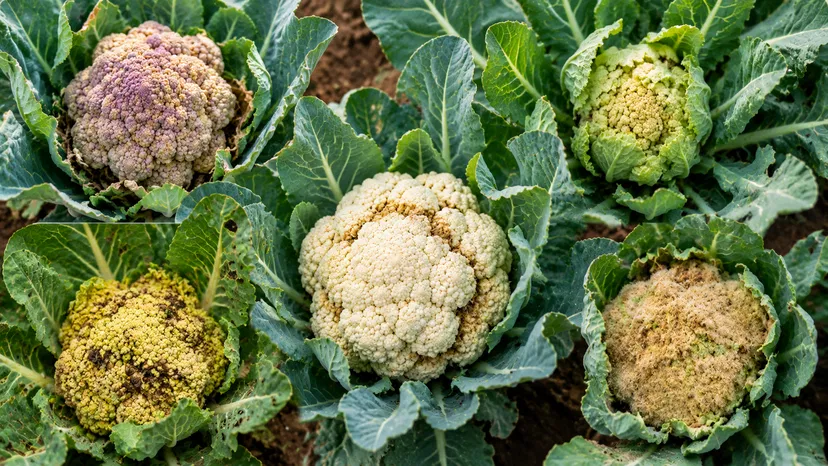
ButtoningSmall curds with too few leavesCaused by seedlings older than 6 weeks, a variety that does not suit the season, hot dry weather, moisture stress or low nitrogen. Use healthy seedlings, the right variety and steady moisture
RiceynessGranular, loose curdsCaused by early flower bud formation. Use pure seed and a variety suited to the season
FuzzinessVelvety curds with long stalksSow good quality seed in the right season
LeafinessSmall thin leaves inside the curdIncreases with high temperature during curd formation. Choose varieties adapted to your area
BlindnessNo central growing point, with large thick dark green leavesCaused by cold in young plants or damage to the growing tip by handling or pests. Handle seedlings gently
Browning (brown or red rot)Water soaked patches turning rusty brown on curdsCaused by boron deficiency. Spray borax 1 kg in 500 litres of water per hectare (about 400 g in 200 litres per acre) at 30 days after planting
WhiptailLeaf blades do not develop and only the midrib formsCaused by molybdenum deficiency, mostly in acidic soil. Spray sodium molybdate 100 g in 500 litres of water per hectare (about 40 g in 200 litres per acre) at 30 days after planting
For boron deficiency, Solubor Micronutrient Fertilizer lists cauliflower among its crops and is used at 1 g per litre of water.
Harvest, Yield and Storage
Harvest when the curds are compact, white and full size. A delayed harvest can make the curds loose, leafy, ricey or fuzzy. Cut the stalk below the curd with a sharp knife or sickle and trim the outer leaves and stem.
Crop TypeYield (per hectare)Per Acre
Early maturing8 to 12 tonnes3 to 5 tonnes
Main season15 to 20 tonnes6 to 8 tonnes
Snowball and other late types25 to 30 tonnes10 to 12 tonnes
Curds can be kept for 2 to 4 weeks at 0°C and 90 to 95% humidity, so for local markets it is best to cut and send them quickly.
Crop Calendar at a Glance
StageWhat to Do
Before sowingChoose the variety for your season, treat the seed and prepare the nursery bed
Nursery (4 to 5 weeks)Keep beds drained and protected from heavy rain, and avoid seedlings older than 6 weeks
Before transplantingForm ridges and furrows, apply manure and basal fertilizer
TransplantingPlant in the evening and irrigate at once
20 daysFill gaps and take up the first shallow weeding
30 daysWeeding and earthing up. Spray borax and sodium molybdate
45 daysTop dress nitrogen and watch for curd initiation
4 to 5 days before harvestBlanch curds in white varieties
HarvestCut when curds are compact, white and full size
Frequently Asked Questions
Which month is best to sow cauliflower?
It depends on the maturity group and your region. In the north Indian plains, early types are sown from mid May to June and late types from late September to mid October.
How much cauliflower seed is needed per acre?
Roughly 120 to 300 g per acre, with early types needing more seed than late types.
What spacing is used for cauliflower?
Early types are planted at 45 × 30 cm, and mid and late types at 60 × 45 cm.
How much fertilizer does cauliflower need per acre?
A common plan is about 6 tonnes of farmyard manure, 40 kg nitrogen, 40 kg phosphorus and 20 kg potash per acre, with the nitrogen split in two. A soil test can give a more exact dose.
Why do cauliflower plants give small curds or buttons?
Old seedlings, a wrong variety for the season, hot dry weather, low nitrogen or moisture stress are the usual reasons.
How do I keep cauliflower curds white?
Tie the outer leaves loosely over the curd, or place a leaf over it, 4 to 5 days before harvest. Self blanching varieties do not need this.
Also Read
15 Steps to Boost Cauliflower Production
Tiny Terror: Diamondback Moth Threat to Cabbage Fields
Disclaimer: Sowing time, seed rate, spacing and fertilizer doses vary with region, variety, soil, season and irrigation method, so please confirm them with your local horticulture or agriculture office before applying.
This article is for general guidance. Do your own research and verification before any farming decision.