Watermelon Cultivation: Planting and Package of Practices
Watermelon pays well when the crop is sown at the right time, spaced properly and watered evenly. Small slips such as a wrong sowing month, crowded vines or uneven irrigation can lead to cracked, small or poorly sweet fruits. This guide brings together state and national recommendations on sowing time, seed rate, spacing, fertilizer dose per acre, irrigation, pest and disease care and harvest, so farmers can plan the crop from field to market. Recommendations differ between regions, so ranges are shown where they do.
Climate and Soil for Watermelon
Watermelon is a warm season crop that likes dry weather and plenty of sunshine. Vines generally grow well at about 24 to 35°C, seeds germinate best above 20°C, and warm days with cool nights help sugar build up in the fruit. High humidity during vine growth can raise the risk of fungal diseases.
Sandy loam or other light, well-drained soil rich in organic matter suits the crop, with a pH of about 6.0 to 7.5. Waterlogged and heavy clay fields are best avoided.
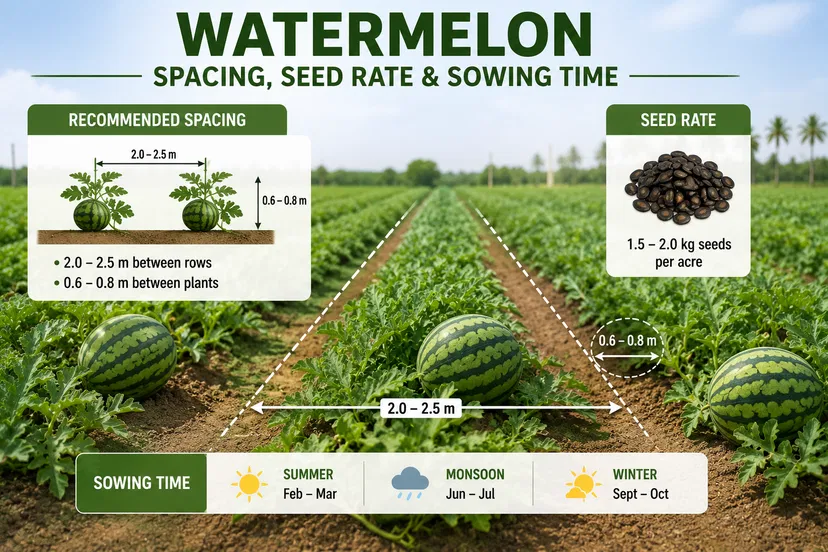
Watermelon Sowing Time in India
RegionSowing Time
North Indian plainsFebruary to March
North eastern and western IndiaNovember to January
South and Central IndiaNearly through the year, since winter is mild and short
Tamil NaduNovember to December; January to February sowing gives summer harvests that often fetch higher prices
KeralaDecember to April
Fruit fly numbers peak in the rainy season, so sowing time can be adjusted to avoid that period.
Watermelon Varieties and Hybrids
Pick a variety for your market first. Large fruits suit wholesale markets, small round fruits suit local and retail sales, and seedless or yellow types fetch a premium in some areas. You can see the available watermelon seeds and compare their listed traits.
Variety or HybridTypeFruit WeightDurationPoints to Note
Arka ManikVarietyAbout 6 kgNot statedDeep crimson flesh, TSS about 12 to 15%, stores and transports well, resistant to powdery mildew, downy mildew and anthracnose
Arka MuthuVariety2.5 to 3 kg75 to 80 daysDwarf vine of about 1.2 m, early maturing, round to oval fruit with deep red flesh
Arka JyotiF1 hybrid6 to 8 kgMid seasonCrimson flesh, TSS about 11 to 13%
Sugar BabyVariety3 to 5 kgAbout 85 daysSmall round fruit, bluish black rind, deep pink flesh
Asahi YamatoVariety6 to 8 kgAbout 95 daysLight green rind, deep pink flesh
Durgapura MeethaVariety6 to 8 kgAbout 125 daysLate maturing, thick light green rind, dark red flesh, good keeping quality
Durgapura KesarVariety4 to 5 kgLateYellow flesh
Pusa BedanaSeedless hybridNot statedNot statedSeedless type
PKM 1VarietyLarge fruit122 to 135 daysDark green skin, red flesh
Land Preparation
Plough the field twice, crosswise, to a fine tilth. Mix farmyard manure and form furrows, pits or raised beds according to the planting method you choose. The watermelon field preparation guide covers this step in more detail.
Seed Rate, Seed Treatment and Spacing
Seed rate differs because hybrids, varieties and planting methods differ. Please use the rate printed on the seed packet or advised by your local horticulture office.
Crop TypeSeed Rate (kg per hectare)About (kg per acre)
Watermelon, commonly recommended range1.0 to 3.50.4 to 1.4
To improve germination, soak seeds in lukewarm water for 12 hours, drain them and keep them overnight in a wet gunny bag. Seed treatment with Trichoderma viride at 4 g per kg or Pseudomonas fluorescens at 10 g per kg of seed may also help.
Planting MethodSpacing and Pit SizeSeeds
Furrow methodFurrows 2 to 3 m apart, spots 60 to 90 cm apart along the furrow3 to 4 seeds per spot, then keep 2 to 3 plants
Pit methodPits about 60 cm wide and 30 to 60 cm deep, at 2 to 3.5 m × 0.6 to 1.2 m (3.0 × 2.0 m is also used). Fill with equal parts farmyard manure and soil4 to 5 seeds per pit, then keep 2 to 3 plants
Hill method (river beds)Pits 30 × 30 × 30 cm at 1 to 1.5 m apart, filled with equal parts soil and farmyard manure2 seeds per hill
Raised bedsChannels 2.5 m apart, beds 1.2 m wide and 30 cm high, hills 0.9 m apart on one side of the channelThin to 2 seedlings per hill at 15 days
At 2.5 m × 0.9 m, the raised bed layout works out to roughly 1,800 hills per acre. Seeds germinate in 8 to 10 days, and the weak seedlings are thinned out so that only 2 to 3 stay in a pit, or 2 in a hill.
Watermelon Fertilizer Dose Per Acre
Per acre values are rounded, so please use them as a guide, and a soil test gives a more accurate dose.
NutrientDose (per hectare)About (per acre)When to Apply
Farmyard manure20 tonnes8 tonnesBasal, during land preparation
Nitrogen (N)55 kg22 kg30 days after sowing
Phosphorus (P2O5)55 kg22 kgBasal
Potassium (K2O)55 kg22 kgBasal
Under drip fertigation, nitrogen is split across crop stages, with about 10% in the first 10 days, then about 30% each over the next two 30 day stages and about 30% over the final 45 day harvesting stage. Biofertilizers such as Azospirillum and phosphobacteria are also advised with farmyard manure and neem cake before the last ploughing. Your local horticulture office can give the exact fertigation schedule. For general feeding advice, you can also read the watermelon cultivation guide.
Irrigation
Irrigate before sowing or dibbling, then at regular intervals
Water every 3 to 4 days in early growth, on alternate days during flowering and fruiting, and less often as fruits mature
Water at the root zone and avoid wetting vines and leaves
Keep the water supply even, since long dry spells followed by heavy irrigation can crack fruits
Reduce or stop irrigation when fruits begin to ripen
Drip irrigation suits watermelon well, because water goes straight to the roots and can be combined with fertigation. The drip system is generally run for 8 to 12 hours before planting to wet the bed.
Mulching
Plastic mulch of about 30 micron, black or silver on black, may help save soil moisture and suppress weeds
Black mulch also warms the soil, which can support earlier and better yields
Mulching in general reduces moisture loss from the soil
Weeding, Vine Care and Pollination
Weed 2 to 3 times, with the first weeding at 20 to 25 days after sowing and the next about a month later
Pendimethalin at 1 kg a.i. per hectare is recommended as a pre-emergence herbicide just before planting
Pinching the tips of vines at about 1 m may encourage side shoots
Keep 2 to 3 fruits per vine at fruit set for better size
NAA at 100 ppm at the two-leaf stage and ethrel at 250 ppm are used in some places to increase female flowers, and should be used only as locally advised
Bees do the pollination, so avoid spraying at peak flowering and keep bee boxes near the field if possible
Pests in Watermelon
PestManagementDoseRecommended Product
Aphids, thrips, whitefly, leaf minerCheck leaf undersides and young growth often, and act early1.8 ml per litre (360 ml per acre in 200 litres). Waiting period 5 daysBenevia Insecticide
Red pumpkin beetleCheck seedlings early, since they are the most exposed--
Fruit flyDestroy and bury affected fruits, plough to expose pupae, adjust sowing time, use neem oil 3% if neededTraps from flowering: 10 to 15 per acre to monitor, 20 to 25 for mass trapping, lure changed every 60 days. Neem oil 3% is 30 ml per litreTapas Fruit Fly Trap and Lure IPM Combo
Diseases in Watermelon
DiseaseManagementDoseRecommended Product
Powdery mildewResistant varieties like Arka Manik, proper spacing, early spray1200 ml per acre. Waiting period 5 daysKatyayani Azochlo Star
Downy mildewResistant varieties, dry foliage, early spray in humid weather1200 ml per acre. Waiting period 5 daysKatyayani Azochlo Star
Fusarium wiltRotation, healthy seedlings, good drainage, seed treatment with Trichoderma viride or Pseudomonas fluorescens4 g or 10 g per kg of seed-
For symptoms and control steps, see the common watermelon diseases guide.
Harvest, Yield and Storage
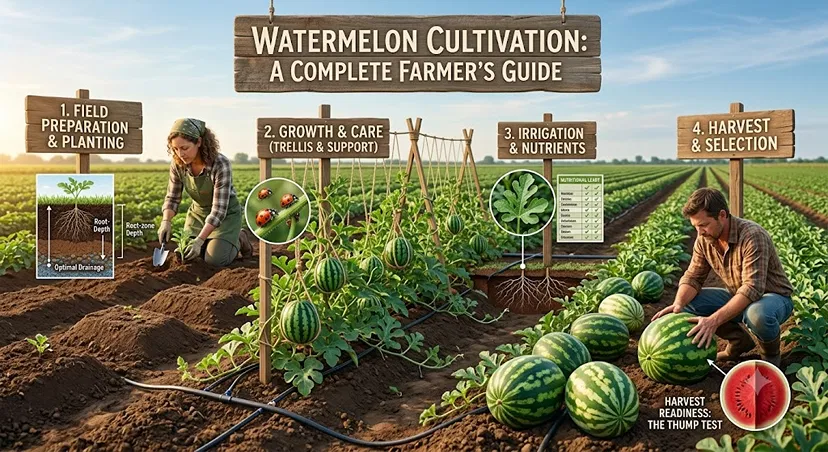
Most watermelons are ready about 75 to 100 days after sowing. A fruit is generally ripe when:
The tendril near the fruit stalk dries up
The spot touching the ground turns from white to light yellow
The fruit gives a dull sound when tapped
Cut the fruit with a knife and avoid pulling it off the vine. Yield figures range from about 20 to 30 tonnes per hectare (about 8 to 12 tonnes per acre), and the fruit can keep for around 14 days at 15°C. Keep it away from apples and bananas, since the ethylene they give off can soften the fruit. If you are comparing crops, the watermelon and muskmelon guide is also useful.
Crop Calendar at a Glance
Days After SowingWhat to Do
Before sowingPrepare beds or pits, mix farmyard manure, apply basal phosphorus and potassium, treat seed
8 to 10Seeds germinate, so check for gaps and beetle damage
15Thin to the plants you want to keep
20 to 25First weeding
30Nitrogen dose
Flowering and fruit setBee activity, keep 2 to 3 fruits per vine, avoid spraying at peak flowering
75 to 100 (variety dependent)Harvest when the signs below appear
Frequently Asked Questions
Which month is best to sow watermelon?
It depends on your region: February to March in the north Indian plains, and November to January in many other parts. South India can sow nearly through the year.
How much watermelon seed is needed per acre?
Recommendations range from about 0.4 to 2 kg per acre depending on the state and whether you grow a variety or a hybrid.
What spacing is used for watermelon?
Furrows 2 to 3 m apart with plants 60 to 90 cm apart is common. Pits are also used at 2 to 3.5 m × 0.6 to 1.2 m.
How many days does watermelon take to harvest?
Most varieties are ready in about 75 to 100 days after sowing. Early types like Arka Muthu can be ready in 75 to 80 days.
How do I know a watermelon is ripe?
The tendril near the fruit stalk dries, the ground spot turns from white to light yellow, and a tap gives a dull sound.
Why do watermelons crack?
Long dry spells followed by heavy irrigation can crack the fruit, so keep watering even.
Also Read
Watermelon Cultivation Guide: Grow Sweet, High-Yield Crops
How to Prepare Field for Watermelon Farming Right?
Common Watermelon Diseases and How to Control Them: A Complete Grower's Guide
Disclaimer: Sowing time, seed rate, spacing and fertilizer doses vary with state, variety, soil, season and irrigation method, so please confirm them with your local horticulture or agriculture office before applying.
This article is for general guidance. Do your own research and verification before any farming decision.