Tomato (Solanum lycopersicum) carries one of the heaviest insect pest loads of any vegetable grown in India. The crop stands in the field for months, is picked repeatedly over a long harvest window, and is grown somewhere in the country in every season, which means pest populations never get a break and simply move from one planting to the next.
Tomato pests are expensive in a way that is specific to this crop: the fruit is the product, and it is sold on appearance. A single borer hole or a cluster of thrips scars turns a fruit from first grade to waste, however healthy the plant behind it. The sucking pests add a second layer of cost, because whitefly transmits leaf curl virus and thrips carries bud necrosis, and no spray can cure a plant once it is infected.
Scouting matters more here than in almost any other crop. Most of these pests are controllable when caught early and nearly impossible once they are inside the fruit or once a virus is moving through the field. This guide covers the 9 pests that cost Indian tomato growers the most, the damage signs that identify each one, and the solutions registered against it.
1. Fruit Borer (Helicoverpa armigera)
The fruit borer is the single most damaging pest of tomato in India and the reason most growers spray at all. A caterpillar bores into a fruit, feeds inside for a few days, then abandons it and moves to the next, so one larva can destroy several fruits in its lifetime. Once it is inside, no spray will reach it, which makes timing the whole game.
How to Spot It
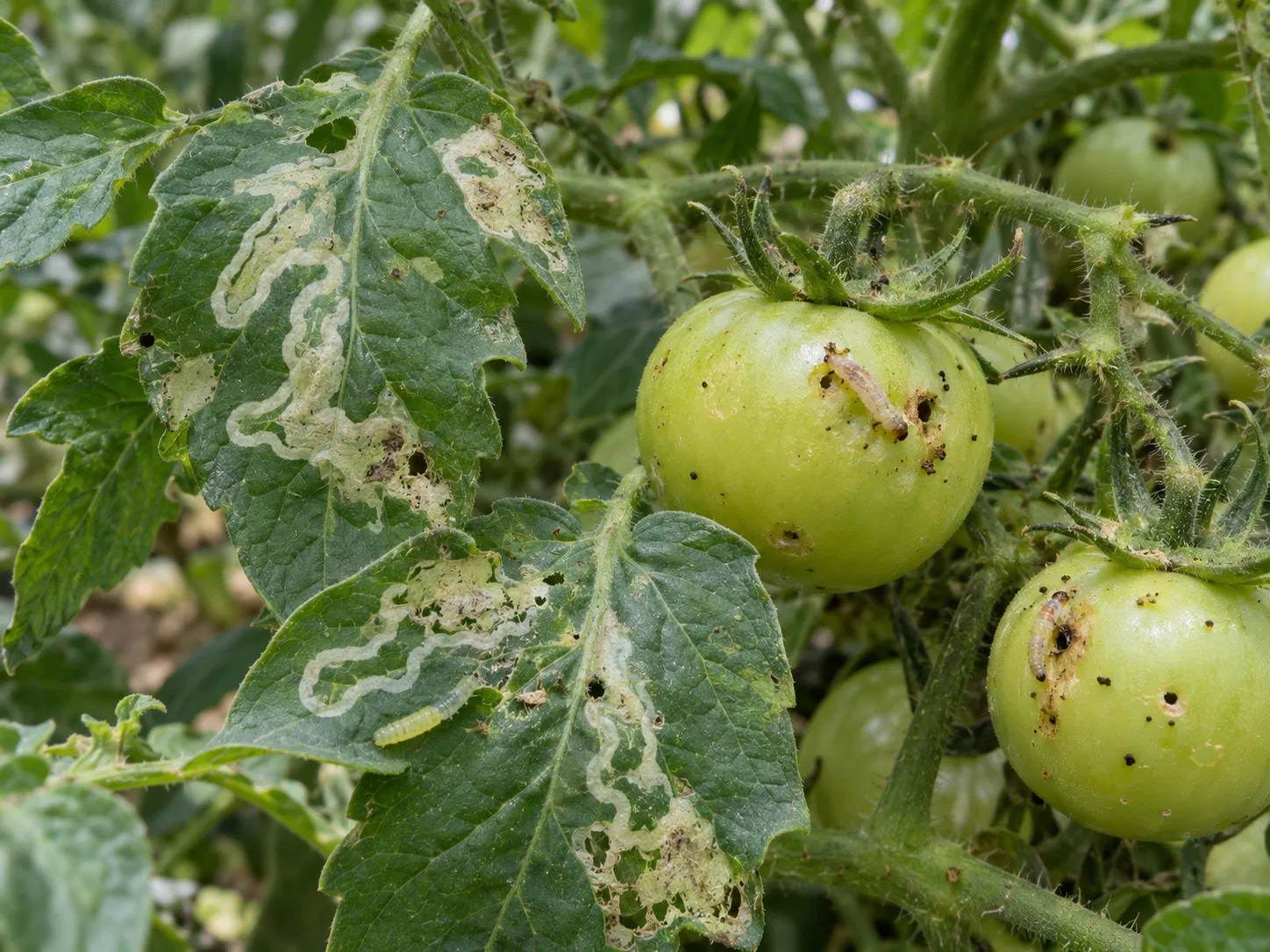
Round bore holes in green and ripening fruit, usually near the stem end, often with dark moist excreta packed around the opening; fruit that looks sound outside but is hollowed and rotting within when cut open; stout caterpillars, green to brown with pale lengthwise stripes, with the head and front of the body pushed inside a fruit; damaged fruit dropping early.
Solutions to Control It
| Product | Active Ingredient |
|---|---|
| FMC Coragen Insecticide | Chlorantraniliprole 18.5% SC |
| FMC Benevia Insecticide | Cyantraniliprole 10.26% OD |
| BASF Exponus Insecticide | Broflanilide 300 g/l SC |
| Syngenta Alika Insecticide | Thiamethoxam 12.6% + Lambda-cyhalothrin 9.5% ZC |
| Corteva Delegate Insecticide | Spinetoram 11.70% SC |
| Bayer Vayego Insecticide | Tetraniliprole 18.18% SC |
2. Whitefly (Bemisia tabaci)
Whitefly does only modest damage by feeding, but it matters out of all proportion because it transmits tomato leaf curl virus. An infected plant cannot be cured, stays permanently stunted and yields almost nothing, so the whole defence rests on keeping whitefly numbers down before the virus moves through the field. Populations build fastest in warm, dry weather.
How to Spot It
Clouds of tiny white winged insects lifting off when the canopy is disturbed, then settling back on leaf undersides; flat oval pale scale-like nymphs fixed under the leaves; sticky honeydew on lower foliage, often blackened by sooty mould. The warning sign that matters most is virus: upward curling and cupping of young leaves, thickened leathery leaflets, severe stunting and a bushy appearance.
Solutions to Control It
| Product | Active Ingredient |
|---|---|
| FMC Benevia Insecticide | Cyantraniliprole 10.26% OD |
| Bayer Oberon Insecticide | Spiromesifen 22.90% SC |
| Syngenta Pegasus Insecticide | Diafenthiuron 50% WP |
| Syngenta Actara Insecticide | Thiamethoxam 25% WG |
| Syngenta Alika Insecticide | Thiamethoxam 12.6% + Lambda-cyhalothrin 9.5% ZC |
| Syngenta Voliam Flexi Insecticide | Chlorantraniliprole 8.8% + Thiamethoxam 17.5% w/w SC |
3. Leaf Miner (Liriomyza trifolii)
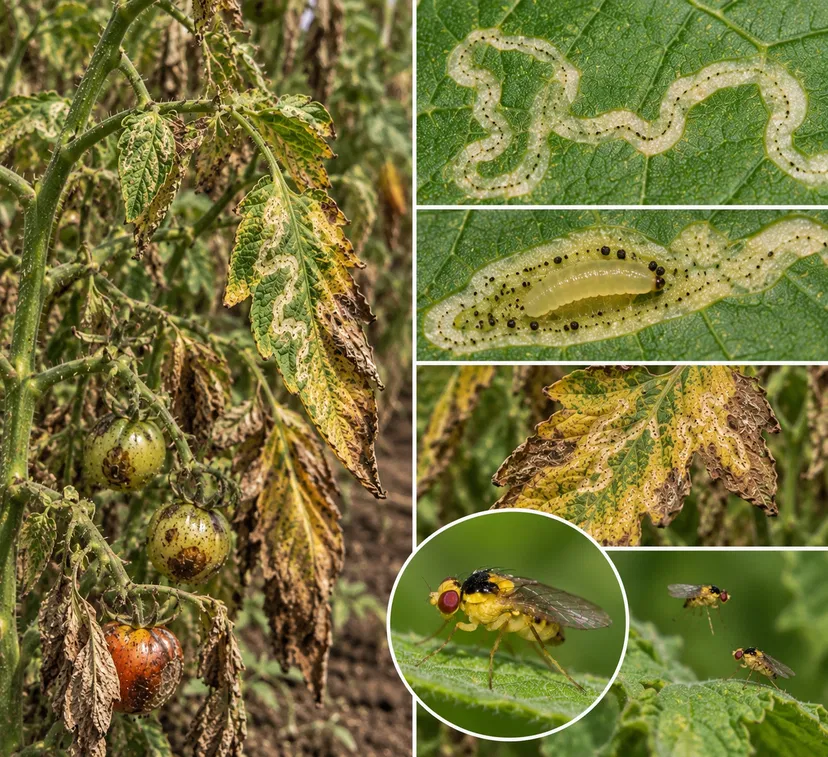
Leaf miner maggots feed between the upper and lower skin of the leaf, carving tunnels that destroy working leaf tissue without ever exposing the insect to a contact spray. A heavy infestation can leave the canopy so riddled that the plant cannot support its fruit load, and young plants attacked soon after transplanting are set back badly.
How to Spot It
Pale winding serpentine trails on the leaf surface that widen as they go, the unmistakable signature of this pest; a tiny maggot visible at the wide end of a fresh mine when the leaf is held against the light; leaves heavily mined until they dry, brown off and drop; small pale puncture marks on the leaf where adult flies have fed and laid eggs.
Solutions to Control It
| Product | Active Ingredient |
|---|---|
| FMC Benevia Insecticide | Cyantraniliprole 10.26% OD |
| Corteva Delegate Insecticide | Spinetoram 11.70% SC |
| BASF Exponus Insecticide | Broflanilide 300 g/l SC |
| Bayer Vayego Insecticide | Tetraniliprole 18.18% SC |
| Syngenta Voliam Flexi Insecticide | Chlorantraniliprole 8.8% + Thiamethoxam 17.5% w/w SC |
4. Thrips (Thrips tabaci, Scirtothrips dorsalis)
Thrips rasp at leaf and flower tissue and feed on the sap that seeps out, and like whitefly their real threat is viral: they transmit tomato bud necrosis virus. Because they shelter deep inside flowers and growing tips, they are easy to miss until flowers start dropping or the first necrotic rings appear on fruit.
How to Spot It
Silvery white streaks and patches on leaves, often with fine black specks of excreta alongside; leaves curling upward with a crinkled, hardened feel; flowers dropping before setting fruit; slender fast-moving yellow-to-brown insects that appear when a flower or growing tip is tapped over white paper. Virus infection shows as bronzing of young leaves and brown necrotic rings on the fruit.
Solutions to Control It
| Product | Active Ingredient |
|---|---|
| FMC Benevia Insecticide | Cyantraniliprole 10.26% OD |
| Syngenta Alika Insecticide | Thiamethoxam 12.6% + Lambda-cyhalothrin 9.5% ZC |
5. Aphids (Aphis gossypii, Myzus persicae)
Aphids cluster on the tenderest parts of the plant, growing tips, young leaves and flower buds, and drain sap in large colonies. Beyond the direct feeding loss, the honeydew they excrete supports a sooty mould that blackens leaves and blocks light, and they transmit several plant viruses. Colonies build explosively in cool, humid conditions.
How to Spot It
Dense colonies of small soft-bodied green, yellow or black insects packed along growing tips and the underside of young leaves; curled, crinkled and stunted new growth; sticky honeydew coating the foliage below, later turning black with sooty mould; ants running up and down the stems, a reliable indirect sign of a colony above.
Solutions to Control It
| Product | Active Ingredient |
|---|---|
| FMC Benevia Insecticide | Cyantraniliprole 10.26% OD |
| UPL Ulala Insecticide | Flonicamid 50% WG |
6. Two-Spotted Spider Mite (Tetranychus urticae)
Spider mites colonise leaf undersides and drain cell contents, and in hot dry weather their numbers can explode within days because a generation completes in about a week. They are also the pest most often made worse by spraying, since broad-spectrum insecticides kill the predatory mites that hold them in check.
How to Spot It
Fine pale stippling or speckling across the upper leaf surface that later turns bronze or rusty; tiny moving specks on the underside, best seen against light or through a hand lens; fine silky webbing over leaf undersides and growing tips in heavy infestations; leaves drying and dropping from the lower canopy upward, worst in hot, dry, dusty conditions.
Solutions to Control It
| Product | Active Ingredient |
|---|---|
| Bayer Oberon Insecticide | Spiromesifen 22.90% SC |
| Syngenta Pegasus Insecticide | Diafenthiuron 50% WP |
| Magister Insecticide | Fenazaquin 10% EC |
7. Tobacco Caterpillar and Leaf Eating Caterpillar (Spodoptera litura)
The tobacco caterpillar and the leaf eating caterpillar are the same insect, Spodoptera litura, and it is the most destructive defoliator of tomato when it arrives in numbers. Older larvae eat enormous quantities of leaf, feed at night and hide by day, which makes them hard to catch. Young larvae stay together on the leaf where they hatched, and that is the moment to act.
How to Spot It
Clusters of dozens of tiny caterpillars scraping the surface off a single leaf, leaving it papery and translucent, the earliest and best stage to spray; larger larvae, dark green to brown with a pair of dark crescent marks on each segment, sheltering in soil cracks and leaf litter by day; large irregular holes and stripped shoots appearing overnight; heaps of dark excreta pellets beneath damaged plants.
Solutions to Control It
| Product | Active Ingredient |
|---|---|
| Corteva Delegate Insecticide | Spinetoram 11.70% SC |
| Plethora Insecticide | Novaluron 5.25% + Indoxacarb 4.50% SC |
8. Tomato Pinworm (Phthorimaea absoluta)
The tomato pinworm, still widely known by its former name Tuta absoluta, is the newest serious threat to Indian tomato and among the hardest to control. It attacks leaves, stems and fruit at every stage, completes a generation in under a month, and develops insecticide resistance quickly. Unchecked, it can take most of a crop.
How to Spot It
Large irregular blotchy mines in the leaves, broad blister-like patches rather than the narrow winding trails of leaf miner; dark grainy excreta inside the mines, which is the quickest way to separate the two; pinhole entry points on green fruit, usually near the calyx, with galleries and excreta inside; mined stems and growing tips that wither and die back.
Solutions to Control It
| Product | Active Ingredient |
|---|---|
| Corteva Delegate Insecticide | Spinetoram 11.70% SC |
9. Jassids (Amrasca biguttula biguttula)
Jassids, also called leafhoppers, suck sap from leaf undersides and inject a toxic saliva as they feed. The result is a scorched, curled leaf margin known as hopperburn, which destroys the leaf's ability to photosynthesise well before the leaf actually dies. Young transplants are hit hardest, so early scouting pays.
How to Spot It
Small wedge-shaped green insects that run sideways or hop away when a leaf is turned over; leaf margins yellowing, then browning and curling downward into a scorched cup, the hopperburn pattern; stunted plants with a bronzed or reddish cast to the foliage; damage concentrated on the younger upper leaves.
Solutions to Control It
| Product | Active Ingredient |
|---|---|
| UPL Ulala Insecticide | Flonicamid 50% WG |
Disclaimer: Always confirm current label registration, approved dosage, water volume, and pre-harvest interval (PHI) for your state before using any product, labels are periodically revised by regulatory authorities.
This guide is a general advisory. Do your own research and verification before using any product. Always confirm suitability for your crop stage, region, and field conditions before making any purchase, spray, or crop-management decision.