Rose (Rosa spp.) is India's most commercially important cut flower, grown across open fields in Karnataka, Maharashtra, Tamil Nadu and West Bengal, and in polyhouses for the export and premium bouquet trade. Unlike a vegetable crop harvested once, roses are cut over and over from the same bushes for years, so a pest population that establishes itself keeps feeding on the same plants season after season.
Rose is also a crop where cosmetic damage is commercial damage. A bloom with speckled foliage, silvered petals or sticky sooty deposits fetches a lower price or gets rejected outright, even when the bush itself is healthy. That is why rose growers spot pest trouble not by counting dead plants, but by watching flower grade slip.
Warm, dry weather and the sheltered conditions inside polyhouses suit sap-sucking pests particularly well, and they multiply fastest on the tender new growth that produces saleable blooms. This guide covers the 3 pests that cause the most damage to roses in Indian growing conditions, how to identify each one in the field, and the solutions labelled to control them.
1. Two-Spotted Spider Mite (Tetranychus urticae)
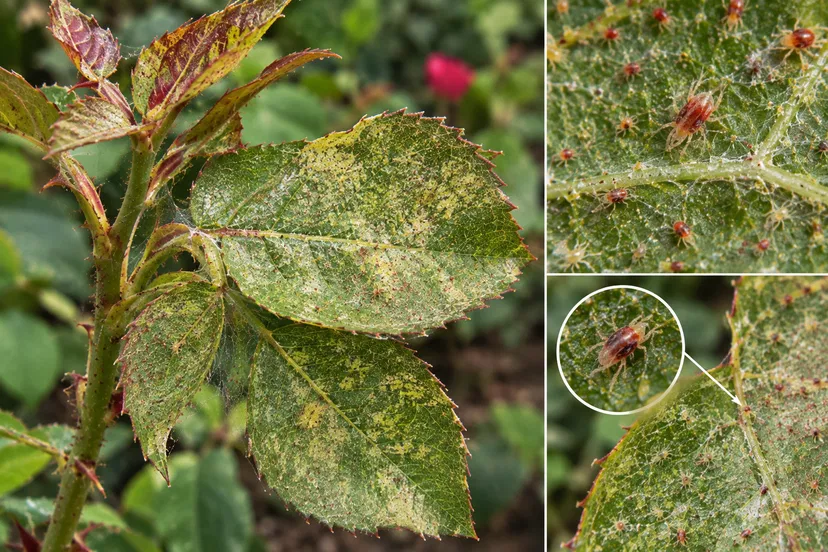
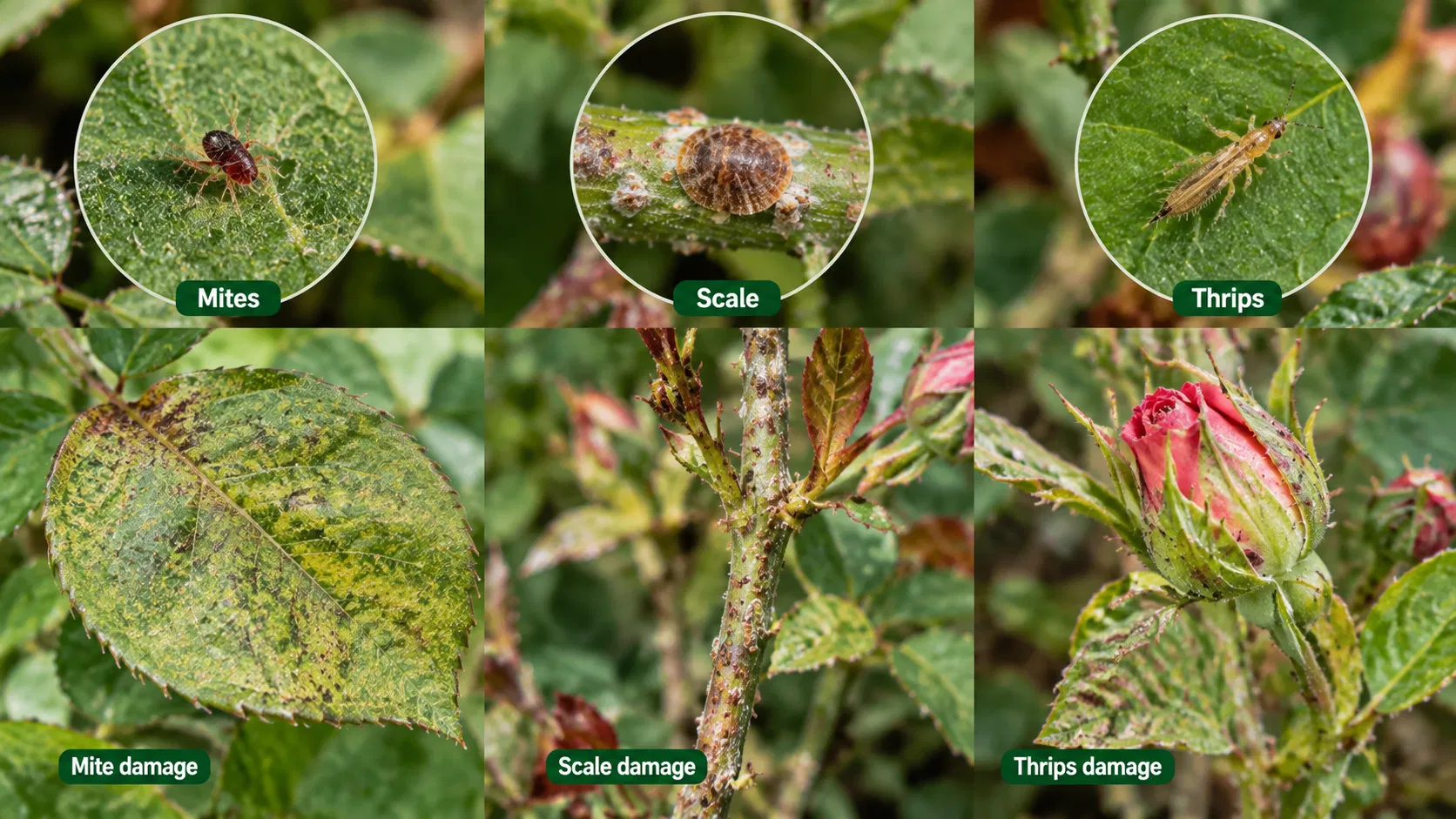
Spider mites are the most serious pest of roses in India, and the one with the widest range of registered solutions. They colonise the underside of leaves and drain cell contents, weakening the bush and cutting both stem length and bloom quality. Hot, dry weather and dusty conditions let their numbers explode within days, and a heavy infestation strips the plant of the foliage it needs to push out quality flowers.
How to Spot It
Fine pale stippling or speckling on the upper leaf surface that later turns bronze or rusty; tiny moving specks on the underside of leaves, best seen against light or through a hand lens; fine silky webbing over leaf undersides, shoot tips and buds in heavy infestations; leaves that yellow, dry and drop early, starting from the lower canopy.
Solutions to Control It
| Product | Active Ingredient |
|---|---|
| Crystal Abacin Insecticide | Abamectin 1.9% EC |
| Katra Miticide | Abamectin 1.9% EC |
| UPL Floramite 240 SC | Bifenazate 22.60% SC |
| Biostadt Maiden Insecticide | Hexythiazox 5.45% EC |
| Kunoichi Miticide | Cyenopyrafen 30% SC |
2. Thrips (Scirtothrips dorsalis, Thrips tabaci)
Thrips go straight for the part of the plant that earns the money. They rasp at petal and leaf tissue and feed on the sap that seeps out, and because they hide deep inside buds and half-open blooms, the damage usually shows up only once the flower opens, when it is already too late to save that stem.
How to Spot It
Silvery or whitish streaks and patches on petals, often browning at the edges as the bloom opens; distorted, malformed or discoloured flowers that fail to open evenly; curled, silvered young leaves with tiny black specks of excreta; slender, fast-moving yellow-to-brown insects visible when a bud or open bloom is tapped over white paper.
Solutions to Control It
| Product | Active Ingredient |
|---|---|
| FMC Rogor Insecticide | Dimethoate 30% EC |
| Tata Tafgor Insecticide | Dimethoate 30% EC |
3. Scale Insects (Aulacaspis rosae, Lindingaspis spp.)
Scale insects are the quiet, long-term threat in an established rose planting. Protected under a hard waxy shell, they attach themselves to canes and stems and feed continuously, draining the bush over months. Growers often miss them until canes start dying back, because the crusty coating on the stems looks more like bark or scurf than an insect.
How to Spot It
Raised white, grey or brown crusty scabs clustered along canes, stems and older wood, which do not brush off easily; canes that look encrusted or whitewashed in heavy infestations; yellowing leaves, weak new shoots, reduced flowering and gradual dieback of affected canes; sticky honeydew on leaves below, often followed by a black sooty mould that dirties foliage and blooms.
Solutions to Control It
| Product | Active Ingredient |
|---|---|
| FMC Rogor Insecticide | Dimethoate 30% EC |
| Tata Tafgor Insecticide | Dimethoate 30% EC |
Disclaimer
Always confirm current label registration, approved dosage, water volume, and pre-harvest interval (PHI) for your state before using any product labels are periodically revised by regulatory authorities.
This guide is a general advisory. Do your own research and verification before using any product. Always confirm suitability for your crop stage, region, and field conditions before making any purchase, spray, or crop-management decision.