Mango is one of India's most widely grown fruit crops, but the flowering and fruiting stages are also when the tree is most vulnerable to sap-sucking insect pests. Left unchecked, these pests can trigger heavy flower and fruit drop, disfigure fruit, and open the door to secondary problems like sooty mould, all of which cut directly into yield and market value.
This guide covers the three insect pests that most commonly affect mango, how to identify each one in the orchard, and the insecticide solutions available to manage them.
1. Hoppers (Idioscopus spp., Amritodus atkinsoni)
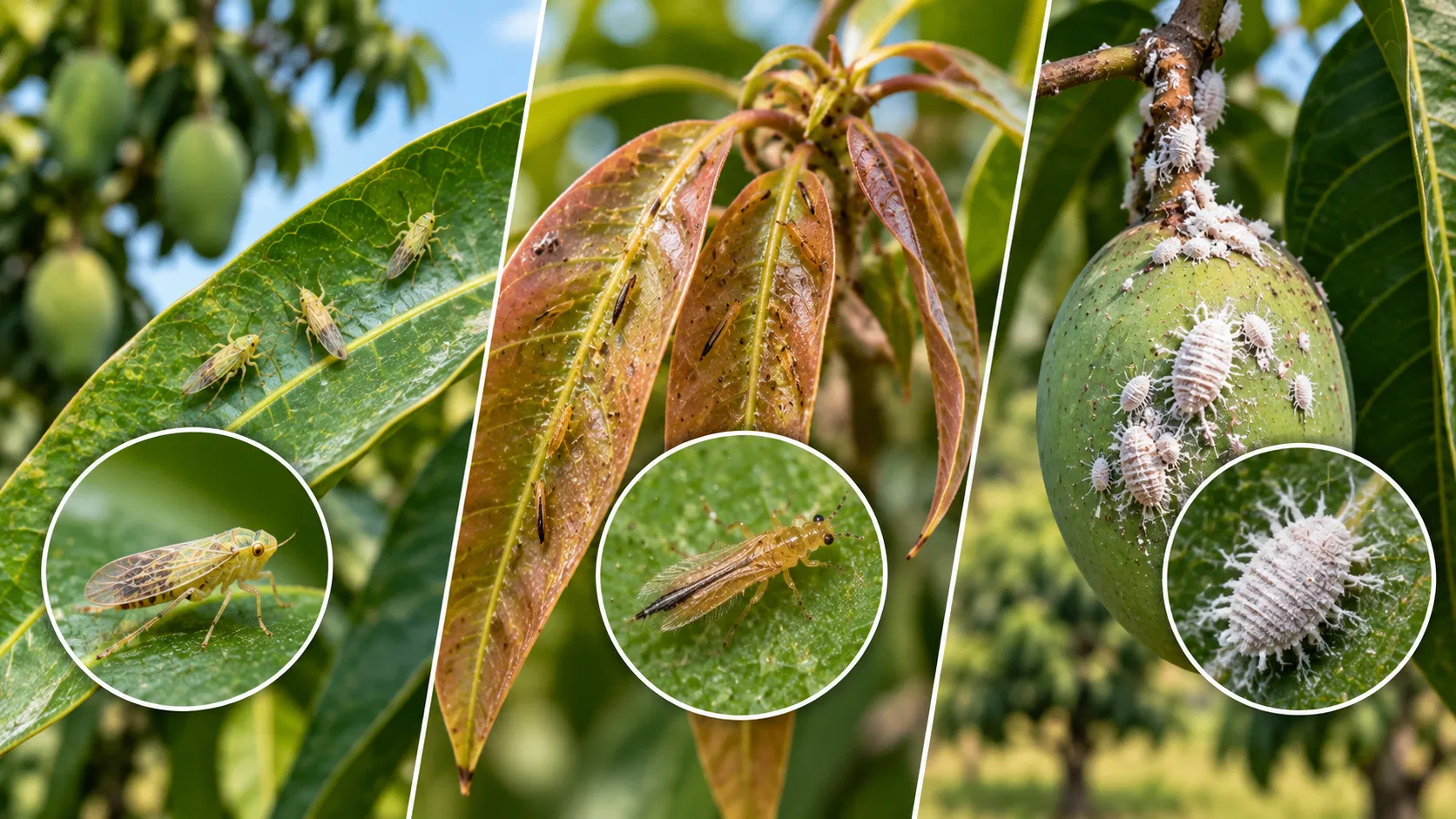
Mango hoppers are among the most damaging pests at the flowering stage. Nymphs and adults suck sap from inflorescence, tender shoots, and young leaves, causing heavy flower and fruitlet drop. Their honeydew excretion also promotes sooty mould, which blackens leaves and fruit and further reduces photosynthesis and marketability.
How to Spot It
Look for small, wedge-shaped, greenish-brown to grey insects clustering on flower panicles and tender shoots, which jump or fly off quickly when disturbed. Sticky honeydew deposits and a black sooty coating on leaves and fruit are common signs, along with poor fruit set on heavily infested panicles.
Solutions to Manage/Control It
| Product | Active Ingredient |
|---|---|
| Bayer Confidor Insecticide | Imidacloprid 17.8% SL |
| Syngenta Actara Insecticide | Thiamethoxam 25% WG |
| Syngenta Karate Insecticide | Lambda-cyhalothrin 5% EC |
2. Thrips
Thrips rasp and feed on young leaves, flowers, and the developing fruit surface. This feeding causes silvering and scarring on leaves, distorted new growth, and characteristic corky, russeted patches on fruit skin that lower market grade even when the fruit itself is otherwise healthy.
How to Spot It
Thrips are tiny, slender, yellowish to blackish insects, best seen by tapping a flower panicle or leaf onto a white sheet of paper. Look for silvery streaks or fine specks on the underside of leaves, and rough, brownish, corky scarring on the fruit surface as it develops.
Solutions to Manage/Control It
| Product | Active Ingredient |
|---|---|
| Corteva Delegate Insecticide | Spinetoram 11.7% SC |
| PI Industries Keefun Insecticide | Tolfenpyrad 15% EC |
3. Mealy Bug
Mealybugs form colonies of soft-bodied, wax-covered insects that suck sap from twigs, panicle stalks, and fruit stalks. Heavy infestation weakens shoots, triggers flower and fruit drop, and their honeydew secretion promotes sooty mould on leaves and fruit. Crawlers can also move down to breed around the base of the trunk.
How to Spot It
Look for white, cottony, waxy masses clustered on twigs, panicle stalks, and the undersides of leaves, often with ants actively tending the colonies for honeydew. Sticky honeydew and a black sooty coating on leaves and fruit are also common signs of an active infestation.
Solutions to Manage/Control It
| Product | Active Ingredient |
|---|---|
| Bayer Movento Energy Insecticide | Spirotetramat 11.01% + Imidacloprid 11.01% w/w SC |
Frequently Asked Questions
Why are mango hoppers considered such a serious pest?
Mango hoppers attack the flower panicles directly at the flowering stage, so heavy infestation can cause severe flower and fruitlet drop before fruit set even happens, directly cutting into the season's yield.
How can I tell thrips damage apart from a nutrient deficiency?
Thrips damage shows up as fine silvery streaks on leaves and rough, corky scarring on the fruit surface, and you can usually confirm it by tapping a panicle onto white paper and spotting the tiny moving insects.
Do mealybugs only affect the leaves and fruit of the mango tree?
No, mealybug crawlers can also move down and breed around the base of the trunk, which is why sticky grease banding around the trunk is commonly used alongside sprays to stop them climbing back up.
When should spraying for mango hoppers and thrips begin?
Spraying is most effective when started at flower panicle emergence, since both hoppers and thrips build up quickly on the panicles just as flowering begins.
- Always confirm the current label registration, approved dosage, and pre-harvest interval (PHI) for your state before using any product, as labels are periodically revised by regulatory authorities.
- This is general advisory content. Please do your own research and verify with a local agronomist or dealer before making any purchase, spray, or crop-management decision.