Thrips are the pest that costs Indian chilli growers more than any other, and the reason is not that effective insecticides do not exist. It is that thrips breed fast enough to build resistance within a single season, and the usual response to a failed spray, which is to spray again sooner and stronger, makes the problem worse rather than better. Two species are involved, they cause different-looking damage, and one of them responds poorly to the products that worked for decades against the other. Getting the identification and the spray rotation right matters far more here than the choice of any single product.
Symptoms
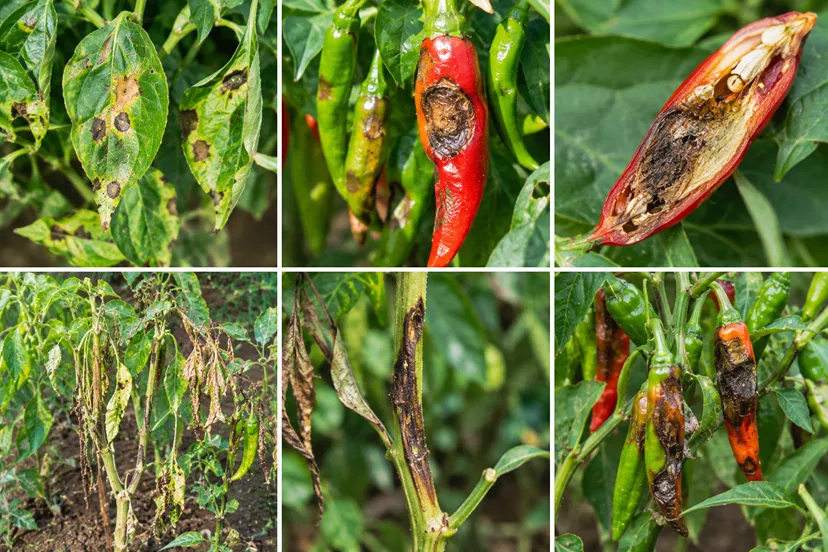
- Upward curling of leaves with crinkled margins and reduced leaf size, the condition growers commonly call leaf curl or murda, typical of the older chilli thrips
- Downward curling with thickened, brittle, drooping leaves, typical of black thrips
- Silvery or brown streaks and scarring on the underside of leaves, running along the midrib and main veins where the insects feed
- Heavy shedding of flowers and buds, often with blackening of the flowers before they drop, which is where most of the yield loss comes from
- Corky, russeted scarring on the fruit surface that downgrades the produce even when the yield itself holds up
- Shortened internodes and a stunted, bunched appearance at the top of the plant
- Fine black specks of excreta scattered on leaves and inside flowers
Causes
- Two different pests under one name: Scirtothrips dorsalis, the long-established chilli thrips, and Thrips parvispinus, the black thrips that spread across Indian chilli belts from 2021 and proved far harder to control
- A life cycle of only two to three weeks with overlapping generations, so a population rebuilds between sprays and selection for resistance happens within one season
- Hot, dry weather with low humidity, which lets numbers climb rapidly; heavy rain physically knocks thrips off the plant and suppresses them
- Repeated use of the same insecticide groups, which has produced widespread resistance, particularly to the neonicotinoid and pyrethroid products that were relied on for years
- Broad-spectrum sprays that wipe out predatory mites, anthocorid bugs, green lacewings and predatory thrips, removing the natural check on the population
- A very wide host range covering cotton, onion, brinjal, papaya, beans and many weeds, which keeps a reservoir alive near the field
- Staggered and overlapping chilli plantings in the same area, giving the pest a continuous host supply with no break
- Pupation in the soil, which means a portion of the population is out of reach of any foliar spray at any given moment
- Excess nitrogen, which produces the soft succulent growth that supports faster breeding
How to Identify
Thrips are only one to two millimetres long and slender, so they are easier to detect by their behaviour than by sight. Hold a sheet of white paper under a flower or growing tip and tap it sharply: the insects fall onto the paper and run about, which confirms their presence in seconds. Check inside flowers first, since that is where they concentrate, then the leaf undersides along the veins.
Colour separates the two species. Chilli thrips are pale yellow to light brown, while black thrips are distinctly dark brown to black, and their nymphs are pale in both cases. The direction of leaf curl gives a useful second clue: upward curling with crinkling points to chilli thrips, while downward curling with drooping, thickened leaves and heavy flower drop points to black thrips. Knowing which is present is worth the effort, because black thrips shrugs off several of the products that still work reasonably well on the older species.
Rule out the two lookalike problems before spraying. Mite damage also curls leaves downward but produces a bronzed underside with no visible insects when you tap the flower. Leaf curl virus distorts growth and shortens internodes but leaves no silvery feeding scars. Put up blue sticky traps rather than yellow, since blue attracts thrips far more strongly, and scout twice a week from transplanting through the flowering period.
Control Methods
Chemical Control
1. Isocycloseram 9.2% w/w DC
Isocycloseram is the newest chemistry available for this pest and belongs to a group with no cross-resistance to anything used before it. It acts on the insect nervous system as a modulator of GABA-gated chloride channels, a different target from the neonicotinoids, pyrethroids and organophosphates that thrips populations have already defeated. Feeding stops within a few hours of contact, it moves translaminarly to reach insects sheltering on leaf undersides, and residual activity runs to two or three weeks. Where older products have been failing, this is the group to reach for.
Product Recommendation
2. Spinetoram 11.70% SC
Spinetoram is a semi-synthetic spinosyn that overstimulates nicotinic acetylcholine receptors at a binding site no other insecticide group uses. Feeding stops within minutes and death follows within a day, and its translaminar movement carries it through the leaf to thrips feeding on the underside. It is comparatively soft on pollinators and natural enemies at label dose, which makes it one of the better choices for keeping the biological control in the field intact.
Product Recommendation
3. Spinosad 45% SC
Spinosad comes from fermentation of the soil bacterium Saccharopolyspora spinosa and works on the same receptor site as spinetoram, through contact and ingestion. It gives rapid feeding cessation and good activity against thrips in flowers, where much of the damage happens. Because it shares a mode of action with spinetoram, treat the two as one group when planning the rotation rather than alternating between them.
Product Recommendation
4. Cyantraniliprole 10.26% OD
Cyantraniliprole is a diamide that binds to ryanodine receptors and drains the muscle cells of calcium, stopping feeding within hours and causing paralysis. It moves systemically within the plant, which lets it reach thrips inside curled leaves and developing buds that a contact spray cannot wet. The oil dispersion formulation spreads and sticks well on waxy chilli foliage, improving the coverage that thrips control depends on.
Product Recommendation
5. Tolfenpyrad 15% EC
Tolfenpyrad belongs to the pyrazole group and blocks mitochondrial electron transport, cutting off the insect's energy supply. Its strong anti-feeding action means thrips stop damaging the crop almost immediately on contact, before they die, and it works across egg-laying adults and nymphs alike so the whole population is hit at once. It also suppresses egg laying and reduces the survival of eggs already present.
Product Recommendation
6. Beta-cyfluthrin 8.49% + Imidacloprid 19.81% w/w OD
This combination pairs a pyrethroid that gives rapid contact knockdown with a systemic neonicotinoid absorbed and moved through the plant. It remains a useful broad-spectrum option where aphids, jassids and whitefly are present alongside thrips, and where the thrips population is still the older chilli thrips rather than black thrips.
Product Recommendation
Be realistic about this group. Neonicotinoids and pyrethroids carry the heaviest resistance burden in Indian thrips populations, and black thrips in particular often survives them. If two well-timed applications from this group produce no visible drop in numbers, the answer is to change the group rather than to raise the dose or shorten the interval.
Rotating the Groups
Thrips control succeeds or fails on rotation. The five groups above act on completely different targets, which is exactly what makes them useful together: isocycloseram, the spinosyns, cyantraniliprole, tolfenpyrad, and the pyrethroid and neonicotinoid combination. Use one group for no more than two consecutive sprays, then move to a different group, and do not return to the first until at least one full thrips generation, around three weeks, has passed. Treat spinetoram and spinosad as a single group, since they share a binding site and resistance to one carries to the other.
Three habits make resistance worse and are worth naming plainly. Raising the dose above the label rate does not overcome resistance; it selects for it faster. Shortening the spray interval has the same effect while also killing off the predators that were suppressing part of the population. And tank-mixing several products in the hope of hitting everything exposes the pest to multiple groups at once, which is the quickest route to multi-group resistance. Spray in the early morning or late evening when thrips are active on the plant surface, direct the spray into flowers and growing points, and use enough water to reach the leaf undersides.
Cultural Control
- Raise seedlings under insect-proof net of 40 to 50 mesh so transplants enter the field clean, and avoid carrying an infestation in from the nursery
- Avoid staggered and overlapping chilli plantings in the same area, and keep a host-free break between crops to cut the continuous supply the pest depends on
- Plough deeply after harvest to expose soil-dwelling pupae, and destroy crop residue instead of leaving it in the field
- Clear weed hosts from bunds and field borders, since thrips survive on a very wide range of plants between crops
- Avoid planting next to onion, cotton or an older chilli crop, which release waves of thrips as they mature or are harvested
- Sow two or three border rows of maize or sorghum as a barrier crop to slow thrips moving in from neighbouring fields
- Keep nitrogen at the recommended dose and split it, since lush growth supports faster breeding
- Irrigate adequately through dry spells, and use sprinkler irrigation where feasible, as it dislodges thrips and consistently lowers populations
- Protect natural enemies by avoiding calendar sprays; predatory mites, anthocorid bugs and green lacewings suppress a significant share of the population when left undisturbed
Mechanical Control
Install blue sticky traps at 15 to 20 per acre, positioned just above the canopy and raised as the crop grows. Blue attracts thrips considerably more strongly than yellow, and the traps serve two purposes: they catch adults, and more importantly they show when a fresh flight has arrived so the first spray can be timed correctly instead of applied on a calendar. Strip off and destroy severely scarred shoots and blackened flower clusters during routine scouting, and rogue out badly stunted plants that will not recover, since they serve as a breeding base for the rest of the field.
Conclusion
The hardest lesson with chilli thrips is that spraying more is not spraying better. A population that survives a spray is a population that has been selected, and doing the same thing again a week later simply speeds that up. Work out which species is present, scout twice a week with the tap test and blue sticky traps, and plan a season-long sequence that moves between unrelated insecticide groups rather than reaching for whatever worked last time. Support it with a netted nursery, a host-free break, clean field borders and protection of the natural enemies already at work, and the crop holds its flowers through the season, which is where the yield is actually decided.
Disclaimer: Always confirm current label registration, approved dosage, water volume, and pre-harvest interval (PHI) for your state before using any product, since labels are periodically revised by regulatory authorities.
This guide is a general advisory. Do your own research and verification before using any product. Always confirm suitability for your crop stage, region, and field conditions before making any purchase, spray, or crop-management decision.