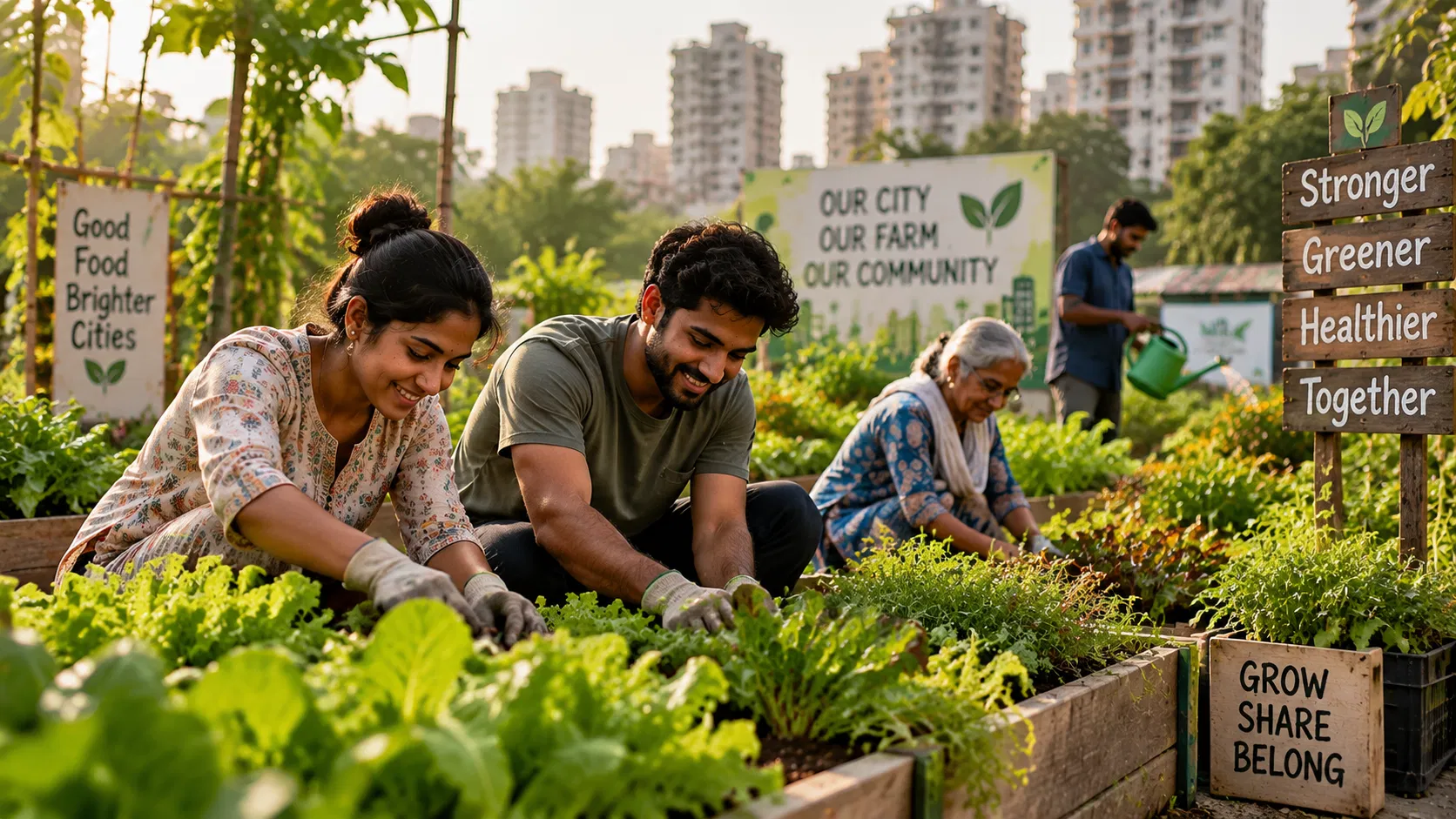
Not every urban grower wants to farm alone. Across Indian cities, shared rooftops, resettlement colonies, schools, and housing society terraces are turning into collective growing spaces — driven less by individual hobby and more by neighbourhoods deciding to grow food together.
What Community Farming Actually Looks Like
Rather than one household managing a balcony, community farming pools space, labour, and harvest across a group — a housing society terrace, an unused plot, a school courtyard, or an anganwadi rooftop. Residents typically split responsibilities like watering, composting, and harvesting on a rotation, and share what's grown rather than each person tending a separate patch.
Where It's Taking Root
In Chennai, an urban farming initiative has worked with anganwadis, schools, and resident welfare associations to set up chemical-free rooftop gardens, with produce from some of these gardens feeding directly into children's mid-day meals. In Delhi, residents of a densely populated neighbourhood turned recycled crates and containers on rooftops into shared vegetable gardens to improve household access to fresh produce. Housing societies in Mumbai and Hyderabad have similarly converted shared terraces into rooftop micro-farms where neighbours split the harvest and often the gardening chores themselves become a social occasion.
Why It's Growing
- Shared effort, shared output: Splitting watering and maintenance across a group makes consistent care realistic even for busy working residents.
- Food security at the neighbourhood level: For lower-income communities especially, shared rooftop gardens provide a genuine, low-cost supplement to household food supply.
- Urban heat and green cover: A rooftop or courtyard full of plants measurably cools the surface compared to bare concrete, offering a small but real defense against urban heat stress.
- Community bonding: Shared harvests, planting days, and potluck-style meals around the garden bring neighbours into regular contact in a way apartment living often doesn't otherwise allow.
- Institutional and CSR support: Corporate CSR programmes and city planning bodies are increasingly funding or facilitating building-level community gardens as part of broader green-cover and sustainability goals.
Common Models
Housing Society / RWA-Led
A resident welfare association allocates shared terrace or ground space, and residents contribute time and a small shared budget for inputs.
NGO or Civic-Led
NGOs provide training, seeds, and technical support to residents, schools, or anganwadis, often targeting food security or nutrition outcomes in specific neighbourhoods.
School and Institutional Gardens
Educational institutions use garden plots as hands-on learning spaces, sometimes feeding produce into mid-day meal programmes.
Corporate CSR Partnerships
Companies sponsor rooftop or campus gardens as part of sustainability initiatives, often involving employees directly in planting and maintenance.
Setting Up a Community Garden: What Actually Helps
Most shared gardens start with the same basics as any container garden, just at a larger, split-cost scale: grow bags or raised beds, a good potting mix, and basic hand tools that can be shared across the group. A shared vermi compost bed is a particularly good fit for community setups, since it turns pooled kitchen waste from multiple households into usable compost for the whole garden — closing the loop in a way that's harder to justify for a single household.
Frequently Asked Questions
Do I need my housing society's permission to start a community garden?
Generally yes — shared spaces like terraces or courtyards need RWA or management approval, along with a plan for water access and waste disposal.
How is produce typically shared in a community garden?
Most groups split the harvest by rotation or contribution level, though some donate a portion to community kitchens or local families in need.
Is community farming only for low-income neighbourhoods?
No — it spans income levels, from resettlement colonies seeking food security to upscale housing societies pursuing sustainability and community-building.
Disclaimer: General overview of community farming trends and models in Indian cities; specific outcomes depend on local participation, space, and institutional support.