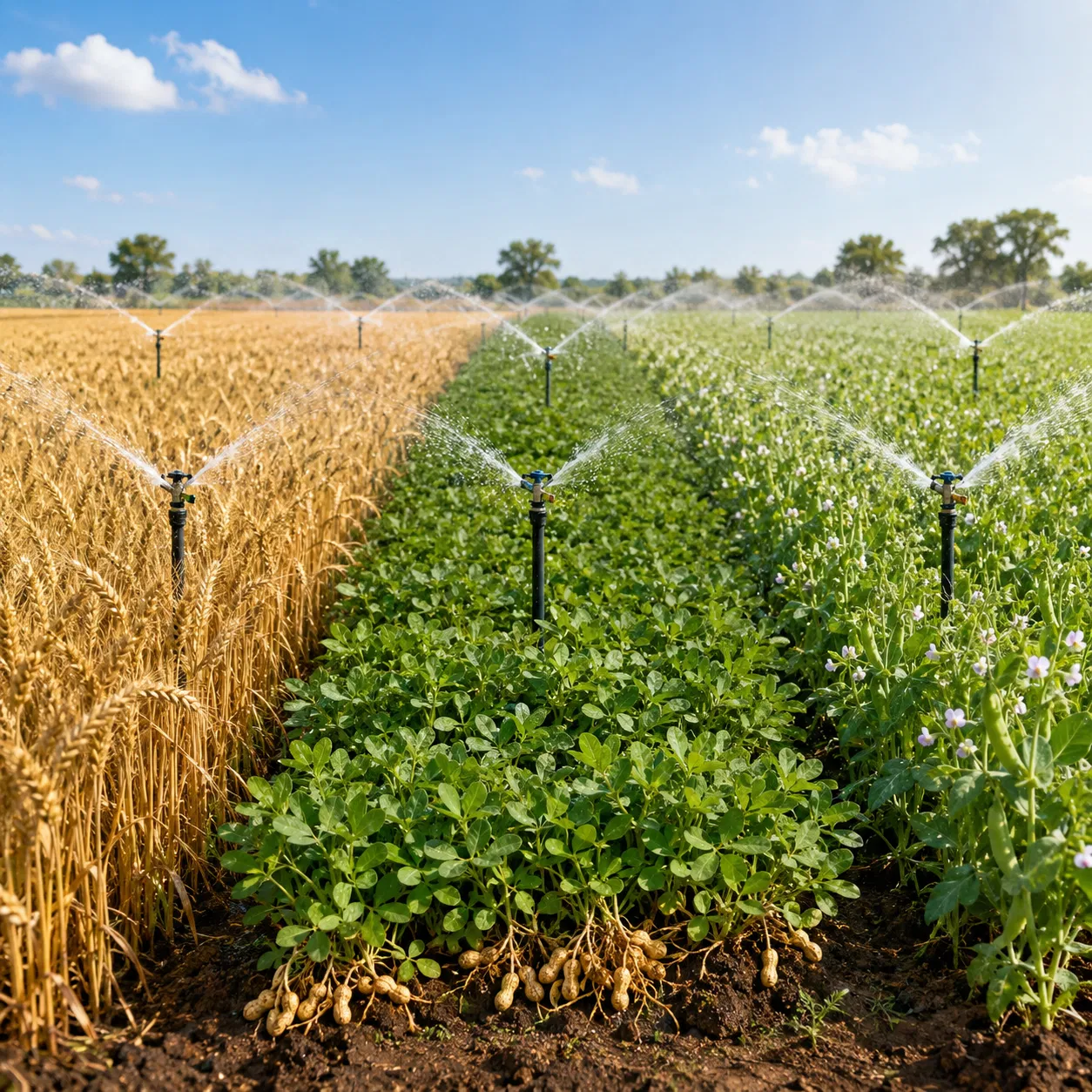
Water scarcity, uneven rainfall, and rising input costs are pushing farmers to look for smarter irrigation methods. For many crops, sprinkler irrigation is one of the most practical solutions. It helps apply water more evenly, reduces wastage, and supports healthy crop growth, especially in fields where traditional flooding is inefficient.
When it comes to wheat, groundnut, and pulses, sprinkler irrigation can make a major difference in crop performance. These crops need timely moisture at critical stages, and sprinklers help deliver water in a controlled way without overwatering or damaging the soil structure. If you want to improve water-use efficiency while protecting yield, this method deserves serious attention.
What Is Sprinkler Irrigation?
Sprinkler irrigation is a pressurized water application method that sprays water over crops in the form of fine droplets, similar to natural rainfall. It is especially useful in areas where water is limited, fields are uneven, or soil erosion is a concern.
Unlike flood irrigation, sprinklers distribute water more uniformly across the field. This helps crops receive the right amount of moisture without waterlogging, runoff, or excessive evaporation.
Why Sprinkler Irrigation Works Well for Wheat, Groundnut, and Pulses
Wheat, groundnut, and pulses all benefit from controlled irrigation, but each crop has different water needs. Sprinklers offer the flexibility to match those needs more closely than surface irrigation methods.
- Better water distribution: Helps ensure even crop growth across the field.
- Water savings: Reduces losses from runoff and deep percolation.
- Improved soil health: Prevents crusting and erosion caused by heavy flooding.
- Timely irrigation: Makes it easier to water crops at critical stages.
- Higher efficiency on light soils: Especially useful where water drains quickly.
Sprinkler Irrigation for Wheat
Wheat is a crop that responds well to timely and uniform irrigation. Moisture stress during key stages like crown root initiation, tillering, booting, flowering, and grain filling can reduce yield significantly. Sprinkler irrigation helps farmers maintain the moisture needed for strong growth and grain development.
Benefits for Wheat
- Supports uniform germination and early crop establishment
- Helps maintain soil moisture during critical growth stages
- Reduces waterlogging in heavier soils
- Improves fertilizer efficiency when used with fertigation systems
Best Practices for Wheat
- Irrigate at key growth stages rather than overwatering frequently.
- Use moderate sprinkler intensity to avoid lodging or soil splash.
- Schedule irrigation during early morning or evening to reduce evaporation loss.
- Monitor soil moisture regularly to avoid unnecessary irrigation.
For wheat, sprinkler systems are especially helpful in regions where canal water is limited or where fields are not perfectly leveled. The ability to irrigate evenly can translate into more stable yields and better grain quality.
Sprinkler Irrigation for Groundnut
Groundnut is sensitive to both excess water and moisture stress. Its root zone needs balanced moisture, particularly during flowering and pod development. Sprinkler irrigation helps provide this balance, making it a highly suitable method for groundnut cultivation.
Why Groundnut Responds Well
- Prevents water stagnation around pods
- Supports pegging and pod formation
- Maintains optimum soil moisture for root growth
- Reduces the risk of fungal problems linked to poor drainage
Key Irrigation Stages in Groundnut
Critical moisture periods for groundnut include: flowering, pegging, and pod development. Water stress during these stages can lower both pod number and kernel size.
Using sprinklers allows farmers to apply smaller amounts of water more frequently, which is often better for groundnut than heavy, infrequent irrigation. This method helps keep the soil consistently moist without causing saturation.
Practical Tips for Groundnut Fields
- Use light, frequent irrigations instead of deep watering.
- Avoid irrigation during strong winds, which can reduce uniformity.
- Check for uniform coverage, especially in corners and uneven areas.
- Do not over-irrigate during pod maturity, as excess moisture may affect harvest quality.
Groundnut farmers often find that sprinkler irrigation improves pod filling and reduces moisture-related issues. It also supports better weed control when used with proper field management.
Sprinkler Irrigation for Pulses
Pulses such as chickpea, mung bean, urad, lentil, and pigeon pea are generally sensitive to excess moisture. At the same time, they need adequate water during germination, branching, flowering, and pod setting. Sprinkler irrigation is an excellent option because it gives the grower greater control over how much water is applied.
Advantages for Pulses
- Minimizes the risk of root rot caused by waterlogging
- Helps maintain moisture for uniform flowering and pod set
- Improves crop stand in dry conditions
- Supports rainfed areas with limited irrigation access
Because many pulse crops are grown in marginal rainfall zones, sprinkler systems can be a game changer. They help bridge dry spells and protect crop productivity without requiring large volumes of water.
Important Management Tips for Pulses
- Irrigate only when the crop shows actual moisture need.
- Apply water lightly to avoid flower drop and soil crusting.
- Focus on flowering and pod development stages for maximum benefit.
- Ensure good drainage in the field to prevent standing water.
For pulses, precision matters. Even a small amount of unnecessary water can create disease problems, while timely irrigation can significantly improve yield and seed quality.
Advantages of Sprinkler Irrigation Across These Crops
Whether you grow wheat, groundnut, or pulses, sprinkler irrigation offers a practical combination of efficiency, flexibility, and crop protection. It is especially valuable in dry regions and where water resources are under pressure.
- Efficient water use: Helps save water and reduce irrigation cost over time.
- Uniform application: Ensures all plants receive similar moisture levels.
- Suitable for varied soils: Works well in sandy, loamy, and uneven fields.
- Reduced erosion: Gentle water application protects topsoil.
- Better crop management: Makes irrigation scheduling easier and more precise.
Limitations to Keep in Mind
While sprinkler irrigation is highly useful, it is not perfect for every situation. Farmers should consider field conditions, crop stage, wind speed, and system maintenance before installation and use.
- Wind can reduce spray uniformity.
- Initial setup cost may be higher than basic surface methods.
- Clogging and maintenance issues can affect performance.
- Improper scheduling may still lead to moisture stress or waste.
To get the best results, the system should be designed according to crop type, soil condition, and water source availability.
How to Get the Best Results from Sprinkler Irrigation
Successful sprinkler irrigation depends on more than just equipment. It requires good scheduling, regular monitoring, and proper field management. Farmers should start by understanding the water needs of each crop and then adjust irrigation intervals accordingly.
- Use soil moisture checks to guide irrigation timing.
- Inspect nozzles, pipes, and pressure levels regularly.
- Avoid irrigating in windy or very hot conditions.
- Match application depth to crop stage and root zone depth.
- Keep the system clean to prevent blockages and uneven spray patterns.
When managed properly, sprinklers can help farmers protect yields, save water, and improve overall farm efficiency.
Conclusion
Sprinkler irrigation for wheat, groundnut, and pulses is a smart, water-efficient approach that supports healthier crops and better yields. It is especially valuable in areas with limited water supply, uneven land, or soils that do not support flooding well. By applying water uniformly and at the right growth stages, farmers can reduce losses and improve crop performance.
If you are looking for a practical way to boost irrigation efficiency and manage water more carefully, sprinkler irrigation is worth adopting. With proper scheduling, regular maintenance, and crop-specific management, it can become one of the most reliable tools for sustainable crop production.