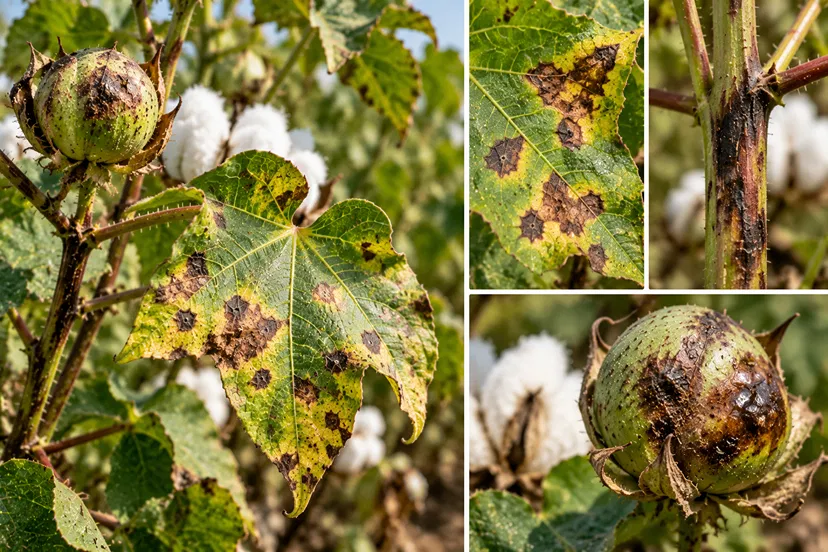
Mites on cotton feed by piercing individual leaf cells and draining their contents, and because they cluster on the underside of leaves and multiply fast in hot, dry weather, an infestation is often well established before the damage is even noticed from above.
Symptoms of Mites in Cotton
- Fine yellow or white stippling on the upper leaf surface where cells have been pierced and drained
- Leaves turning bronze, reddish, or brittle as feeding damage spreads across the surface
- Fine silken webbing on the underside of heavily infested leaves
- Premature leaf drop and reduced boll development under sustained infestation
- Tiny moving specks visible on the underside of leaves when held up to light
Causes of Mites in Cotton
- Hot, dry weather that speeds up the mite life cycle and lets populations build up quickly
- Dust accumulation on foliage, particularly along field edges near roads, which favours mite build-up
- Overuse of broad-spectrum insecticides that kill off the natural predators that would otherwise keep mite numbers in check
- Moisture-stressed plants, which are more susceptible to heavy mite damage than well-irrigated ones
- Nearby infested crops or weeds acting as a source of migrating mites
Solutions to Control Mites in Cotton
1. Spiromesifen 22.90% SC
A tetronic acid insecticide that blocks lipid synthesis in the pest, giving strong activity against mites as well as whitefly nymphs, though it works more slowly than a fast contact poison. It's registered on cotton specifically for whitefly and mite control together.
Product Recommendations
2. Fenpyroximate 5% EC
A phenoxypyrazole acaricide that acts on contact, disrupting the pest's energy production and giving fast knockdown on mite populations. It's registered on cotton for jassids and mites together, useful where both pests are active on the same crop.
Product Recommendations
Note: Rotate between different modes of action across the season rather than repeating the same one, avoid unnecessary broad-spectrum sprays that wipe out predatory mites and other natural enemies, and check the underside of leaves regularly since mite populations build up before damage is easy to spot from above.
Disclaimer: Always confirm current label registration, approved dosage, water volume, and pre-harvest interval (PHI) for your state before using any product - labels are periodically revised by regulatory authorities.
This guide is a general advisory. Do your own research and verification before using any product. Always confirm suitability for your crop stage, region, and field conditions before making any purchase, spray, or crop-management decision.