The bollworm complex in cotton brings together three of the crop's most damaging caterpillar pests: the American bollworm (Helicoverpa armigera), the pink bollworm (Pectinophora gossypiella), and the spotted bollworm (Earias vitella). All three bore into squares and bolls to feed, and by the time the damage shows on the surface, the larvae are already protected inside, so timing and mode of action matter as much as the product itself.
Symptoms of Bollworm Complex in Cotton
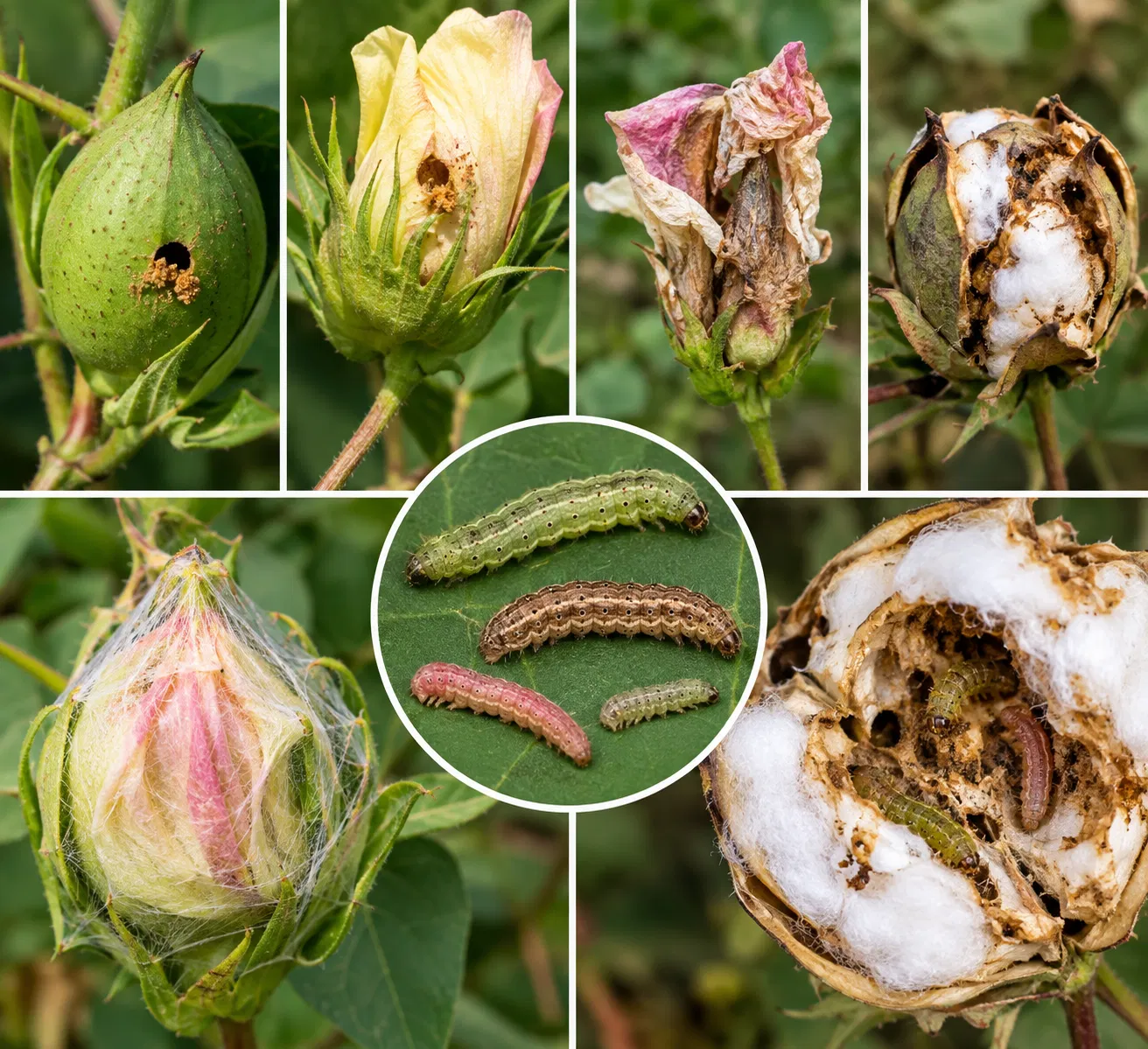
- Small, round entry holes on squares, flowers, and bolls, often plugged with frass (larval excreta)
- Shedding of damaged squares and flowers before they can develop into bolls
- Bolls that open unevenly or rot after larvae have fed inside them, staining and damaging the lint
- "Rosette flowers" with petals held together by silk webbing, a sign of pink bollworm feeding inside the flower
- Caterpillars of varying size and colour (green, brown, or pink-tinged) found inside damaged bolls when opened
Causes of Bollworm Complex in Cotton
- Moths migrating in from nearby infested cotton fields, pigeon pea, or other host crops
- Continuous cotton cropping in the same field or region without rotation, letting populations carry over season to season
- Infested crop residue and unginned lint left over from the previous season, where pink bollworm larvae survive between crops
- Extended cropping cycles and late-season irrigation that let the crop stay green long enough for extra generations to build up
- Warm weather that shortens the pest's life cycle and allows faster population build-up
Solutions to Control Bollworm Complex in Cotton
1. Chlorantraniliprole 18.5% SC
A diamide insecticide that disrupts the calcium channels in the pest's muscle cells, causing feeding to stop almost immediately after ingestion. It's registered on cotton for American bollworm, spotted bollworm, and tobacco caterpillar together, and its ingestion-based action makes it effective even against larvae that have already started boring in, as long as they're still feeding on treated tissue.
Product Recommendations
2. Cyantraniliprole 10.26% OD
A diamide insecticide that acts on both contact and ingestion, disrupting the pest's muscle function after feeding on treated tissue. It's registered on cotton against bollworms alongside whitefly, aphids, thrips, and tobacco caterpillar, making it useful where sucking and chewing pests overlap in the same field.
Product Recommendation
3. Thiamethoxam 12.6% + Lambda-cyhalothrin 9.5% ZC
This combination pairs a systemic neonicotinoid with a pyrethroid, giving both uptake into the plant and fast knockdown on contact. Thiamethoxam moves through the plant tissue to control sucking pests, while lambda-cyhalothrin adds quick contact and stomach action against caterpillars, and it's registered on cotton for jassids, aphids, thrips, and bollworms together.
Product Recommendations
4. Fipronil 5% SC
A phenylpyrazole insecticide that disrupts the pest's nervous system on contact and ingestion. It's registered on cotton with a separate, higher dose specifically for bollworms, alongside its use against aphids, jassids, thrips, and whitefly at a lower dose.
Product Recommendations
5. Emamectin Benzoate 5% SG
A biologically derived insecticide that affects the pest's nerve and muscle function, leading to paralysis and stopped feeding within hours of ingestion. It's registered on cotton specifically for bollworms and remains one of the most widely used options for caterpillar control in the crop.
Product Recommendations
Note: Rotate between different modes of action across the season rather than repeating the same one, time sprays to target early instar larvae before they bore into squares and bolls, and destroy crop residue and unginned lint after harvest, since pink bollworm survives between seasons in exactly this kind of leftover material.
Disclaimer: Always confirm current label registration, approved dosage, water volume, and pre-harvest interval (PHI) for your state before using any product - labels are periodically revised by regulatory authorities.
This guide is a general advisory. Do your own research and verification before using any product. Always confirm suitability for your crop stage, region, and field conditions before making any purchase, spray, or crop-management decision.