Introduction
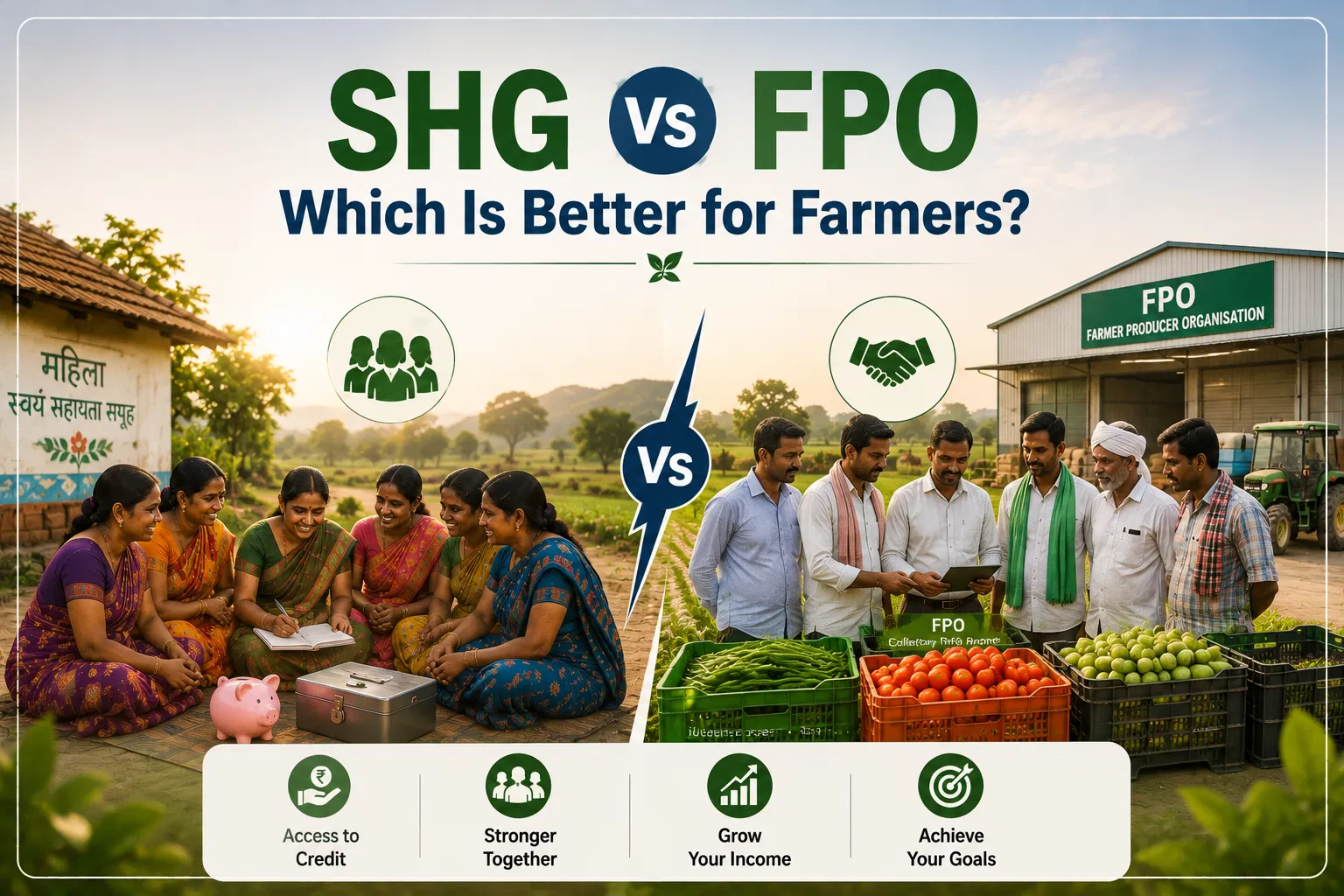
This question assumes SHGs and Farmer Producer Organisations (FPOs) are competing options, but they're usually solving different problems, at different stages of a farmer's journey. A Self-Help Group is a small, informal savings and credit circle, mostly of women, built around financial inclusion. An FPO is a registered, farmer-owned business entity built around commercial aggregation, input supply, and market linkage. Many successful FPOs in India actually grew out of SHGs — the progression is common enough that asking ""which is better"" is a bit like asking whether a savings account or a business is better: they serve different needs, and the honest answer depends entirely on what a farmer or group is trying to achieve.
SHG vs FPO: Quick Comparison
- Primary Purpose — SHG: savings, internal credit, and financial inclusion. FPO: commercial aggregation, input supply, processing, and market linkage
- Legal Structure — SHG: informal, savings-account-based group, typically not a separately registered legal entity. FPO: formally registered as a Producer Company under the Companies Act, or as a cooperative
- Typical Membership — SHG: 10-20 members, mostly women, at village/hamlet level. FPO: minimum 10 individual producers or 2 producer institutions, no upper cap, often 300-1,000+ members
- Credit Access — SHG: collateral-free bank loans up to ₹20 lakh via the SHG-Bank Linkage Programme, savings-linked. FPO: NABKISAN/CGTMSE-backed loans, equity grants, and NABARD/SFAC infrastructure support, business-need-linked
- Governance — SHG: informal, consensus-based group decision-making. FPO: formal board of directors, one-member-one-vote, statutory compliance under the Companies Act
- Business Scope — SHG: primarily savings, internal lending, and small livelihood activities. FPO: input procurement, processing, branding, and direct market/institutional sales
What an SHG Is Built For
- SHGs exist primarily to build a habit of savings and access to small, collateral-free credit — the entry point for financial inclusion, especially for rural women without a prior banking relationship.
- Loans are typically used for small livelihood activities, household needs, or working capital for a modest individual enterprise (a member's tailoring unit, a small shop, livestock rearing).
- Governance is informal — a group of 10-20 women meeting regularly, maintaining savings and internal loan records, without the compliance burden of a registered company.
- SHGs are the natural first step for someone with no prior credit history or collateral, since group-based trust and savings discipline substitute for formal financial credentials.
What an FPO Is Built For
- FPOs exist to give farmers collective bargaining power in buying inputs and selling produce — aggregating volume that no individual smallholder could achieve alone.
- As a registered Producer Company, an FPO can enter contracts, own assets, take larger loans, hire professional management, and access government schemes specifically designed for producer collectives (equity grants, credit guarantee, infrastructure subsidy).
- Business scope is explicitly commercial: input supply, aggregation, grading and sorting, processing, branding, and direct sales to institutional buyers or markets — activities that need scale to be profitable.
- Studies comparing FPO member and non-member households have found FPO households report higher crop diversity and higher total household income, alongside somewhat mixed effects on other measures like diet quality.
How They Often Work Together
- A common and well-documented progression: individual farmers join SHGs for savings and credit, several SHGs federate into Farmer Interest Groups (FIGs) for collective input purchasing, and FIGs eventually federate into a full FPO for commercial-scale marketing.
- An existing SHG network can act as a readymade membership base and trust foundation when a village or cluster decides to formalise into an FPO.
- It's entirely possible — common, even — for the same farmer to be an SHG member for personal savings/credit and an FPO shareholder for the commercial side of their farming business simultaneously.
- NABARD itself supports both models, often through the same regional infrastructure, recognising them as complementary rather than competing parts of rural financial inclusion.
Choosing Between Them: A Practical Guide
- Choose (or start with) an SHG if the immediate need is personal/household credit, savings discipline, or a small individual livelihood activity, and there's no existing collective structure in the village.
- Choose (or move toward) an FPO if the goal is collective bargaining on input costs, better sale prices through aggregation, processing/value-addition, or access to larger infrastructure and equity-linked government schemes.
- If a group is already SHG-linked and has built savings/credit discipline, evolving toward an FPO is usually easier than starting a Producer Company from scratch, since the trust and track record already exist.
- For a purely commercial, scale-driven farming business goal, going straight to FPO registration makes sense if there are at least 10 committed producers and a viable business plan — the SHG stage isn't a mandatory prerequisite.
Limitations of Each Model
- SHGs are not designed for large-scale commercial activity — loan sizes and governance structures suit small, individual-level livelihood needs, not aggregated agribusiness.
- FPOs require more upfront formality — incorporation, compliance, minimum membership, and professional management — which can be a barrier for a very early-stage or informally organised group of farmers.
- An FPO's benefits (equity grants, larger credit lines) are generally proportional to its business maturity — a newly registered FPO with no track record won't access the same terms as an established one.
- SHG credit is savings-linked and grows only as fast as the group's own savings and repayment discipline build, which can feel slow for members wanting faster access to larger capital.
Conclusion
SHG versus FPO isn't really an either/or choice — it's closer to two different tools for two different jobs, and many of India's strongest farmer collectives have used both, often in sequence. An SHG builds the savings habit, trust, and credit history; an FPO turns that foundation into a commercial farming business with real market power. The right starting point depends on whether the immediate need is personal financial inclusion or collective agribusiness — and for many rural communities, the honest answer is eventually both.
Disclaimer: Loan ceilings, registration requirements, and government scheme benefits for SHGs and FPOs are subject to periodic revision by NABARD, the Ministry of Rural Development, and the Ministry of Corporate Affairs. Readers are advised to verify current details with NABARD (nabard.org), the local SRLM office, or a company registration professional before forming or joining either structure.