Introduction
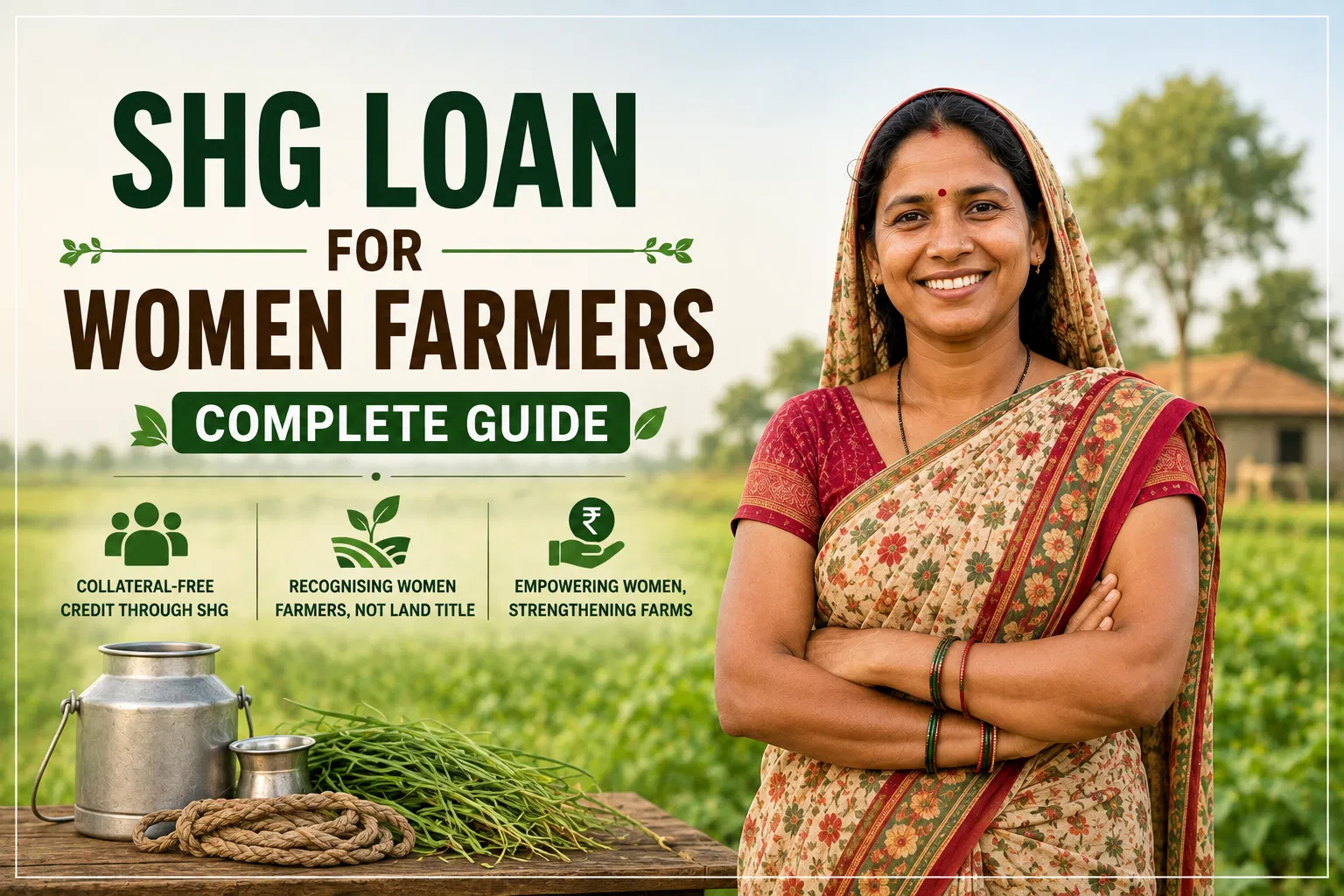
India's mainstream agricultural credit system has a structural blind spot: it's built around land ownership, and land records overwhelmingly sit in men's names. A woman doing the actual work of cultivation — sowing, weeding, harvesting, managing livestock — often has no legal standing as a ""farmer"" at all in the eyes of a bank, because the Kisan Credit Card, PM-KISAN, and crop insurance schemes are generally issued to the landholder, not the cultivator. This is precisely the gap that SHG credit, combined with the Mahila Kisan Sashaktikaran Pariyojana (MKSP), was built to address — recognising and financing women as farmers on the basis of their work, not their land title.
Why This Gap Exists
- KCC (Kisan Credit Card) is issued primarily to land-owning households; most women who farm do not hold that land in their own name and therefore fall outside its default eligibility.
- PM-KISAN excludes tenant farmers and sharecroppers entirely — a category that includes a large share of women who cultivate land they don't legally own.
- Land inheritance and joint-patta (joint land title) provisions exist on paper in several states but remain underused in practice, so formal legal ownership by women stays limited.
- Without land as collateral, women are largely shut out of formal bank finance, crop insurance, and KCC — leaving SHG-Bank Linkage credit as the main formal channel actually accessible to them.
MKSP: Recognising Women as Farmers Without Land Title
- Full Name — Mahila Kisan Sashaktikaran Pariyojana (MKSP), a sub-component of DAY-NRLM under the Ministry of Rural Development, running since 2011
- Core Principle — MKSP formally recognises women as 'Kisan' (farmer) based on their agricultural work, regardless of whether they hold land title — directly addressing the barrier that KCC, PM-KISAN, and PMFBY do not solve
- Reach — Approximately 38 lakh women farmers trained under MKSP as of the Ministry's cited figures
- Delivery Model — Implemented through State Rural Livelihoods Missions via SHGs, Joint Liability Groups of women farmers, Village Organisations, and Cluster Level Federations
- Focus Areas — Sustainable and organic agriculture, seed conservation, water conservation, crop diversification, and livestock-based livelihoods, delivered through training and capacity building rather than direct cash transfer
How SHG Credit Fits a Woman Farmer's Reality
- SHG loans are collateral-free — a woman doesn't need land title to access credit through her group, unlike KCC or a standard crop loan.
- Credit is assessed on the group's savings, meeting regularity, and repayment discipline, not on any individual member's asset ownership.
- Funds can be used flexibly for whatever agricultural or livestock activity a member is actually engaged in — cultivation inputs, livestock, or a small allied enterprise — regardless of whose name is on the land records.
- Where a woman farms as a tenant, sharecropper, or on family land not in her name, a Joint Liability Group (JLG) of women farmers — as used in several state MKSP projects — is a complementary route built specifically for cultivators without land title.
- Interest subvention under DAY-NRLM (7% effective rate on loans up to ₹3 lakh, down to 4% with prompt repayment in 250 identified districts) applies to Women SHG credit generally, including agricultural use.
Objectives of Women-Farmer-Focused Support
- Formally recognise women's role in agriculture, independent of land ownership, in a system that has historically defined ""farmer"" by title deed.
- Build sustainable, lower-input farming practices that reduce dependence on expensive external inputs and reduce drudgery for women cultivators.
- Channel collateral-free credit to women farmers through the SHG platform, since land-based credit routes largely bypass them.
- Strengthen women's decision-making power over agricultural resources and household income.
- Create pathways from individual cultivation toward group-based farming (JLGs) and eventually FPO-level collective agribusiness.
Benefits to Women Farmers
- Formal recognition as a farmer — through MKSP — that doesn't hinge on land title, addressing a structural gap most other schemes leave unresolved.
- Genuinely collateral-free credit through SHG-BLP, at a meaningfully subsidised interest rate for smaller loan amounts.
- Training in sustainable, resource-conserving farming practices that can lower input costs over time.
- A structured, group-based route (JLG) for women who farm as tenants or sharecroppers without land documentation.
- A track record built through SHG savings and credit discipline that can support graduation to larger loans or collective structures like FPOs over time.
Limitations to Understand
- MKSP does not confer legal land title — it recognises a woman's status as a cultivator for programme purposes, but doesn't resolve underlying land ownership or inheritance issues, which require separate legal reform.
- SHG loan sizes remain bounded by the group's own savings and credit cycle — meaningfully smaller, in most cases, than what a land-collateralised crop loan or larger KCC limit could offer.
- MKSP is primarily a capacity-building and training programme, not a direct cash-transfer or subsidy scheme — the tangible support is knowledge, sustainable practice adoption, and credit-linkage facilitation rather than a lump-sum grant.
- Coverage and implementation intensity vary by state, since State Rural Livelihoods Missions run MKSP projects with differing scale and focus.
- A woman farming genuinely landless or as a sharecropper may still need a JLG or SHG route specifically, since KCC and PM-KISAN's land-based eligibility remain unchanged by MKSP's existence.
How to Access This Support
- Connect with the local Self-Help Group or, if farming without land title, enquire about forming or joining a Joint Liability Group of women farmers through the state Rural Livelihoods Mission.
- Ask the Village Organisation or Cluster Level Federation about current MKSP training programmes and sustainable agriculture initiatives active in the area.
- Once part of a credit-linked SHG or JLG, raise the specific agricultural funding need — inputs, livestock, equipment — through the group's normal loan process.
- For women with legal land access, explore whether a joint patta (joint land title with a spouse or family member) is available under state provisions, which can additionally open KCC and PM-KISAN eligibility over time.
Conclusion
The honest starting point for a woman farmer in India is recognising that the mainstream agricultural credit system wasn't built with her in mind — it was built around land title, which most women farmers don't hold. SHG-linked credit, reinforced by MKSP's explicit recognition of women as farmers regardless of land ownership, is currently the most realistic and accessible financing route for the majority of women actually doing the work of cultivation. It isn't a perfect substitute for land rights reform, but it's a functioning bridge that's already reaching tens of lakhs of women farmers across the country.
Disclaimer: Loan ceilings, interest subvention, and MKSP programme availability vary by state and are subject to periodic revision by NABARD and the Ministry of Rural Development. Readers are advised to verify current details with the local State Rural Livelihoods Mission office, NABARD (nabard.org), or their nearest bank branch.