
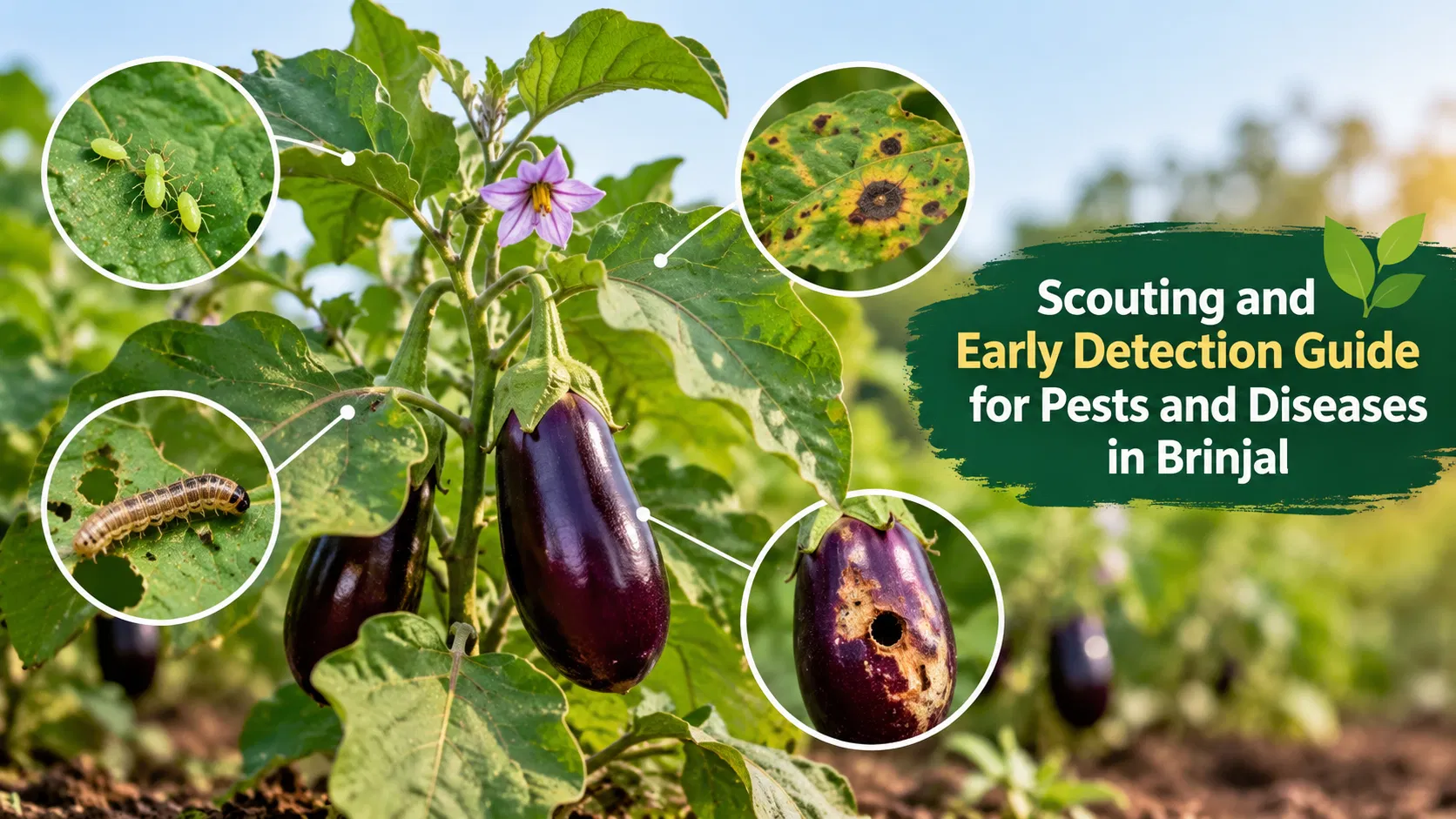
Most losses in brinjal happen not because a pest or disease cannot be controlled, but because it is noticed too late — after the borer is inside the fruit, after wilt has moved down the row, after jassids have curled the whole canopy. Scouting is the habit of walking the field on a fixed day, looking in the right places and writing down what you see. It costs nothing, takes under an hour per acre, and turns traps, bio-agents and need-based sprays into a plan instead of a panic. This guide shows how to scout brinjal and what the earliest warning signs look like.
What Is Scouting in Brinjal?
Scouting means checking a fixed number of plants at fixed spots across the field — generally once a week from transplanting, twice a week during flowering and fruiting or in warm, humid spells. The aim is to find a pest or disease while it is on a few plants, compare it with the action threshold, and decide whether to wait, use a cultural or biological measure, or spray a registered product.
How to Scout a Brinjal Field Step by Step
- Go early in the morning when jassids, whitefly and moths are sluggish and easier to see.
- Walk in a W pattern covering edges, centre and the low-lying corner; pests and wilt often start at borders and wet patches.
- Stop at 5 spots per acre and check 5–10 plants at each, chosen at random rather than only the damaged ones visible from the bund.
- Examine each plant top to bottom: growing tip, underside of 3–4 leaves from top, middle and bottom, open flowers, every fruit, and the stem base.
- Tap test: hold a white sheet under a branch and tap; thrips, jassid nymphs and mites fall onto it and are easy to count. In flowering plots a few Tapas Blue Sticky Traps show thrips build-up between visits.
- Carry a hand lens for mites and thrips, and a knife to cut suspect shoots, fruits and wilted stems.
- Read your traps on the same day each week — a borer pheromone trap such as the Gaiagen Lucin Lure in a funnel or water trap, and a few Tapas Yellow Sticky Traps for whitefly, jassids and aphids. A sudden jump in counts is an early warning before plant damage appears.
- Write it down — spot, pest or disease, plants affected, trap counts and weather.
Earliest Signs of Brinjal Pests and Where to Look
| Pest | Earliest sign | Where to look |
|---|---|---|
| Shoot & fruit borer (Leucinodes orbonalis) | Single drooping tender shoot; moths in pheromone trap | Growing tips, small fruits under the calyx |
| Jassids / leaf hoppers (Amrasca biguttula biguttula) | Slight downward cupping of leaf edges; green nymphs walking sideways | Underside of young leaves |
| Whitefly (Bemisia tabaci) | A few adults fly up when a plant is shaken; adults on yellow traps | Underside of middle leaves |
| Aphids (Aphis gossypii) | Small colonies on the newest shoot; ants moving on the plant | Tender tips and leaf undersides |
| Thrips (Thrips tabaci) | Silvery streaks on young leaves; insects in tap test or on blue traps | Leaf folds, flowers |
| Spider mites (Tetranychus urticae) | Fine yellow speckling on upper leaf surface | Underside of older leaves, with hand lens |
| Epilachna beetle (Henosepilachna vigintioctopunctata) | Yellow egg clusters and small spiny grubs | Leaf undersides |
Earliest Signs of Brinjal Diseases
| Disease | Earliest sign | Quick field check |
|---|---|---|
| Damping off (Pythium, Rhizoctonia spp.) | Water-soaked collar on a few seedlings in a wet patch of the nursery | Seedlings topple when touched |
| Bacterial wilt (Ralstonia solanacearum) | One green plant wilting at midday and recovering at night | Cut the lower stem and dip in clean water — a milky ooze within minutes suggests bacterial wilt |
| Fusarium wilt (Fusarium spp.) | Lower leaves yellowing on one side of the plant | Brown streaks inside the split stem, no ooze |
| Phomopsis blight and fruit rot (Phomopsis vexans) | Small round brown leaf spots; a soft, pale spot on one fruit | Tiny black dots in the spot under a hand lens |
| Leaf spots (Alternaria, Cercospora spp.) | A few spots with rings or light centres on lower leaves | Spots spreading upward after humid nights |
| Collar rot (Sclerotium rolfsii) | Plant wilting with white threads at the stem base | Mustard-seed-like bodies in the soil at the collar |
| Little leaf (phytoplasma) | New leaves smaller and paler on a single plant | Bushy growth, flowers turning leafy; leaf hoppers present |
Action Thresholds: When to Act in Brinjal
- Shoot and fruit borer: around 5% damaged shoots or fruits is generally taken as the level for a need-based registered spray; below it, clip shoots and keep traps working (see management of shoot and fruit borer in brinjal).
- Jassids, whitefly, aphids, thrips: act when found on most sampled plants and leaves start to curl, or when sticky trap counts climb week on week; begin with neem or bio-agents. Jassids deserve extra attention because they carry little leaf — read more on leaf hoppers in brinjal.
- Mites: the first speckling with mites visible under the lens on several plants in hot, dry weather.
- Wilt, collar rot, little leaf: no threshold — remove the first affected plant with roots the day you find it and protect the neighbours; root-related wilt diseases in brinjal explains the next steps.
- Fruit rot and leaf spots: act at the first spots when weather is humid, since spread can be fast.
A Simple Weekly Scouting Record
| Date | Crop stage | Spot | Pest / disease seen | Plants affected (of 10) | Trap count | Action taken |
|---|---|---|---|---|---|---|
| e.g. 12 Aug | 45 DAT, flowering | North edge | Borer – drooping shoots | 2 | 9 moths | Clipped shoots, replaced lure |
One season of records shows when each pest arrives in your field, so traps and bio-sprays can start a week earlier the next year.
Frequently Asked Questions
1. How often should a brinjal field be scouted?
Generally once a week from transplanting, and twice a week during flowering and fruiting or in warm, humid weather.
2. How many plants should I check per acre?
Around 5 spots per acre with 5–10 randomly chosen plants at each, walking in a W pattern so edges and centre are covered.
3. What is the earliest sign of shoot and fruit borer in brinjal?
A single tender shoot drooping while the rest of the plant looks healthy, often a week or two after moth catches rise in the pheromone trap.
4. How can I tell bacterial wilt from fungal wilt in the field?
Cut the lower stem and dip it in clean water: a milky ooze generally means bacterial wilt, while brown streaks inside the stem without ooze point to Fusarium wilt.
5. What is the ETL for brinjal shoot and fruit borer?
Around 5% damaged shoots or fruits is generally used as the level at which a need-based registered spray may be justified.
6. Can pheromone traps be used for monitoring instead of control?
Yes. A few traps per acre read weekly give early warning of moth activity; more traps across the field are used for mass trapping. Sticky traps work the same way for sucking pests — see how to use yellow and blue sticky traps.
7. Which pests are easiest to miss while scouting brinjal?
Mites and thrips, because they are tiny and hide under leaves and in flowers — a hand lens and the tap test catch them early.
8. Why keep a scouting record?
It shows the dates each pest and disease appears in your field, so traps, bio-agents and cultural measures can be timed earlier the following season.
Disclaimer: Scouting intervals, sample sizes and action thresholds given here are general guidelines and may need adjusting to your field size, season and local pest pressure. Confirm identification of any pest or disease and the current label directions for any product with your local agricultural officer or a qualified agronomist before taking action.