
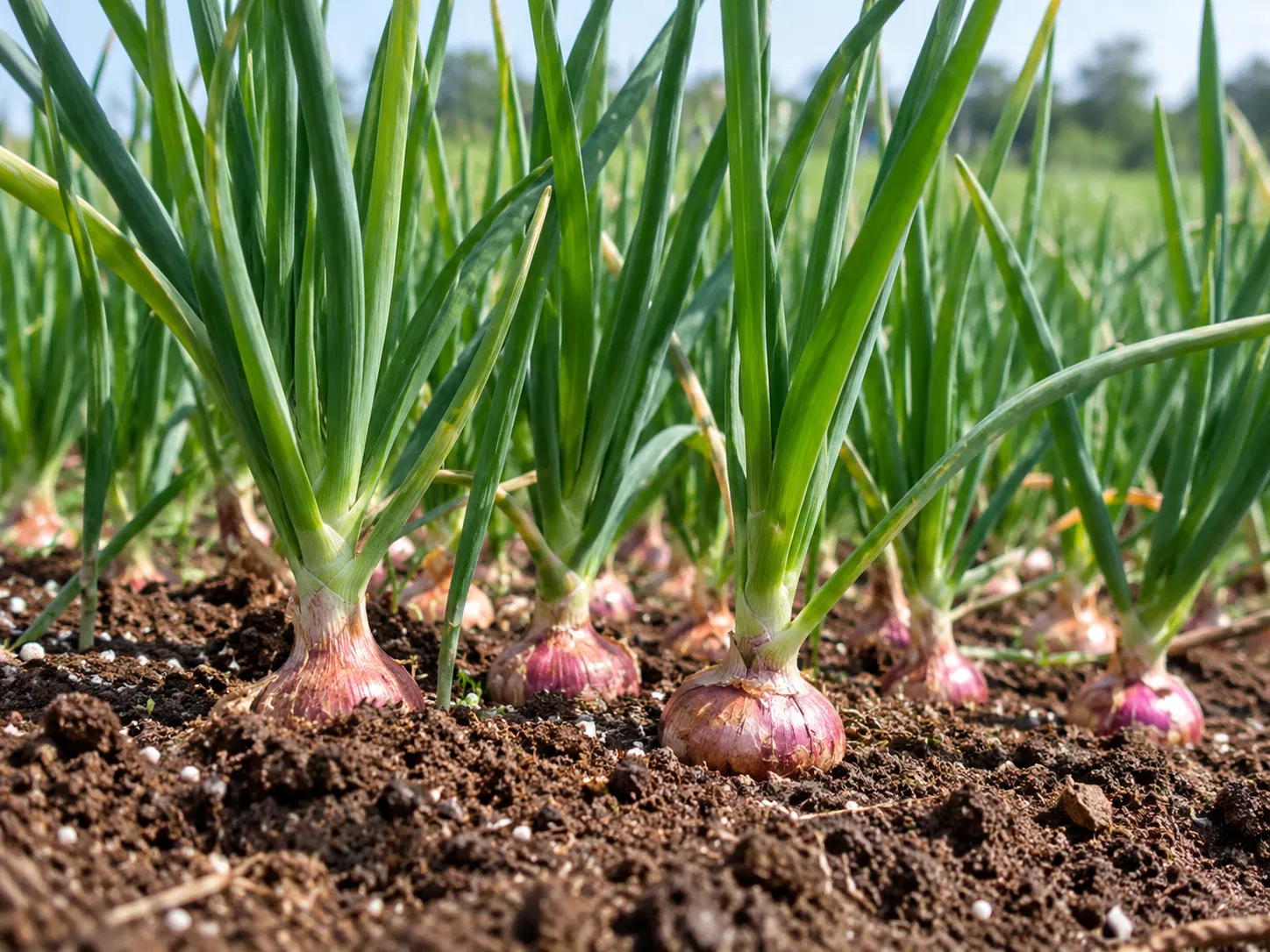
Onion is a crop where feeding mistakes show up months after harvest. A bulb with a thick green neck that never closes, a store full of black mould by June, leaves that blotch within a week of cloudy weather: farmers often blame the fungicide, but all three usually started in the fertiliser bag. Onion builds its bulb from a small root system in a short season, so a plant fed nitrogen too late, or short of potassium, sulphur or calcium, has no time to recover. Balanced nutrition builds tough leaves that thrips and blight fungi find harder to enter, a neck that seals before harvest, and firm scales that keep rot out in storage. This guide explains which nutrients matter for disease resistance in onion, what goes wrong when they are out of balance, and how to feed the crop stage by stage.
How Does Nutrition Affect Disease Resistance in Onion?
Nutrients shape an onion plant's defences in three ways: they decide how waxy the leaf surface and how firm the bulb scales become, they control how much sugar and free amino acid sits in the sap for thrips and leaf fungi to feed on, and they drive the root growth and soil life that keep basal rot and damping off in check. A balanced supply generally gives a plant that is harder to enter, less attractive to thrips and quicker to seal its neck at maturity; an unbalanced one, usually too much nitrogen too late with too little potassium and sulphur, does the reverse whatever is sprayed on top.
Nutrients and the Onion Problems They Influence
| Nutrient | Role in resistance | When out of balance |
| Nitrogen (N) | Builds the leaf area that fills the bulb; excess or late supply makes soft, dense growth | High or late nitrogen generally invites thrips and leaf blights, delays maturity, gives thick necks and storage rot |
| Phosphorus (P) | Root growth and early establishment of the shallow onion root system | Weak roots; slow recovery from damping off and transplant shock |
| Potassium (K) | Thickens cell walls, tightens stomata, moves sugars into the bulb, firms the scales | Deficiency favours leaf blights and basal rot; bulbs are soft, light and keep poorly |
| Sulphur (S) | Onion builds its pungent defence compounds from sulphur; firms scales and improves keeping | Pale, thin leaves and mild bulbs that rot and sprout early in store |
| Calcium (Ca) | Cements cell walls; firm neck and outer scales | Tip dieback of young leaves, soft necks and scales that let neck rot and black mould in |
| Boron (B) | Works with calcium in cell walls and in bulb filling | Brittle, mottled young leaves, hollow or cracked bulbs that split and rot |
| Zinc, copper, manganese | Drive the enzymes that build lignin and the waxy leaf coat; copper firms and colours the skin | Twisted leaves (zinc), pale thin skins that peel and rot (copper), weak defence chemistry |
| Soil pH and organic matter | pH 6 to 7.5 keeps nutrients available; FYM feeds microbes that compete with rot fungi | Depleted soils at the wrong pH lock up nutrients and see damping off and basal rot build up |
Nitrogen: Enough to Fill the Bulb, Finished Before It Forms
Onion needs a strong set of leaves before bulbing, because every leaf becomes a ring in the bulb, so nitrogen cannot be skimped early. Beyond the recommended dose, and especially when applied late, every extra bag produces soft, dark, crowded leaves that stay wet with dew till midday, exactly what purple blotch and Stemphylium want, and the sappy tissue thrips settle on first. Late nitrogen also keeps the plant growing when it should be maturing, giving thick green necks that never close and bulbs that rot in store. Apply it in splits, roughly half as a basal dose and the rest in two top dressings around 30 and 45 days after transplanting, and finish all nitrogen before bulbing begins, generally by 60 days. If the crop looks lush and dark while bulbs are late, ease off rather than add more.
Potassium: The Keeping-Quality Nutrient
Potassium is generally the nutrient that most improves an onion plant's ability to withstand leaf blights and to store well afterwards. It thickens cell walls, helps the plant close its stomata against invading fungi and moves sugars from the leaves into the bulb rather than leaving them in the sap. Fields fed urea alone season after season run short of potash, which shows as scorched leaf tips and small, soft bulbs before disease pressure becomes obvious. Potash belongs in the basal dose in full, and a soil test every two or three years shows whether the field is running low; a foliar potassium spray at bulb development may help where bulbs have been soft in earlier seasons.
Sulphur: The Nutrient Onion Cannot Do Without
No crop depends on sulphur the way onion does. The compounds that give onion its pungency are built from sulphur, and they are also part of the plant's chemical defence against fungi and insects. A sulphur-short crop has pale, thin leaves and mild bulbs that rot and sprout early in storage; the shortage is common on sandy, low-organic soils and in fields fed only urea and DAP, which carry none. Applying 30 to 45 kg of sulphur per hectare through gypsum, elemental sulphur or a sulphur-containing fertiliser before transplanting generally improves yield, firms the scales and cuts storage loss. Treat it as part of the basal dose, not an afterthought.
Calcium and Boron: Firm Scales and a Closed Neck
Calcium cements the cell walls that potassium builds; without enough of it the neck stays soft and the outer scales bruise easily, which neck rot and black mould exploit within weeks of harvest. Boron works alongside calcium in bulb filling; short of it, young leaves turn brittle and mottled and bulbs can crack or hollow, opening the way to rot. Both are most often short on light, alkaline or heavily limed soils and in dry spells. Gypsum covers calcium in most fields; boron is applied on a soil test or past symptoms, generally as a light foliar spray during bulb development, since too much is toxic. Suitable products are grouped under micronutrient fertilisers.
Zinc, Copper and Manganese
Zinc, copper and manganese drive the enzymes that build lignin, the waxy leaf coat and the defence chemicals that make onion leaves hard for thrips and fungi to breach, so hidden deficiencies lower resistance even when leaves look green. Zinc deficiency, common on alkaline soils, shows as twisted, stunted leaves; copper deficiency gives pale, thin skins that peel in store; manganese shortage shows as pale striping between the veins. Where FYM is applied in good quantity these deficiencies are seldom seen; where they appear, a soil-test-based micronutrient mix sprayed at 30 and 45 days after transplanting generally corrects them.
Soil pH, Organic Matter and Soil Biology
Onion takes up nutrients best between pH 6 and 7.5, with sulphur, zinc and boron becoming scarce on the alkaline side and calcium on the acidic side, so a soil test is the first step in any nutrition plan. Well-decomposed FYM at 20 to 25 tonnes per hectare, worked in a month before transplanting, feeds the microbes that compete with damping off and basal rot organisms, supplies most micronutrients and improves the drainage that Fusarium dislikes. Enriching FYM with Trichoderma such as IPL Sanjeevni Bio Fungicide adds a basal rot antagonist, and Azotobacter and phosphorus-solubilising bacteria in the same FYM reduce the fertiliser the crop needs. Neem cake at the last ploughing supplies slow nitrogen while checking grubs; other soil-life inputs are listed under bio fertilisers.
A Practical Feeding Plan for Disease-Resistant Onion
| Stage | What to do |
| Nursery | Well-rotted FYM and a light basal dose in raised beds; Trichoderma seed treatment; no heavy nitrogen, which gives soft seedlings |
| Land preparation | Soil test for pH, potash, sulphur, zinc and boron; FYM enriched with Trichoderma and bio-fertilisers; neem cake; gypsum or sulphur where the test is low |
| Transplanting | Basal dose with full phosphorus, potash and sulphur and about half the nitrogen |
| 30 and 45 days after transplanting | Remaining nitrogen in two equal top dressings; foliar zinc and micronutrients if symptoms or soil test call for them |
| Bulb development (60 days onward) | No further nitrogen; foliar potassium, calcium or boron where soft bulbs, soft necks or cracking have occurred before; even, light irrigation |
| Maturity to harvest | Stop irrigation 10 to 15 days before harvest, lift at neck fall, cure thoroughly and cut necks properly |
Nutrition is one leg of the stool; pair it with treated seed, rotation and the spray timing in the guide on purple blotch in onion, since thrips feeding opens the wounds that blotch and blight use. Sowing windows and spacing are in the onion cultivation guide.
Conclusion
An onion crop fed in balance defends itself twice: in the field, where tough, sulphur-rich leaves and a dry canopy slow thrips and leaf blights, and in the store, where a closed neck and firm, potassium-rich scales keep black mould and neck rot out. Test the soil, build it with FYM and bio-agents, give potash and sulphur in full at transplanting, split the nitrogen and finish it before bulbing, correct zinc, boron and calcium only on evidence, and cure the crop well. Farmers who feed this way generally spray less, lose fewer bulbs in storage and sell a firmer onion.
Frequently Asked Questions
1. Does too much nitrogen cause more disease in onion?
Generally yes. It gives soft, dense leaves that thrips and blight fungi attack, thick necks that never close and bulbs that rot in store.
2. When should the last nitrogen be given to onion?
By about 60 days after transplanting, before bulbing starts. Nitrogen after this delays maturity and weakens storage.
3. Which nutrient is most important for disease resistance in onion?
Potassium for tough leaves and firm bulbs, and sulphur for the plant's own defence compounds. Both belong in the basal dose.
4. Why is sulphur so important for onion?
Onion builds its pungent, protective compounds from sulphur; a sulphur-short crop gives pale leaves and mild bulbs that rot and sprout early.
5. Can fertilisers cure purple blotch or basal rot?
No. They reduce the soft growth and weak roots these diseases exploit, but sprays, treated seed and rotation are still needed.
6. Why does my onion get a thick neck and rot in storage?
Usually late or excess nitrogen, sometimes with low potassium or calcium. Finish nitrogen early and cure the bulbs well.
7. Is FYM enough to feed onion?
No. It builds soil life and supplies micronutrients, but it is low in available potash and sulphur, so pair it with a soil-test-based fertiliser dose.
8. Should micronutrients be sprayed on every onion crop?
Only on a soil test or visible symptoms. Where enough FYM is applied, zinc, boron and copper deficiencies are generally not seen.
Disclaimer: Fertiliser, sulphur and micronutrient needs in onion vary with soil type, season and variety, so the practices here should be adjusted to a soil test and local recommendations. Consult your local agricultural officer or a qualified agronomist before changing your nutrition programme, and follow the label for any micronutrient or bio-input used.