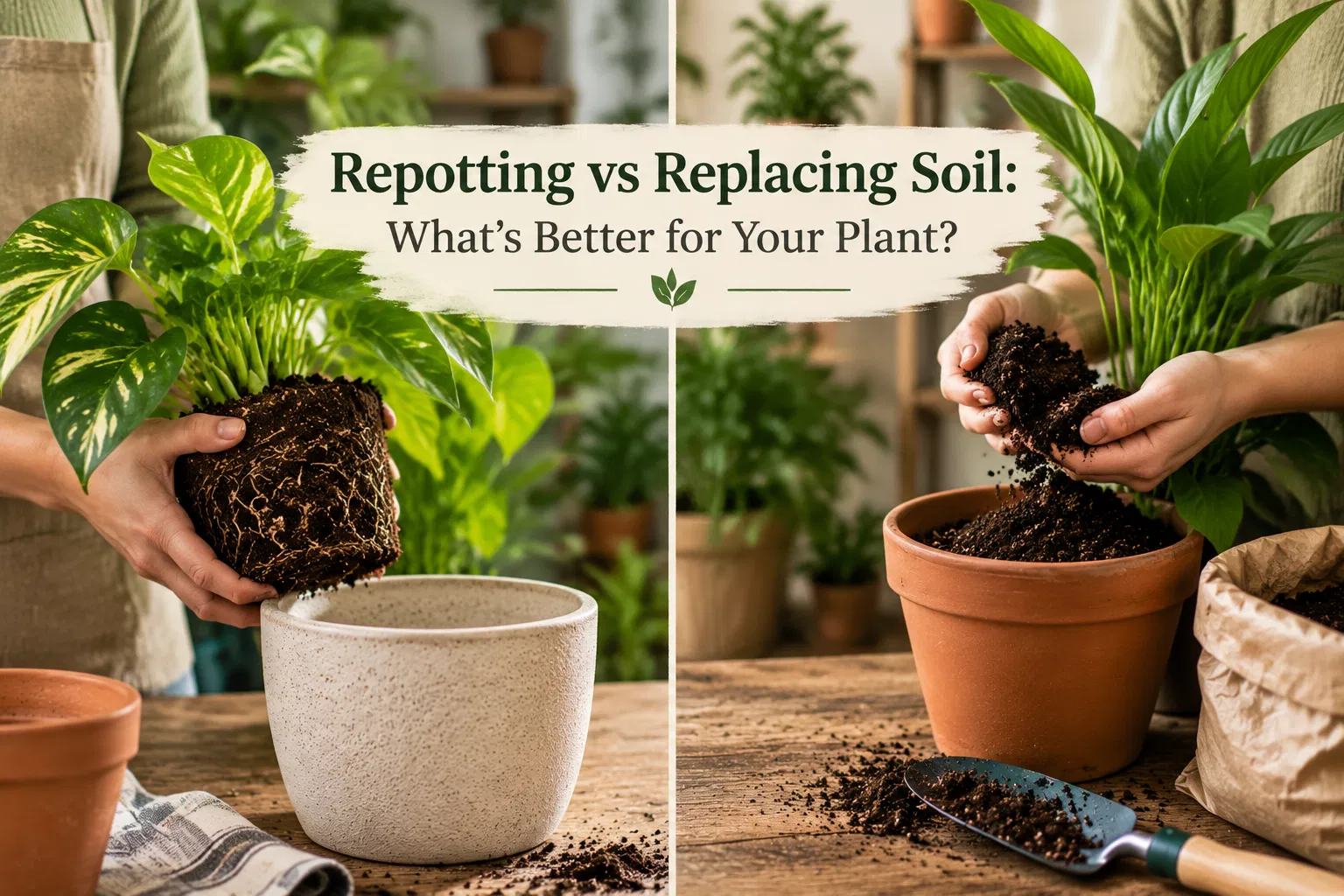
Not every plant that's struggling needs a bigger pot. Sometimes the container is perfectly fine and it's the soil inside it that's exhausted, compacted, or contaminated — and swapping that out is a smaller, less disruptive fix than a full repot. Here's how to tell which one your plant actually needs.
What Each Term Actually Means
Repotting means moving the plant into a different (usually larger) container, typically with fresh soil as part of the process. It addresses a genuine space constraint — the root system has outgrown what it's in.
Replacing soil (also called a soil refresh or soil swap) means removing and replacing the growing medium while keeping the plant in the same pot. It addresses a soil-quality problem rather than a space problem.
Side-by-Side: Which One Fixes What
| Situation | Best Fix |
|---|---|
| Roots circling the pot or emerging from drainage holes | Repot into a larger container |
| Pot size is fine, but soil is compacted or smells sour | Replace soil, same pot |
| Plant is root-bound and growth has stalled | Repot into a larger container |
| Soil has visible pests, mold, or fungus gnats | Replace soil, same pot |
| Plant prefers being slightly snug (snake plant, some succulents) | Replace soil, same pot, unless clearly overcrowded |
| Salt buildup from tap water or fertilizer (white crust on soil/pot) | Replace soil, same pot |
| Recovering from root rot | Repot into a clean pot with fresh soil (smaller if roots were significantly trimmed) |
Why Soil Quality Declines Even Without Root Crowding
Organic components in potting mix, particularly cocopeat and any compost content, break down over time and lose structure, reducing aeration around the roots. Repeated watering also causes mineral salts from tap water and fertilizer to accumulate, which can interfere with nutrient uptake even when the plant still has plenty of room to grow. Neither issue is solved by more fertilizer — the medium itself needs replacing.
Why Choose a Soil Refresh Over a Full Repot
- Less root disturbance: A soil-only refresh, done carefully, disturbs roots less than a full repot into a different container.
- No pot-size guesswork: If the current pot is genuinely the right size, there's no benefit to sizing up just to justify a soil change.
- Faster recovery: Plants that are sensitive to being moved (some orchids, certain aroids) often bounce back faster from a soil swap than a full repot.
How to Do a Soil Refresh Properly
- Gently remove the plant from its pot and shake or brush off as much old soil from the roots as possible without forcing it.
- Inspect the roots — trim any dead, mushy, or clearly rotten sections with a clean, sharp tool.
- Clean the pot if reusing it, especially if the old soil showed pests, mold, or salt crust.
- Refill with a fresh potting mix and cocopeat blend suited to the plant's needs, position the plant at the same depth as before, and firm gently.
- Water lightly to settle the soil, and hold off on fertilizer for 1–2 weeks to let any root handling settle.
When to Choose Repotting Instead
If the roots are genuinely constrained — visibly circling, pushing against the pot walls, or emerging from drainage holes — a soil refresh alone won't solve the underlying space problem. In that case, move up one pot size as part of the process, since simply changing soil in a pot that's already too small just delays the same issue.
Frequently Asked Questions
Can I replace the soil without repotting every plant?
Only if the pot size is still adequate for the root system — if roots are visibly crowded, a soil-only refresh won't fix the underlying space constraint.
How often should I refresh soil without repotting?
Roughly every 12–18 months for most container plants, sooner if you notice compaction, salt buildup, or a sour smell.
Is a soil refresh less stressful for the plant than repotting?
Generally yes, since the plant stays in a familiar container and root handling can be minimized, though some root disturbance is unavoidable either way.
Disclaimer: General guidance for common indoor and container plants; the right choice depends on the specific plant's root sensitivity and current growing conditions.