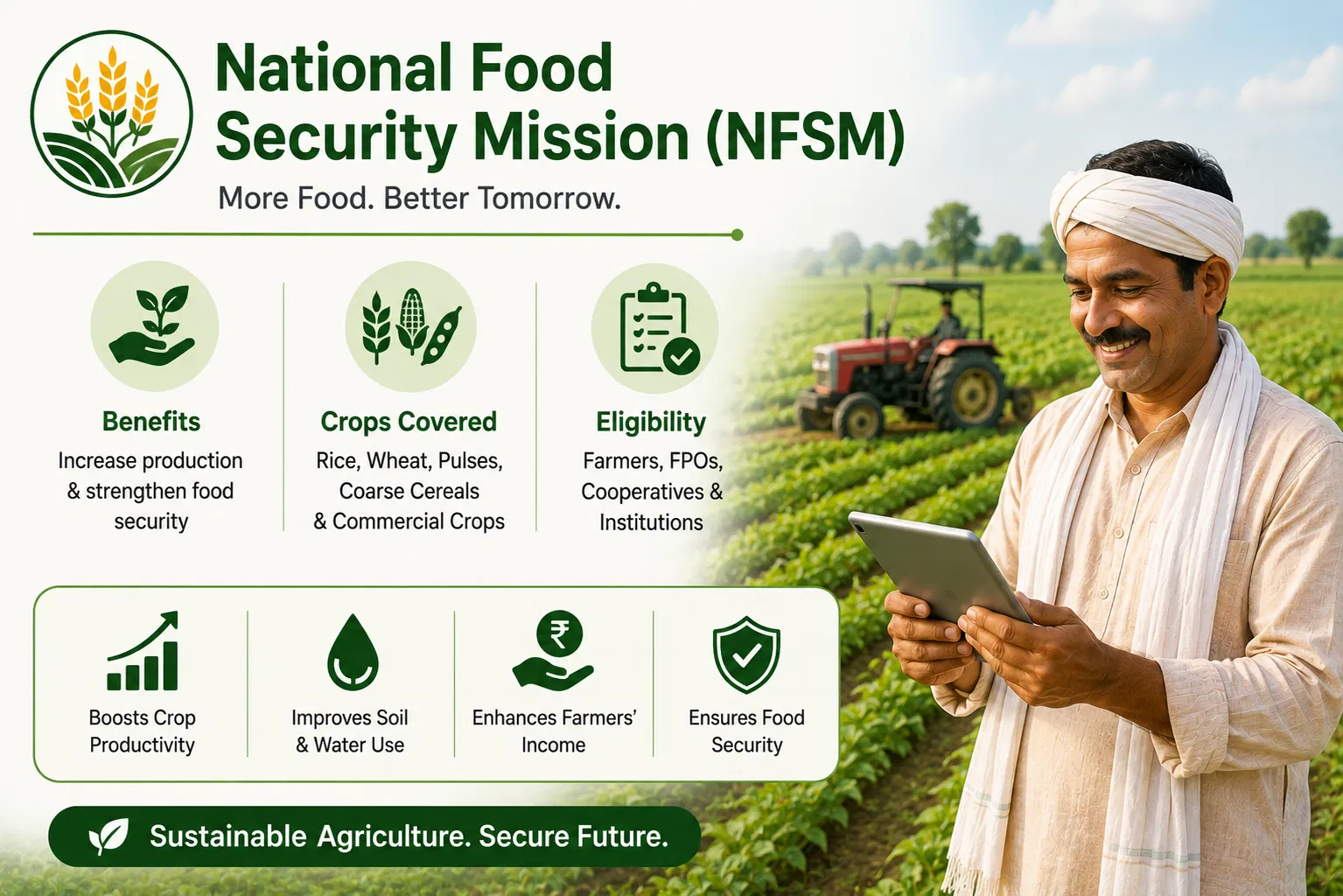
The National Food Security Mission (NFSM) was launched by the Government of India in 2007-08 through the National Development Council, with the core aim of increasing the production of rice, wheat, and pulses in a sustainable way, without degrading soil health or natural resources. It was introduced to bridge the yield gap between what Indian farms could produce and what they were actually producing, by pushing improved seeds, better technology, and sound farm management practices down to the district level. From 2024-25, the mission was renamed the National Food Security & Nutrition Mission (NFSNM) to place greater emphasis on nutrition outcomes alongside food-grain output, though it continues to be widely referred to as NFSM.
NFSM Scheme Overview
- Scheme Name – National Food Security Mission (NFSM), renamed National Food Security & Nutrition Mission (NFSNM) from 2024-25
- Scheme Launch/Modification Date – Launched 2007-08; renamed and refocused on nutrition outcomes from 2024-25
- Scheme Fund Allocated – Centrally Sponsored Scheme, jointly funded by the Centre and states; district-wise and component-wise funds are released annually based on approved State Action Plans
- Type of Scheme – Central Government (Centrally Sponsored Scheme), implemented by the Department of Agriculture and Farmers Welfare through State Governments
- Helpline No – Kisan Call Centre, 1800-180-1551; farmers can also contact their district's Rural Agricultural Extension Officer or nearest Krishi Vigyan Kendra (KVK)
- States Covered – All-India, implemented in identified districts covered under NFSM/NFSNM guidelines, with additional coverage for all Jowar-, Bajra-, Ragi-, and Small-Millet-growing states under NFSM-Nutri-Cereals
Objectives of the Scheme
- Increase the production and productivity of rice, wheat, pulses, and coarse/nutri cereals on a sustainable basis
- Bridge the yield gap through dissemination of improved technologies and farm management practices
- Restore and maintain soil health and fertility at the farm level
- Raise farmers' income through enhanced technology adoption and better farm practices
- Create employment opportunities and strengthen food security at the district and national level
Crops Covered Under NFSM
- Food grain crops – Rice, wheat, and pulses
- Coarse cereals / Nutri-Cereals – Jowar, Bajra, Ragi, and Small Millets
- Commercial crops – Cotton, Jute, and Sugarcane
- Oilseeds and Oil Palm – Covered under the NFSM-Oilseeds and Oil Palm component
- Supported through five major components: NFSM-Food Grain Crops, NFSM-Coarse Cereals, NFSM-Commercial Crops, NFSM-Oilseeds and Oil Palm, and the NFSM-Seed Village Programme
Key Features of NFSM
- Front Line and Cluster Front Line Demonstrations (FLDs/CFLDs) showcase improved technologies; a sole-crop demonstration on one hectare earns ₹9,000, a cropping-system-based demonstration earns ₹15,000, and coarse cereal demonstrations earn ₹6,000 per hectare
- Seed subsidy is provided for distribution of high-yielding and hybrid varieties, generally limited to 2 hectares per farmer, with rates such as ₹50 per kg (or 50% of cost, whichever is less) for newer varieties and ₹10 per kg for varieties older than 10 years
- Fertiliser assistance is capped at a maximum of 2 hectares for rice, wheat, and pulses
- Support extends to Integrated Pest Management (IPM), Integrated Nutrient Management (INM), bio-pesticides, micronutrients, and bio-fertilisers
- Assistance is also available for irrigation equipment (like sprinkler and pipeline sets) and hand-operated or power-driven farm machinery
- The Seed Village Programme supports production of quality seeds at the village level to improve local seed availability
- Beneficiary selection is done transparently through Gram Panchayats and Panchayati Raj Institutions, prioritising farmers willing to contribute some of their own resources
- Funds flow from the Centre to State Governments (on NFSM Executive Committee approval), then to State and District Level Agencies, and finally to the beneficiary through PFMS/Treasury and Direct Benefit Transfer (DBT) where applicable
NFSM Benefits to Farmers
- Access to high-yielding and hybrid seed varieties at subsidised rates
- Financial support for fertilisers, bio-pesticides, and nutrient management to improve soil health
- Hands-on exposure to improved farming techniques through cluster and front-line demonstrations
- Support for irrigation equipment and farm machinery that improve efficiency and reduce input costs
- Capacity building through crop-based training organised with Krishi Vigyan Kendras (KVKs)
- Special allocations and support for Scheduled Castes, Scheduled Tribes, women farmers, and Forest Rights Act (FRA) patta holders, where applicable
Eligibility for NFSM
- Must be a farmer cultivating an NFSM-notified crop in a district covered under the scheme
- Farmers of all categories are eligible — small, marginal, women, and SC/ST farmers, with no exclusion based on landholding size
- Must have proof of land ownership or cultivation, such as land records, khasra, or survey number documentation
- Must provide identity proof (Aadhaar) and bank account details for benefit transfer
- Willingness to contribute some of one's own resources is generally preferred in the participatory beneficiary selection process
Limitations of the Scheme
- Seed and fertiliser subsidy benefits are generally capped at 2 hectares per farmer, regardless of larger landholding size
- Coverage is limited to identified NFSM/NFSNM districts and notified crops — farmers outside these districts or growing non-notified crops may not be eligible
- Beneficiary selection depends on Gram Panchayat-level processes, which can vary in speed and transparency across regions
- Official guidance on SHG and FPO eligibility is not always clearly listed, creating some ambiguity for group applicants
- Fund flow through multiple levels (Centre to State to District to beneficiary) can add processing time before assistance reaches farmers
Documents Required
- Aadhaar Card
- Land records (such as B1/Khasra or survey number, or irrigation certificate where applicable)
- Bank passbook copy
- Passport-size photograph
- Caste certificate, where applying under SC/ST category benefits
How to Apply for NFSM Benefits
- Confirm with your district's Rural Agricultural Extension Officer or Krishi Vigyan Kendra (KVK) whether your area and crop are covered under NFSM/NFSNM.
- Gather the required documents: Aadhaar card, land records, bank passbook, and photograph.
- Apply through your Gram Panchayat or the relevant State Agriculture Department scheme portal (some states, like Madhya Pradesh, use dedicated e-Krishi Yantra portals for equipment-related components).
- Beneficiary selection is done in a participatory, transparent manner involving the Gram Panchayat and Panchayati Raj Institutions.
- Once selected, funds or input assistance are released through the District Level Agency, often via Direct Benefit Transfer to your bank account.
- Participate in any associated demonstrations or training organised with Krishi Vigyan Kendras to make full use of the scheme's technical support.
Conclusion
NFSM (now NFSNM) remains one of India's foundational agricultural schemes, working quietly at the district level to close the gap between a farm's potential yield and what it actually produces. By combining subsidised seeds, fertiliser support, demonstrations, and machinery assistance, it gives farmers — especially small and marginal ones — practical tools to grow more rice, wheat, pulses, and other essential crops sustainably. With its renewed focus on nutrition from 2024-25, the mission is positioned to support not just food quantity but food quality across the country.
Disclaimer: This article is for informational purposes only. Scheme details, interest rates, and subvention amounts are subject to periodic revision by the Government of India, RBI, and NABARD. Farmers are advised to verify the latest terms and eligibility criteria with their bank, NABARD, or official government sources before applying.