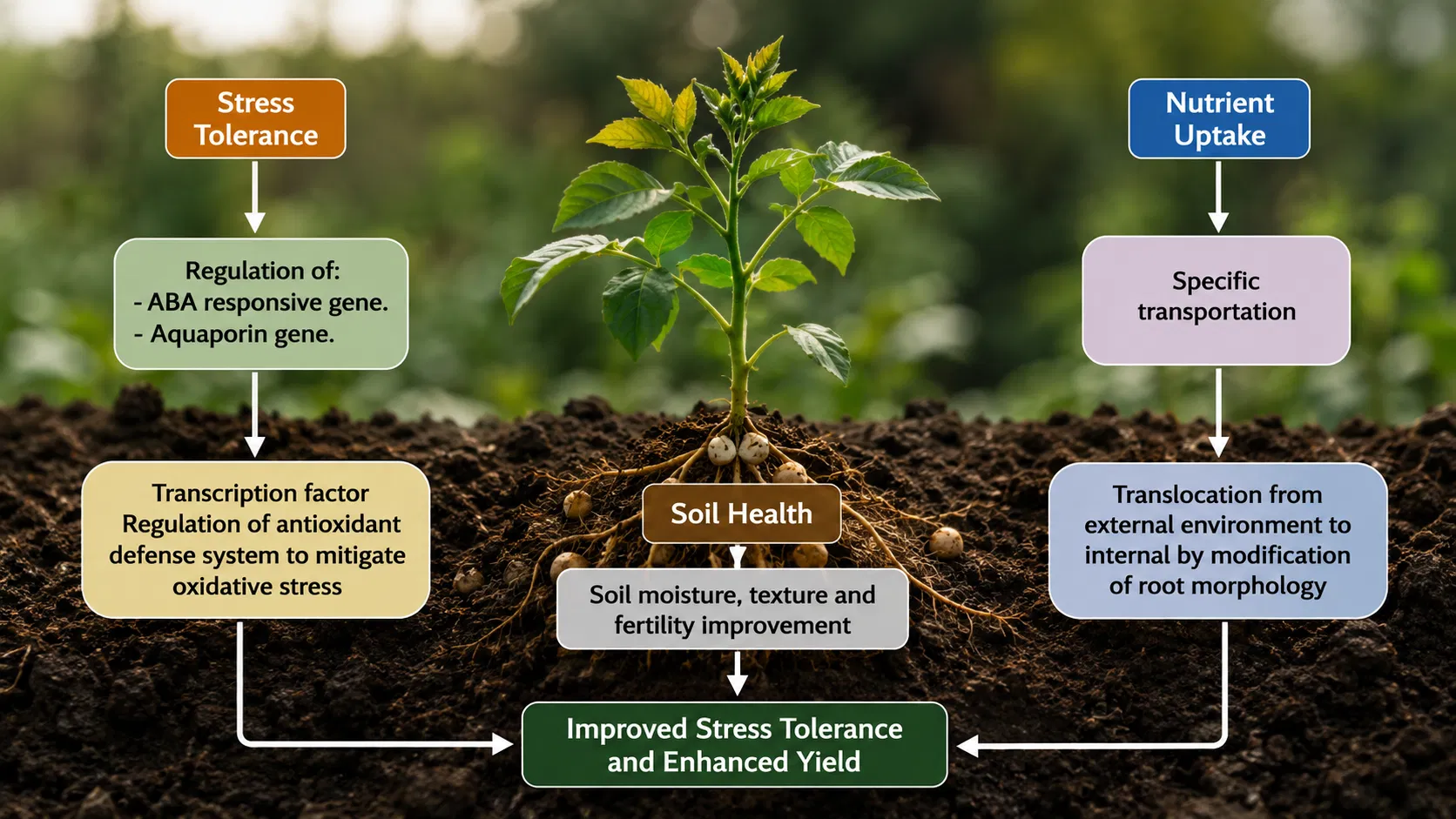
Drought stress begins when roots cannot supply water fast enough to meet plant demand. Mycorrhizal fungi help by extending fine hyphae beyond the root surface and exploring soil pores that roots cannot easily enter.
Mycorrhizal inoculants are commonly sold as bio-fertilizers for nurseries, transplanting, horticulture, and field crops.
How the Fungal Network Extends Root Reach
Hyphae are finer than roots and enter small pores containing water and nutrients. This increases the effective volume of soil explored by the plant-fungus partnership.
How Mycorrhiza Supports Root Growth
Improved phosphorus uptake can support early root development and establishment. The fungus does not replace roots, but it increases the functional reach of the root system.
- Greater root-zone exploration
- Improved transplant survival
- Better nutrient uptake
- Stronger root-to-shoot balance
- Improved association with beneficial soil organisms
How Mycorrhiza Helps During Drought
Improved Access to Water
Hyphae can explore beyond the immediate root-depletion zone and may help plants access small quantities of water as the soil dries.
Better Soil Aggregation
Fungal networks help bind soil particles. Stable aggregates improve infiltration, pore structure, and water storage.
Improved Nutrient Status
Drought slows nutrient movement. Mycorrhiza may help maintain phosphorus and micronutrients uptake under moderate stress.
Mycorrhiza Does Not Replace Irrigation
Mycorrhizal fungi can improve water-use efficiency, but they cannot protect crops indefinitely after soil moisture is exhausted. Good irrigation scheduling remains essential.
The greatest benefit is often under moderate stress, where improved soil exploration delays damage and supports recovery. Under extreme drought, both roots and fungi become less active.
Best Conditions for Colonisation
- Moderate soil moisture
- Healthy roots
- Compatible crop and fungal species
- Low to moderate available phosphorus
- Adequate organic matter
- Direct root contact
Role of Organic Matter
Mature compost supports aggregation, moisture retention, and biological activity. It does not automatically contain the required mycorrhizal strain, but it improves the environment around roots.
Application Methods
- Mix into nursery media.
- Place in the transplanting hole.
- Apply near the seed row.
- Place around active feeder roots.
Surface broadcasting may be ineffective when the inoculant cannot reach living roots.
Phosphorus Management
Very high phosphorus availability can suppress colonisation. Use balanced fertilizers according to soil testing rather than applying excessive phosphorus.
Compatibility With Fungicides
Some fungicides reduce fungal survival. Check compatibility and application sequence. Do not assume that every biological and chemical product can be mixed safely.
Factors That Limit Drought Benefits
- Severe or prolonged drought
- Waterlogged soil
- Excessive phosphorus
- High salinity
- Root disease
- Incompatible fungicides
- Poor inoculant storage
- Application without root contact
How to Evaluate Performance
Compare treated and untreated areas under the same conditions. Monitor establishment, root growth, wilting, recovery after irrigation, yield, and water-use efficiency. Root staining or laboratory analysis can confirm colonisation.
Final Thoughts
Mycorrhizal fungi improve the functional reach of roots and may help crops use water and nutrients more efficiently. They work best as part of a complete system that includes healthy soil, balanced nutrition, organic matter, suitable irrigation, and careful chemical use.