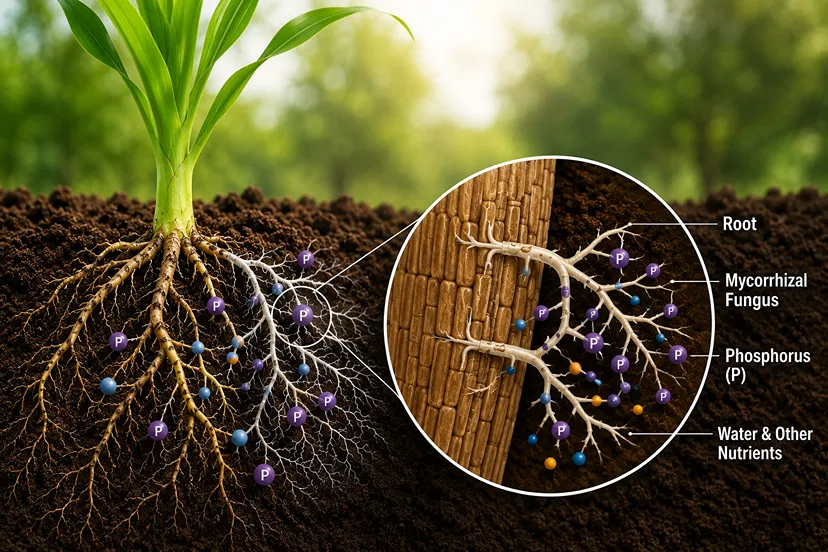
Mycorrhiza is a beneficial partnership between certain fungi and plant roots. The fungi receive sugars from the plant, while fine hyphae extend beyond the root surface and help the crop access water and nutrients.
Mycorrhizal products are often grouped with bio-fertilizers because they improve biological nutrient uptake rather than directly supplying large nutrient quantities.
What Is Mycorrhiza?
The word means fungus-root. Mycorrhizal fungi colonise roots and create a network of microscopic filaments in the surrounding soil. This network explores pores that normal roots cannot easily reach.
Main Types
Arbuscular Mycorrhiza
Arbuscular mycorrhizal fungi colonise many agricultural and horticultural crops. They form structures inside root cells where nutrient exchange occurs.
Ectomycorrhiza
Ectomycorrhizal fungi form a sheath around roots and are common in many forest trees.
How Mycorrhiza Feeds Plants
Fungal hyphae increase the effective absorbing area of the root system. They are especially important for phosphorus, zinc, copper, and water.
Role in Phosphorus Uptake
Phosphorus moves slowly in soil and may become fixed near the point of application. Mycorrhizal hyphae explore a larger soil volume and transport phosphorus back to roots.
Very high phosphorus application can reduce colonisation. Balanced fertilizers should therefore be used according to soil tests.
Root and Crop Benefits
- Improved transplant establishment
- Greater soil exploration
- Better nutrient uptake
- More efficient moisture use
- Improved root-zone biological activity
Micronutrient Uptake
Mycorrhiza can improve the uptake of zinc, copper, and other micronutrients. It is most useful when the soil contains these nutrients but their movement to roots is limited.
Effect on Soil Structure
Fungal hyphae help bind soil particles into aggregates. Better aggregation improves pore space, aeration, infiltration, and resistance to erosion.
Adding mature compost and reducing unnecessary disturbance can support mycorrhizal networks and wider soil biological activity.
Application Methods
- Place granules in the planting hole.
- Mix inoculant into nursery media.
- Apply near seed rows.
- Dip roots before transplanting.
- Place around active roots according to the label.
The inoculant must contact living roots. Broadcasting far from roots reduces the chance of colonisation.
Water Management
Moderate moisture supports fungal activity and root growth. Good irrigation management is important after application. Dry soil limits establishment, while waterlogging reduces oxygen and damages roots.
Compatibility With Fungicides
Some fungicides suppress mycorrhizal fungi. Check compatibility and timing before seed or soil treatment. Do not mix products unless the label confirms safety.
Factors That Reduce Performance
- Very high phosphorus
- Waterlogging
- Severe drought after application
- Incompatible fungicides
- Expired product
- Poor root contact
- Extreme pH or salinity
Can Mycorrhiza Replace Fertilizer?
Mycorrhiza improves nutrient access but cannot create minerals where soil reserves are critically low. It works best within integrated nutrient management that includes organic matter, balanced nutrition, healthy roots, and suitable moisture.
Final Thoughts
Mycorrhizal fungi act as biological extensions of roots. Under suitable conditions, they improve access to phosphorus, water, and selected nutrients while supporting soil aggregation and sustainable crop growth.