Updated on: 13 October 2026
Latest update
- The Union Cabinet approved the new Rabi MSP for 2027-28 on 30 September 2026. Wheat MSP is now ₹2,610 per quintal (up ₹25) and mustard MSP is ₹6,613 per quintal (up ₹413).
- Paddy procurement at MSP started in Haryana on 29 September 2026 and in Punjab on 1 October 2026.
- Paddy MSP for Kharif 2026-27 is ₹2,441 per quintal for Common paddy and ₹2,461 per quintal for Grade A paddy.
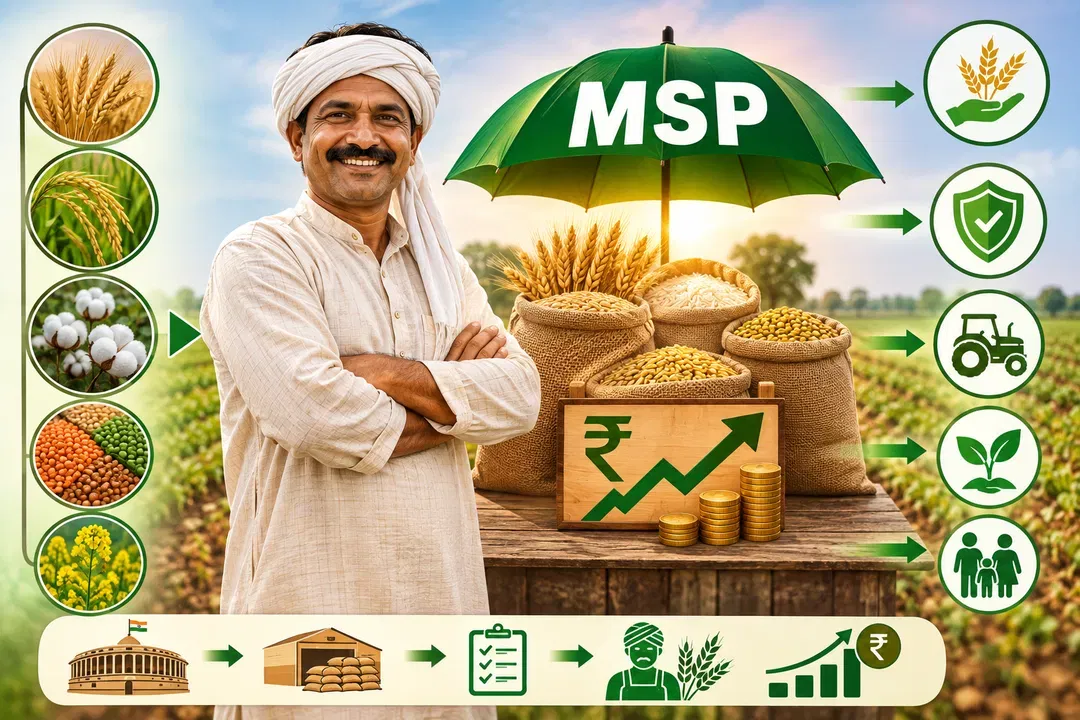
The Cabinet Committee on Economic Affairs (CCEA) approves Minimum Support Prices (MSP) twice a year — once for Kharif crops and once for Rabi crops — based on recommendations from the Commission for Agricultural Costs and Prices (CACP). For the 2026-27 marketing season, the CCEA approved the Rabi MSP hike on 1 October 2025 and the Kharif MSP hike on 13 May 2026. Both rounds continued the government's stated approach of pricing crops at least 1.5 times their All-India weighted average cost of production, with particularly strong increases again favouring pulses, oilseeds, and nutri-cereals (Shree Anna) over traditional cereals.
MSP 2026-27 at a Glance: Most Searched Crops
Here are the latest MSP rates for the crops farmers check most often. Full crop-wise tables are given below.
| Crop | Latest MSP (₹ per quintal) | Season |
| Paddy (Dhan) | ₹2,441 (Common), ₹2,461 (Grade A) | Kharif 2026-27 |
| Wheat (Gehu) | ₹2,610 | Rabi 2027-28 (new) |
| Soybean (Yellow) | ₹5,708 | Kharif 2026-27 |
| Bajra | ₹2,900 | Kharif 2026-27 |
| Cotton (Kapas), Medium Staple | ₹8,267 | Kharif 2026-27 |
| Moong | ₹8,780 | Kharif 2026-27 |
MSP 2026-27 Overview
- Rabi MSP 2026-27 Approved – 1 October 2025, by the CCEA chaired by Prime Minister Narendra Modi
- Kharif MSP 2026-27 Approved – 13 May 2026, by the CCEA
- Total Crops Covered – 22 mandated crops: 14 Kharif, 6 Rabi, and 2 commercial crops (sugarcane is priced separately via Fair and Remunerative Price, not MSP)
- Estimated Kharif 2026-27 Payout – Around ₹2.6 lakh crore to farmers, with an estimated 824 lakh metric tonnes of Kharif crops to be procured
- Type – Central Government price-support mechanism, procured through FCI (paddy/wheat), NAFED and similar bodies (pulses/oilseeds), and state agencies
- Helpline No – Kisan Call Centre, 1800-180-1551, for procurement-related queries
- States Covered – All-India, though physical procurement infrastructure and volumes vary significantly by state and crop
Kharif MSP 2026-27 (₹ per quintal)
| Crop | MSP 2026-27 | MSP 2025-26 | Increase | Margin over Cost |
| Paddy Common (Dhan) | ₹2,441 | ₹2,369 | ₹72 | 50% |
| Paddy Grade A (Dhan) | ₹2,461 | ₹2,389 | ₹72 | NA |
| Jowar Hybrid | ₹4,023 | ₹3,699 | ₹324 | 50% |
| Jowar Maldandi | ₹4,073 | ₹3,749 | ₹324 | NA |
| Bajra | ₹2,900 | ₹2,775 | ₹125 | 56% |
| Ragi (Nachni) | ₹5,205 | ₹4,886 | ₹319 | 50% |
| Maize (Makka) | ₹2,410 | ₹2,400 | ₹10 | 56% |
| Tur (Arhar) | ₹8,450 | ₹8,000 | ₹450 | 54% |
| Moong | ₹8,780 | ₹8,768 | ₹12 | 61% |
| Urad | ₹8,200 | ₹7,800 | ₹400 | About 50% |
| Groundnut (Moongphali) | ₹7,517 | ₹7,263 | ₹254 | About 50% |
| Sunflower Seed (Surajmukhi) | ₹8,343 | ₹7,721 | ₹622 | About 50% |
| Soybean Yellow | ₹5,708 | ₹5,328 | ₹380 | About 50% |
| Sesamum (Til) | ₹10,346 | ₹9,846 | ₹500 | About 50% |
| Nigerseed (Ramtil) | ₹10,052 | ₹9,537 | ₹515 | About 50% |
| Cotton Medium Staple (Kapas) | ₹8,267 | ₹7,710 | ₹557 | About 50% |
| Cotton Long Staple (Kapas) | ₹8,667 | ₹8,110 | ₹557 | About 50% |
Kharif MSP in ₹ per quintal, approved on 13 May 2026.
Figures per official CCEA/PIB announcements (13 May 2026) for Kharif Marketing Season 2026-27. Moong shows the highest expected farmer margin at 61%, followed by bajra and maize at 56% each, and tur/arhar at 54%.
Rabi MSP 2027-28 and 2026-27 (₹ per quintal)
The Cabinet approved new MSP rates for all six Rabi crops on 30 September 2026. These rates are for the Rabi Marketing Season 2027-28, so they apply to crops being sown now, between October and December 2026, and sold from around April 2027. The 2026-27 rates in the table were for the Rabi crop sold in 2026.
| Crop | MSP 2026-27 | MSP 2027-28 | Increase | Margin over Cost (2027-28) |
| Wheat (Gehu) | ₹2,585 | ₹2,610 | ₹25 (0.97%) | 106% |
| Barley (Jau) | ₹2,150 | ₹2,286 | ₹136 (6.33%) | 58% |
| Gram (Chana) | ₹5,875 | ₹5,958 | ₹83 (1.41%) | 59% |
| Masur (Lentil) | ₹7,000 | ₹7,390 | ₹390 (5.57%) | 92% |
| Rapeseed & Mustard (Sarso) | ₹6,200 | ₹6,613 | ₹413 (6.66%) | 96% |
| Safflower (Kusum) | ₹6,540 | ₹7,215 | ₹675 (10.32%) | 50% |
Rabi MSP in ₹ per quintal. The 2027-28 rates were approved on 30 September 2026.
What the New Rabi MSP Means for Farmers
- Safflower (₹675), mustard (₹413) and masur (₹390) got the biggest increases this year, as pulses and oilseeds generally continue to get more support than cereals.
- Wheat got a small increase of ₹25, but it still has the highest margin over cost among Rabi crops, at about 106%.
- Farmers can compare these rates with local mandi prices, water availability and expected yield before buying wheat seeds or mustard seeds for the season.
Before sowing, our guides on wheat planting and mustard planting can help with sowing time, seed rate and fertilizer planning.
Paddy MSP and Procurement in Punjab and Haryana 2026
Punjab and Haryana are among the biggest paddy procurement states in India. The same national MSP applies in both states for the Kharif Marketing Season 2026-27.
| State | Paddy MSP 2026-27 (₹ per quintal) | Procurement Started | Key Details |
| Punjab | ₹2,441 (Common), ₹2,461 (Grade A) | 1 October 2026 | Target of 180 lakh metric tonnes; 1,887 mandis and purchase yards notified |
| Haryana | ₹2,441 (Common), ₹2,461 (Grade A) | 29 September 2026 | Started two days before the planned 1 October date |
Paddy Price in Punjab 2026 (Jhona and Jiri Rate)
In Punjab, paddy is commonly called jhona or jiri. The government rate (MSP) for jhona in 2026 is ₹2,441 per quintal for Common paddy and ₹2,461 per quintal for Grade A paddy. Non-basmati PR varieties are generally bought at these MSP rates, while basmati is usually sold at market prices.
Paddy Price in Haryana 2026 (Jiri and PR Dhan Rate)
In Haryana, farmers often call paddy jiri or PR dhan, where PR refers to the non-basmati PR varieties. The MSP for PR dhan in 2026 is the same as the national rate: ₹2,441 per quintal for Common paddy and ₹2,461 per quintal for Grade A paddy. Procurement in Haryana started a little earlier this year, on 29 September 2026.
How to Sell Paddy at MSP in Punjab and Haryana
- Register your crop: In Haryana, farmers generally need to register their crop on the Meri Fasal Mera Byora portal before selling. In Punjab, farmers usually sell through their arhtiya at the notified mandi, and payment is handled through the Anaaj Kharid portal.
- Dry the crop well: Paddy is generally accepted at up to 17% moisture, so bringing dry and clean paddy can help avoid delays or rejection at the mandi.
- Keep documents ready: Carry your Aadhaar, land record and bank details, as the mandi or agency may ask for them.
- Check your payment: Payment for paddy sold at MSP is generally sent directly to the farmer's bank account.
Bajra MSP in Haryana 2026
Bajra MSP for Kharif 2026-27 is ₹2,900 per quintal, which is ₹125 more than last year. In Haryana, farmers who want to sell bajra at the government rate (sarkari rate) generally need to register the crop on the Meri Fasal Mera Byora portal. Purchase dates and quantities can change each season, so it is best to check with your nearest mandi or market committee office before bringing the crop.
How MSP Rates Are Determined
- The Commission for Agricultural Costs and Prices (CACP) submits separate price policy reports for Kharif crops, Rabi crops, sugarcane, raw jute, and copra each year
- CACP calculates cost of production using A2 (actual paid-out cost), A2+FL (paid-out cost plus imputed family labour), and C2 (comprehensive cost including rental value of owned land and interest on fixed capital)
- Since the Union Budget 2018-19 announcement, MSP is fixed at a minimum of 1.5 times the All-India weighted average cost of production (A2+FL)
- Final rates are approved by the Cabinet Committee on Economic Affairs (CCEA), chaired by the Prime Minister
- Kharif MSP is typically announced just before the monsoon sowing season (May-June); Rabi MSP is announced before winter sowing (around October)
Benefits to Farmers
- A guaranteed floor price for 22 mandated crops, protecting farmers from distress sales when market prices crash
- Strong margins over production cost for several crops — 109% for wheat and 93% for rapeseed & mustard among Rabi crops; 61% for moong and 56% for bajra/maize among Kharif crops
- Higher relative hikes for pulses, oilseeds, and nutri-cereals encourage crop diversification away from water-intensive staples like paddy
- Between 2014-15 and 2025-26, the government paid out ₹18.99 lakh crore in MSP for the 14 Kharif crops alone, compared to ₹4.75 lakh crore during 2004-05 to 2013-14 — a sign of expanding procurement reach over the past decade
- Procurement volumes have also scaled up significantly: paddy procurement reached 8,418 lakh metric tonnes between 2014-15 and 2025-26, nearly double the prior decade's 4,590 LMT
Limitations of MSP
- MSP applies only to the 22 notified crops — produce outside this list has no equivalent central price floor
- Procurement infrastructure remains far stronger for paddy and wheat in states like Punjab and Haryana than for many other crops or regions, so real-world access to MSP benefit is uneven across India
- MSP is a policy-announced floor price, not a universal legal guarantee in most cases — farmers in areas with limited procurement infrastructure may still end up selling below MSP in the open market
- Some crops saw only marginal absolute increases this cycle (maize up just ₹10/quintal, moong up ₹12/quintal), which may not fully offset rising input costs for those specific crops
- Farmers must register and sell during a specific, notified procurement window at a designated centre — missing this window can mean losing MSP access for that season
Documents Required to Sell at MSP
- Aadhaar Card
- Land ownership or valid tenancy/cultivation proof
- Bank account passbook, linked to Aadhaar for direct payment
- Registration on the relevant state procurement portal
- Crop-specific quality/grading certification, as required at the procurement centre
How Farmers Can Sell Produce at MSP
- Confirm the current MSP rate for your specific crop and variety/grade from the tables above or the official CACP/PIB announcement.
- Register on your state's procurement portal ahead of the notified buying window.
- Keep Aadhaar, land records, and bank account details ready for registration and payment.
- Bring your produce to a notified procurement centre or APMC mandi during the active procurement window for grading and quality verification.
- Sell to the designated procurement agency — FCI, NAFED, or the relevant state agency — at the announced MSP rate.
- Payment is typically credited directly to your registered bank account; confirm local procurement availability beforehand, since not all crops are procured in every state.
Conclusion
The 2026-27 MSP cycle continues a clear policy pattern — steady increases for staple cereals like paddy and wheat, but noticeably sharper hikes for pulses, oilseeds, and nutri-cereals to nudge farmers toward more diversified, less water-intensive cropping. With wheat now guaranteeing a 109% margin over production cost and moong offering a 61% margin, the 2026-27 rates give farmers a fairly clear price signal ahead of their sowing decisions. As always, the real value of MSP depends on being registered and ready when the procurement window opens in your state, so checking with your local agriculture office ahead of each season remains essential.
Frequently Asked Questions
What is the paddy MSP for 2026-27?
Paddy MSP for Kharif 2026-27 is ₹2,441 per quintal for Common paddy and ₹2,461 per quintal for Grade A paddy.
How many crops are under MSP?
MSP is announced for 22 crops: 14 Kharif crops, 6 Rabi crops and 2 commercial crops (copra and jute). Sugarcane gets a separate Fair and Remunerative Price (FRP).
How many Rabi crops are under MSP?
Six Rabi crops get MSP: wheat, barley, gram, masur, rapeseed and mustard, and safflower.
What is the wheat MSP for 2027-28?
Wheat MSP for 2027-28 is ₹2,610 per quintal, ₹25 more than ₹2,585 in 2026-27. It applies to wheat sown this season and sold from around April 2027.
When does paddy procurement start in Punjab?
Paddy procurement in Punjab started on 1 October 2026 for this season. In Haryana, it started a little earlier, on 29 September 2026.
Does basmati get MSP?
Basmati paddy is generally not covered under MSP. It is usually sold at market prices, which depend on demand and grain quality.
Disclaimer: MSP rates and procurement dates in this article are based on government announcements available at the time of updating and may change. Purchase rules, dates and quality norms can differ by state and mandi. Farmers are advised to confirm the latest details with their local mandi, procurement agency or agriculture department before selling.