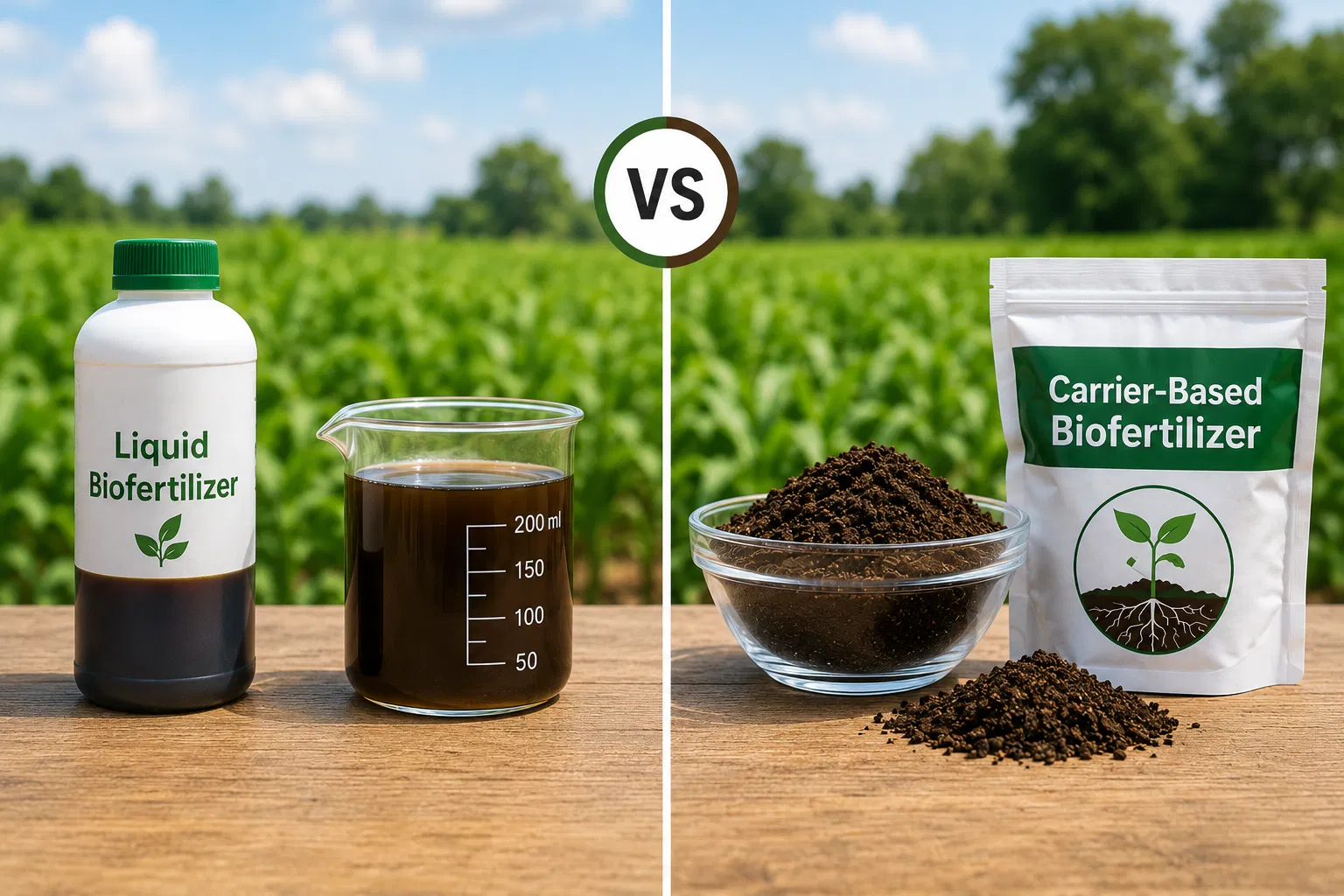
Choosing the right biofertilizer can make a real difference in plant health, soil fertility, and overall crop productivity. But when farmers and growers compare liquid biofertilizers vs carrier-based biofertilizers, the answer is not always obvious. Each type has strengths, limitations, and ideal use cases depending on the crop, climate, storage conditions, and application method.
If you are asking which biofertilizer is better, the truth is that the best option depends on your farming goals. In this article, we break down the key differences between liquid and carrier-based biofertilizers, compare their benefits, and help you decide which one suits your field or garden best.
What Are Biofertilizers?
Biofertilizers are natural inputs containing beneficial microorganisms that improve nutrient availability in the soil. These microbes help plants absorb essential nutrients such as nitrogen, phosphorus, and potassium more efficiently. Unlike chemical fertilizers, biofertilizers support long-term soil health while reducing dependency on synthetic inputs.
The two most common forms are:
- Liquid biofertilizers – microbial cultures suspended in a liquid medium
- Carrier-based biofertilizers – microbes mixed into solid materials like peat, lignite, compost, or talc
Liquid Biofertilizers: Overview
Liquid biofertilizers are concentrated formulations of live microorganisms in a nutrient-rich solution. They are designed for easy handling, quick application, and better survival of microbes under proper storage conditions.
Key Advantages of Liquid Biofertilizers
- Higher microbial count compared to many traditional formulations
- Longer shelf life when stored correctly
- Easy application through seed treatment, soil drenching, or fertigation
- Better survival rate of beneficial microbes
- Faster activation after application
Liquid biofertilizers are especially popular in modern agriculture because they are convenient and work well with precision farming methods. Their uniform consistency also ensures more even distribution of microbes.
Limitations of Liquid Biofertilizers
- May require proper storage away from heat and direct sunlight
- Can be more expensive than carrier-based options
- Need careful handling to maintain effectiveness
Carrier-Based Biofertilizers: Overview
Carrier-based biofertilizers use a solid medium to deliver the microorganisms. The carrier material helps protect the microbes and provides a stable environment for storage and transport. These products have been widely used for decades and remain common in many farming systems.
Key Advantages of Carrier-Based Biofertilizers
- Lower cost in many markets
- Simple production process
- Widely available and familiar to farmers
- Useful for seed coating and soil application
For small-scale farmers or those with limited access to advanced input systems, carrier-based biofertilizers can be a practical and affordable choice.
Limitations of Carrier-Based Biofertilizers
- Usually contain lower microbial populations than liquid products
- Shorter shelf life in many cases
- Carrier quality can affect effectiveness
- Application may be less uniform
Liquid vs Carrier-Based Biofertilizers: Side-by-Side Comparison
To understand which biofertilizer is better, it helps to compare them directly across the most important performance factors.
| Feature | Liquid Biofertilizers | Carrier-Based Biofertilizers |
|---|---|---|
| Microbial concentration | Generally higher | Moderate to lower |
| Shelf life | Usually longer | Often shorter |
| Application | Easy and uniform | Simple but less precise |
| Cost | Higher | Lower |
| Storage stability | Better with proper conditions | More sensitive to carrier quality |
| Best use | Precision agriculture, fertigation, seed treatment | Traditional farming, budget-sensitive use |
Which Biofertilizer Is Better for Crop Growth?
From a performance standpoint, liquid biofertilizers are often considered better because they usually offer higher microbial viability, better shelf life, and easier application. They are especially effective when farmers need fast, efficient, and consistent results.
However, that does not mean carrier-based biofertilizers are inferior in every situation. They still provide valuable benefits, particularly in low-cost farming systems or where liquid formulations are not easily available.
The better biofertilizer is the one that matches your crop needs, budget, and application system.
When to Choose Liquid Biofertilizers
Liquid biofertilizers are a smart choice if you want better microbial performance and more flexible application methods. They are ideal when:
- You use drip irrigation or fertigation systems
- You need seed treatment with uniform coverage
- You want longer storage stability
- You manage high-value crops
- You need faster microbial activation in the field
They are also a strong option for commercial growers who prioritize efficiency and consistency.
When to Choose Carrier-Based Biofertilizers
Carrier-based biofertilizers can still be the right choice in many practical farming situations. They work well when:
- Budget is a major concern
- You are using traditional farming methods
- Local supply of liquid products is limited
- You need a familiar, easy-to-use formulation
- You are applying biofertilizer on a smaller scale
For many farmers, the lower cost and easy availability make carrier-based products a dependable starting point.
Factors That Affect Biofertilizer Performance
Whether you choose liquid or carrier-based biofertilizers, results depend on more than just the product type. Several factors influence effectiveness:
- Microbial quality – The strain and viability of microbes matter greatly.
- Storage conditions – Heat, sunlight, and moisture can reduce effectiveness.
- Soil environment – pH, organic matter, and moisture affect microbial survival.
- Application timing – Applying at the right crop stage improves results.
- Compatibility – Some chemicals and pesticides may harm beneficial microbes.
Even the best biofertilizer will underperform if used improperly, so correct storage and application are essential.
Final Verdict: Liquid vs Carrier-Based Biofertilizers
If you are looking for the most efficient and modern option, liquid biofertilizers generally have the edge. They tend to deliver better microbial survival, easier application, and stronger performance across a wide range of farming systems.
Still, carrier-based biofertilizers remain useful, affordable, and accessible. For farmers who need a lower-cost solution, they can be a practical alternative.
In short:
- Choose liquid biofertilizers for performance, convenience, and precision
- Choose carrier-based biofertilizers for affordability and traditional use
Conclusion
When comparing liquid vs carrier-based biofertilizers, there is no one-size-fits-all answer. Liquid formulations are often better for consistent results, longer shelf life, and advanced farming methods. Carrier-based products, on the other hand, remain a cost-effective solution for many growers.
The best approach is to match the biofertilizer type with your crop, soil, and farming system. If your goal is to maximize efficiency and microbial activity, liquid biofertilizers are usually the better choice. If your priority is affordability and accessibility, carrier-based biofertilizers can still deliver meaningful benefits.
Take the next step by evaluating your field conditions and selecting the biofertilizer that supports both productivity and long-term soil health.