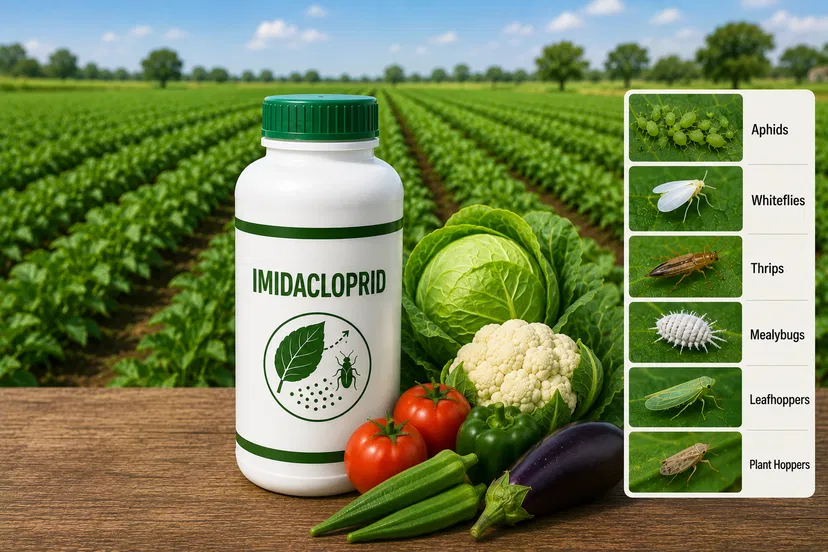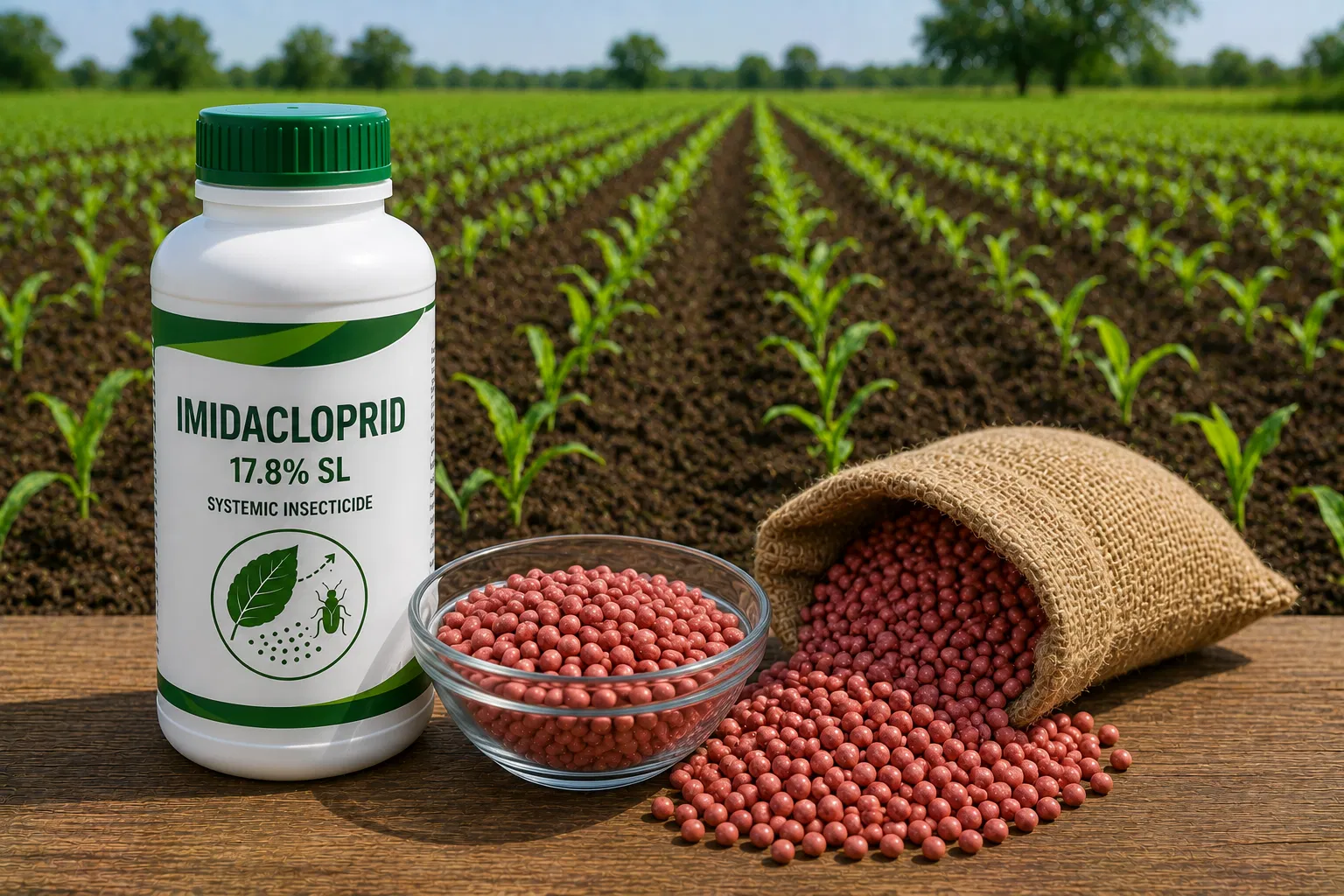
Imidacloprid seed treatment protects germinating seed and young seedlings from selected early-season sucking pests, termites, shoot flies, and other labelled pests. It places a small quantity of insecticide on the seed so the active ingredient is available during establishment.
Safe and effective seed treatment begins with the correct formulation. Products such as imidacloprid 48% FS and 70% WS have seed-dressing claims. A foliar formulation such as 17.8% SL must not be substituted unless its own label specifically authorises seed use.
Why Treat Seed With Imidacloprid?
- Protect seedlings during vulnerable early growth
- Reduce early sucking-pest damage
- Provide targeted placement with less field spray volume
- Support uniform establishment where the labelled pest is expected
- Delay the need for an early foliar application in some situations
Seed treatment is preventive and should be justified by pest history, crop value, and label approval. It does not protect the crop for the entire season.
Seed-Treatment Formulations
Imidacloprid 48% FS
FS means flowable concentrate for seed treatment. It is designed to coat seed evenly and remain attached during handling and sowing.
Imidacloprid 70% WS
WS means water-dispersible powder for slurry treatment. The product is mixed according to label instructions and applied uniformly to the seed.
Do not confuse these formulations with foliar insecticides.
Official Rate Examples
Indian label tables present seed-treatment rates by crop and formulation. Examples for imidacloprid 48% FS include:
| Crop | Target pest | 48% FS formulation per 100 kg seed |
|---|---|---|
| Wheat | Aphids and termite | 0.35 kg |
| Green pea | Aphids and jassids | 0.20–0.30 kg |
| Black gram | Aphids, jassids and whitefly | 0.70 kg |
| Groundnut | Termite | 0.20 kg |
| Chilli | Aphids, jassids and thrips | 1.20–1.50 kg |
Examples for imidacloprid 70% WS include crop-specific ranges such as 5–10 g/kg seed for cotton and okra and 10–15 g/kg seed for chilli. Always use the current package label because claims and units are formulation-specific.
Practical Treatment Steps
- Calculate the exact weight of seed to be treated.
- Read the dose per kilogram or per 100 kilograms on the label.
- Measure the product accurately.
- Prepare the recommended slurry volume.
- Place seed in a clean drum, mixer, or treatment container.
- Add the slurry gradually while rotating or mixing.
- Continue mixing until all seed is evenly coated.
- Dry briefly in shade if the label directs.
- Sow within the recommended period.
Wheat Seed Treatment
For wheat, the official 48% FS example targets aphids and termites at 0.35 kg formulation per 100 kg seed. Do not convert this directly to a different imidacloprid formulation.
Black Gram Seed Treatment
For black gram, the official 48% FS example targets aphids, jassids, and whitefly at 0.70 kg formulation per 100 kg seed. Confirm that the exact product label carries this crop claim.
Sequence With Fungicides and Biofertilizers
When more than one seed input is required, application order matters. Chemical protectants may harm microbial inoculants. Follow the product labels and local recommendation; commonly, compatible chemical treatments are applied and dried before a biofertilizer is added as the final layer.
Do not create an untested multi-product slurry. Uneven coating, seed injury, or loss of microbial viability can result.
Handling Treated Seed
- Clearly label treated seed as not for food, feed, or oil extraction.
- Wear gloves and avoid inhaling dust or mist.
- Keep treated seed away from children, livestock, and birds.
- Do not store it in food or feed containers.
- Collect spills and dispose of them according to the label.
- Wash equipment and protective clothing separately.
Sowing and Field Management
Sow at the correct depth into adequately moist soil. Seed treatment does not compensate for poor seed quality, waterlogging, drought, nutrient deficiency, or improper planting depth.
Continue scouting after emergence. Early protection may decline as the plant grows, and later pests may require a different crop protection response.
Resistance and Pollinator Considerations
Seed treatment contributes to exposure of pest populations to Group 4A chemistry. Avoid unnecessary follow-up sprays from the same mode-of-action group. Follow environmental precautions, including rules for treated-seed dust, spills, and disposal.
Common Mistakes
- Using 17.8% SL instead of an approved seed-treatment formulation
- Applying a rate copied from another crop
- Estimating seed weight or product volume
- Leaving patches of uncoated seed
- Mixing directly with incompatible biofertilizers
- Using treated seed for food or feed
- Repeating Group 4A foliar sprays without resistance rotation
Final Thoughts
Imidacloprid seed treatment can protect labelled crops during establishment, but only when the formulation, crop, pest, and rate match the label. Measure accurately, coat uniformly, handle treated seed safely, and integrate the treatment with field scouting and resistance management.