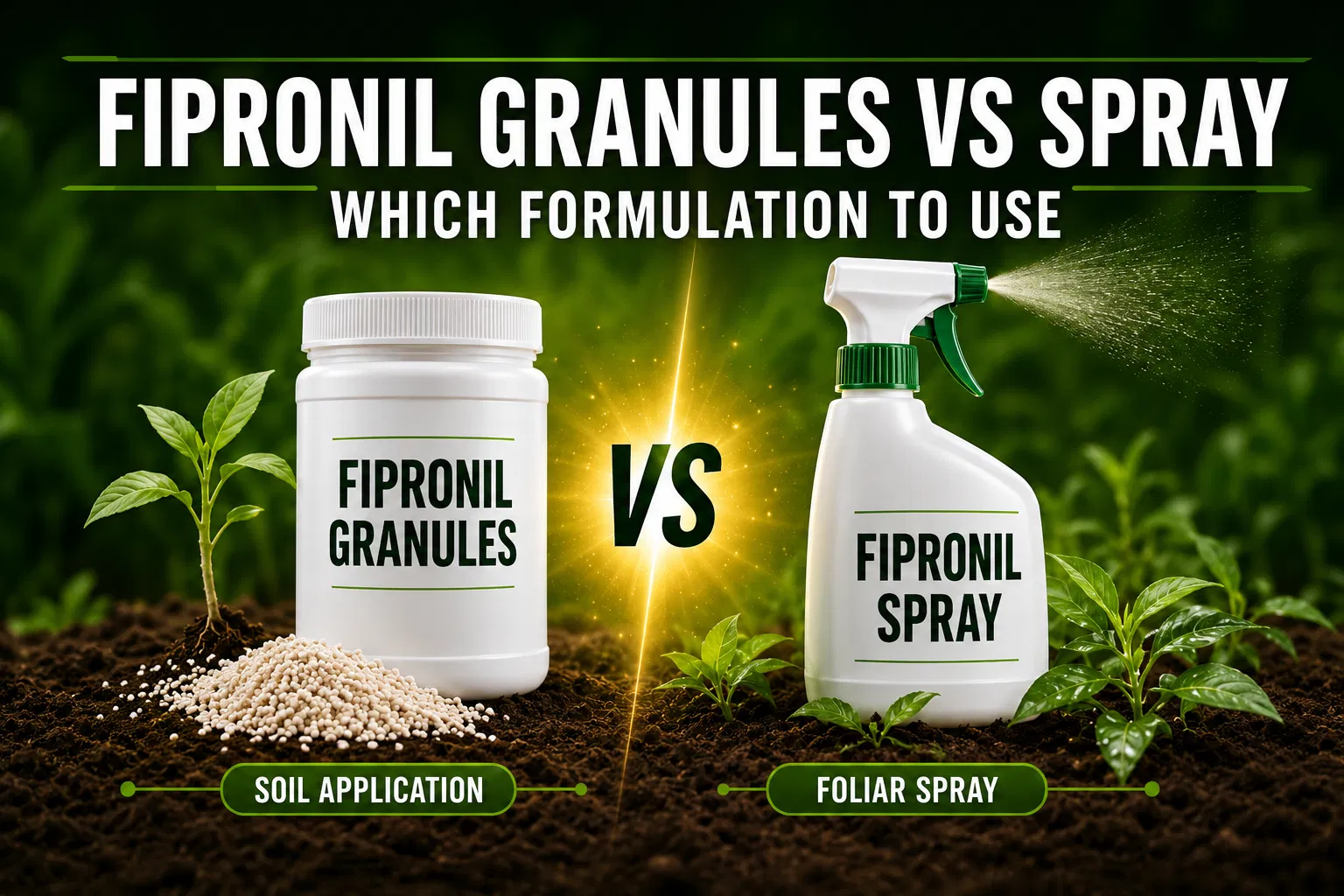
When it comes to pest control, choosing the right formulation can make all the difference. Fipronil granules vs spray is a common comparison for homeowners, gardeners, and pest management professionals trying to decide which option will work best for their situation. Both contain the same active ingredient, but they behave very differently once applied.
If you’re dealing with ants, termites, fleas, or other stubborn pests, understanding the strengths and limitations of each fipronil formulation can help you choose a more effective and practical solution. The best choice depends on where the pest problem is happening, how fast you need results, and whether you need long-lasting control or targeted coverage.
What Is Fipronil?
Fipronil is a broad-spectrum insecticide used to control a wide range of pests. It works by disrupting the insect nervous system, eventually causing paralysis and death. Because it is highly effective at low doses, fipronil is widely used in pest control products for lawns, structures, and professional applications.
Two of the most common forms are:
- Fipronil granules – solid particles designed to be spread over soil, turf, or landscaped areas
- Fipronil spray – a liquid formulation applied directly to surfaces, cracks, crevices, or targeted areas
Fipronil Granules vs Spray: The Main Difference
The biggest difference between fipronil granules and spray is how they deliver the active ingredient. Granules are typically used for soil-based or outdoor applications, while sprays are better suited for direct contact or surface treatment.
In simple terms:
- Granules are ideal for broad area treatment and slow release
- Sprays are ideal for precise, immediate application
That means the right choice depends less on the product itself and more on the pest control goal.
When to Use Fipronil Granules
Fipronil granules are a strong option when you need coverage over a larger outdoor area. They are commonly used in lawns, gardens, and around the perimeter of buildings where pests travel through soil or mulch.
Best uses for granules
- Controlling ants in lawns and landscaped areas
- Targeting soil-dwelling pests
- Creating a protective barrier around structures
- Treating large outdoor spaces more efficiently
Granules can be especially useful when pests are not concentrated in one visible spot. Because they are distributed over an area, they can provide more even coverage in outdoor environments.
Advantages of granules
- Easy to apply across large areas
- Less drift compared with sprays
- Good for soil and turf applications
- Longer residual presence in the treated zone
Granules are often preferred for preventive treatment or when the pest pressure is tied to outdoor nesting or foraging activity. They also reduce the chance of overspray onto non-target surfaces.
Limitations of granules
- May need watering-in to activate the treatment
- Not ideal for indoor infestations
- Less precise than sprays for targeted applications
- May work more slowly in some situations
If the issue is a specific crack, crevice, or nesting point, granules are usually not the most efficient option.
When to Use Fipronil Spray
Fipronil spray is generally better when you need targeted pest control. It is commonly used for indoor cracks and crevices, foundation edges, voids, or other places where pests hide and travel.
Best uses for spray
- Indoor ant and cockroach control
- Spot treating entry points and hiding places
- Perimeter applications around structures
- Fast, targeted pest management
Sprays are especially effective when you can identify exactly where pests are entering or nesting. They allow you to place the insecticide more precisely, which can improve efficiency and reduce waste.
Advantages of spray
- Precise application to problem areas
- Fast coverage for active infestations
- Versatile use in indoor and outdoor settings
- Better for cracks, crevices, and surfaces
For active pest problems inside a home or building, spray often delivers faster practical results because it can be directed exactly where pests are hiding or moving.
Limitations of spray
- Can drift or overspray if not applied carefully
- May dry faster on exposed surfaces
- Less suitable for broad lawn treatment
- May require more frequent reapplication depending on conditions
Sprays are less ideal when you need to treat a wide outdoor area efficiently or when weather may interfere with application.
How to Choose Between Fipronil Granules and Spray
To decide between fipronil granules vs spray, ask yourself a few key questions:
- Where are the pests located? Indoor cracks and crevices usually call for spray. Lawns and soil areas often call for granules.
- How broad is the problem? A large area is usually easier to treat with granules.
- Do you need precision? If yes, spray is the better choice.
- Do you need longer-lasting outdoor coverage? Granules may be more suitable.
- Is speed important? Spray is often preferred for immediate targeting.
The best formulation is the one that matches the pest’s behavior and the location of the infestation. Using the wrong form can reduce effectiveness, waste product, and delay control.
Granules vs Spray for Common Pest Problems
Ant control
For ants in lawns, mulch beds, or along outdoor trails, fipronil granules can work well. For ants entering a kitchen, wall void, or foundation crack, a spray is usually more practical.
Termite control
Termites typically require specialized professional treatment. In some cases, fipronil-based products are used in barrier treatments, but application method matters greatly. Sprays or soil treatments may be chosen depending on the treatment plan and product label.
Cockroach control
Sprays are often favored for cockroach control because infestations are frequently tied to indoor hiding spots, cracks, and dark travel paths. Granules are rarely the first choice for indoor roaches.
Flea control
Fleas may require treatment of outdoor shaded areas, pet resting zones, or soil-based environments. Granules may be useful outdoors, while sprays are better for targeted surface treatment depending on the specific product and setting.
Safety and Application Considerations
Regardless of whether you choose granules or spray, proper application is essential. Always follow the product label and use protective measures as directed. Overapplication does not improve performance and may increase risk.
Important: The right formulation is only effective when used exactly as directed on the label for the specific pest and application site.
Keep children, pets, and non-target areas in mind during treatment. Outdoor areas may require watering-in for granules, while spray applications may need drying time before reentry.
Which Fipronil Formulation Is Better?
There is no universal winner in the fipronil granules vs spray debate. The better formulation depends on the job:
- Choose granules for larger outdoor areas, lawns, and soil-based pest control
- Choose spray for targeted indoor or perimeter applications
If your pest issue is spread out across a yard or landscaped space, granules may be the most efficient option. If the pests are concentrated in one area or entering through a specific point, spray is usually better.
Final Verdict
When comparing fipronil granules vs spray, the best formulation comes down to location, precision, and treatment goals. Granules are typically better for broad outdoor control, while sprays excel at pinpointing active infestation zones. Both can be highly effective when matched to the right pest and applied correctly.
If you want the most reliable results, start by identifying where the pests are active, then choose the formulation that fits that environment. In pest control, using the right tool is often the difference between a temporary fix and lasting control.