Water scarcity, rising input costs, and the need for higher crop productivity have made drip irrigation one of the smartest investments for Indian farmers. The good news is that the Government of India and state agriculture departments offer drip irrigation subsidies in India to help farmers adopt micro-irrigation at a lower cost. If you are planning to install a drip system on your farm, understanding how to apply for drip irrigation subsidy in India can save you both time and money.
In this guide, you will learn the subsidy process, eligibility rules, documents required, benefits, and practical steps to apply without confusion.
What Is Drip Irrigation Subsidy in India?
Drip irrigation subsidy is financial assistance provided by the government to encourage farmers to install water-efficient irrigation systems. Under various micro-irrigation schemes, farmers can receive a percentage of the system cost as subsidy, reducing the burden of purchasing pipes, emitters, filters, pumps, and other equipment.
The main objective is to:
- Save water
- Improve crop yield
- Reduce fertilizer wastage
- Increase farm income
- Promote sustainable agriculture
Why Drip Irrigation Is Worth It
Drip irrigation delivers water directly to the root zone of plants in small, controlled quantities. This makes it highly efficient compared to traditional flood irrigation.
Drip irrigation can reduce water use significantly while improving crop quality and productivity.
Farmers growing vegetables, orchards, sugarcane, cotton, bananas, and plantation crops often benefit the most from drip systems. Since the subsidy reduces the initial cost, it becomes easier for small and marginal farmers to adopt modern irrigation methods.
Drip Irrigation Subsidy in India: Key Benefits
Before applying, it helps to understand the real advantages of the scheme:
- Lower installation cost: Subsidy reduces the upfront expense of drip equipment.
- Water conservation: Uses much less water than conventional irrigation.
- Better crop growth: Plants receive water consistently and efficiently.
- Reduced weed growth: Less water reaches unwanted areas.
- Improved fertilizer efficiency: Fertigation becomes easier and more effective.
- Higher yields: Crops often show better quality and productivity.
Eligibility for Drip Irrigation Subsidy in India
Eligibility may vary slightly from state to state, but the general criteria are similar across India.
Common eligibility conditions
- The applicant must be an Indian farmer.
- The farmer should own agricultural land or have legal cultivation rights.
- The land should be suitable for drip irrigation.
- The applicant should meet the state-specific scheme rules.
- Priority may be given to small and marginal farmers, women farmers, SC/ST farmers, and farmers from water-scarce areas.
In many states, the subsidy is also linked to crop type, landholding size, and the approved beneficiary list under the agriculture department.
Documents Required for Drip Irrigation Subsidy Application
Keep the following documents ready before starting the application process:
- Aadhaar card
- Land ownership documents or land record proof
- Bank account details with passbook copy
- Passport-size photograph
- Mobile number linked to Aadhaar, if required
- Caste certificate, if applicable
- Income certificate, if required by the state scheme
- Passport or voter ID, if asked for identity verification
- Quotation or estimate from an approved drip irrigation supplier
- Farmer registration details, if already registered on the state portal
Some states may ask for additional documents such as a water source certificate, land map, or electricity connection details for pump-based systems.
How to Apply for Drip Irrigation Subsidy in India
The application process can be completed online in many states. In some cases, farmers can also apply through local agriculture offices, horticulture departments, or Common Service Centres.
Step 1: Check your state subsidy scheme
Start by visiting your state agriculture or horticulture department website. Search for the latest micro-irrigation or drip irrigation subsidy scheme details. Each state may offer different subsidy percentages, beneficiary categories, and application deadlines.
Step 2: Verify your eligibility
Read the scheme guidelines carefully. Confirm that your land, crop, and farmer category qualify for the subsidy. This step is important because incomplete or ineligible applications may get rejected.
Step 3: Register as a farmer, if needed
Many states require farmers to register on an agricultural portal before applying. You may need to create a profile using your Aadhaar number, mobile number, and land details.
Step 4: Get an approved quotation
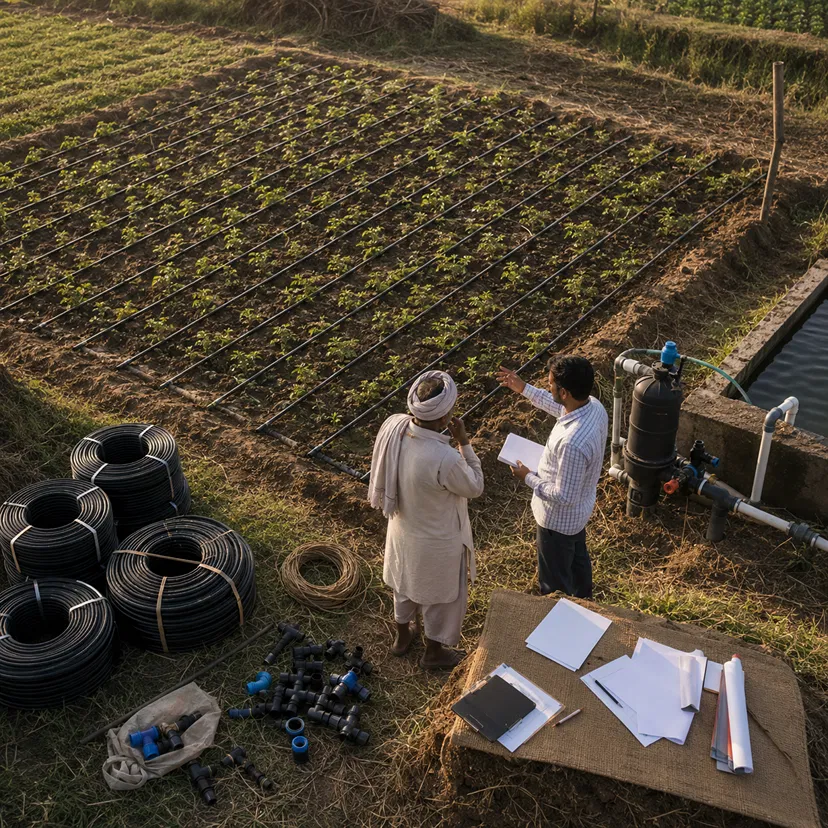
Contact an authorized drip irrigation vendor or supplier listed under the scheme. Ask for a system estimate or quotation based on your land size and crop requirement. Make sure the supplier is recognized by the department if the scheme requires approved vendors.
Step 5: Fill out the application form
Submit the online or offline application form with accurate details such as:
- Farmer name
- Father’s or husband’s name
- Address
- Landholding details
- Crop type
- Area to be covered under drip irrigation
- Bank account information
- Quotation and document uploads
Step 6: Upload documents
Scan and upload all required documents in the prescribed format and size. Incorrect or blurry uploads can delay approval.
Step 7: Submit and note the reference number
After submitting the form, save the acknowledgment or reference number. This number helps you track the status of your application later.
Step 8: Site inspection or verification
In many cases, the agriculture department conducts a field inspection before approving the subsidy. Officers may verify land ownership, crop details, and suitability of the site.
Step 9: Install the drip system
Once approved, you may be allowed to install the system through the selected vendor. Some states require installation after approval, while others may permit reimbursement after purchase.
Step 10: Claim subsidy or receive direct benefit transfer
After verification and installation, the subsidy amount is usually transferred to the farmer’s bank account through DBT or adjusted directly depending on the scheme rules.
Where to Apply for Drip Irrigation Subsidy
You can usually apply through one of the following channels:
- State agriculture department portal
- Horticulture department website
- District agriculture office
- Block agriculture office
- Common Service Centre (CSC)
- Authorized scheme portal under PMKSY or state micro-irrigation programs
If you are unsure, visit your nearest agriculture office and ask for the current micro-irrigation subsidy application process in your district.
How Much Subsidy Can You Get?
The subsidy amount depends on your state, category, crop, landholding size, and scheme guidelines. In many cases, farmers can receive a significant percentage of the drip irrigation system cost under centrally sponsored or state-sponsored schemes.
Subsidy norms may differ for:
- Small and marginal farmers
- General category farmers
- SC/ST farmers
- Women farmers
- Farmers in tribal or drought-prone regions
Since the percentage and ceiling amount can change, always check the latest official notification before applying.
Common Mistakes to Avoid
Many applications get delayed because of simple errors. Avoid these mistakes:
- Submitting incomplete forms
- Uploading unclear documents
- Choosing an unapproved supplier
- Providing incorrect land details
- Missing the scheme deadline
- Ignoring inspection visits
- Not keeping a copy of the application and reference number
Final Tips for a Smooth Application
To increase your chances of approval, keep all records updated, apply early, and follow the official instructions exactly. If possible, take help from your local agriculture officer or CSC operator to avoid mistakes in the form.
Also, compare the drip system design with your crop and field size before purchase. A properly planned system gives better water savings and higher returns on investment.
Conclusion
Drip irrigation subsidy in India is a valuable opportunity for farmers who want to save water, reduce costs, and improve productivity. By understanding the eligibility rules, preparing the right documents, and following the step-by-step application process, you can apply with confidence and increase your chances of getting approved.
If you are planning to install drip irrigation, check your state’s latest subsidy scheme today and begin your application as early as possible. The sooner you apply, the sooner you can make your farm more efficient, profitable, and sustainable.