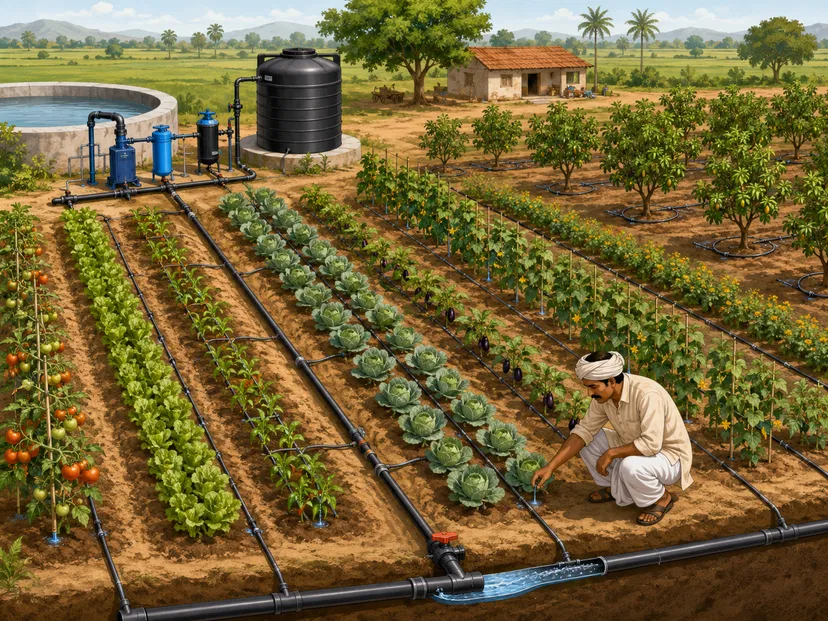
Water is one of the most valuable inputs in agriculture, and for orchards and plantation crops, every drop counts. Whether you grow mangoes, citrus, grapes, coffee, coconut, bananas, or other perennial crops, drip irrigation offers a smarter way to deliver moisture directly to the root zone with precision, consistency, and efficiency.
Unlike flood or sprinkler systems, drip irrigation minimizes waste, reduces weed growth, improves fertilizer use, and helps crops develop healthier root systems. For high-value orchards and plantation farms, it is often the difference between average performance and consistently strong yields.
What Is Drip Irrigation?
Drip irrigation is a micro-irrigation method that applies water slowly and directly to the base of plants through emitters, pipes, and valves. Instead of wetting the entire field, it targets the root zone where plants need moisture most.
This system is especially effective for orchards and plantation crops because these crops are usually spaced apart and require controlled watering throughout the season. Drip irrigation can be automated, customized by crop stage, and integrated with fertigation for even better results.
Why Drip Irrigation Works So Well for Orchards and Plantation Crops
Perennial crops have unique water needs. They grow for many years, produce higher-value harvests, and often occupy large areas. Drip irrigation supports these crops by improving both plant health and farm economics.
- Water efficiency: Uses significantly less water than traditional irrigation methods.
- Better yield potential: Maintains consistent soil moisture for improved flowering, fruit set, and crop development.
- Reduced weed growth: Water is delivered only where needed, not across the entire field.
- Lower disease pressure: Keeps foliage dry and reduces the spread of many moisture-related diseases.
- Improved fertilizer use: Enables fertigation, where nutrients are applied through the irrigation system.
- Labor savings: Automation reduces the need for frequent manual watering.
Key Benefits of Drip Irrigation for Plantation Crops
Plantation crops such as coffee, tea, banana, rubber, cocoa, coconut, and oil palm often benefit from steady water delivery during critical growth periods. Drip systems help farmers maintain a more stable environment around the plant roots.
1. Consistent Soil Moisture
Sudden swings between dry and wet soil can stress plants and affect production. Drip irrigation keeps moisture levels more stable, which is especially important during flowering and fruit development.
2. Higher Nutrient Efficiency
When combined with fertigation, nutrients can be delivered in small, controlled doses. This improves uptake, reduces leaching, and helps plants use fertilizers more effectively.
3. Better Root Development
Since water is applied close to the root zone, roots tend to grow deeper and stronger in search of moisture. Healthy roots support better nutrient absorption and stronger plant growth.
4. Improved Crop Quality
In orchards, uniform moisture can improve fruit size, color, sweetness, and marketability. For plantation crops, it can contribute to more uniform growth and harvest quality.
How to Design a Drip Irrigation System for Orchards
A well-designed drip irrigation system should match crop type, soil characteristics, tree age, spacing, climate, and water availability. Poor design can lead to uneven watering and disappointing results, so planning is essential.
- Assess water source and quality: Check flow rate, pressure, salinity, and sediment levels.
- Map tree spacing and field layout: Determine emitter placement based on crop geometry and canopy size.
- Select the right emitters: Choose pressure-compensating or non-compensating emitters depending on field conditions.
- Plan filtration: Install filters to prevent clogging from debris or mineral buildup.
- Design zoning: Divide the orchard into irrigation zones for better control and efficiency.
- Set irrigation schedule: Adjust runtime based on soil type, weather, crop stage, and evapotranspiration demand.
Important Components of a Drip Irrigation System
Understanding the main parts of the system helps farmers operate and maintain it effectively. Each component plays an important role in delivering water accurately and reliably.
- Pump: Provides the pressure needed to move water through the system.
- Filters: Remove particles and protect emitters from clogging.
- Mainline and sub-main lines: Carry water from the source to different parts of the field.
- Laterals: Smaller pipes that distribute water near the plants.
- Emitters or drippers: Release water slowly and uniformly.
- Valves and controllers: Regulate flow and allow automation.
- Fertilizer injector: Enables fertigation for precise nutrient delivery.
Best Practices for Drip Irrigation in Orchards
Getting the most from drip irrigation requires regular monitoring and good management. Small adjustments can make a big difference in crop performance and water savings.
- Monitor soil moisture regularly to avoid under- or over-irrigation.
- Flush lines periodically to remove sediment and prevent clogging.
- Inspect emitters for uniform water delivery.
- Adjust irrigation frequency during hot, dry, or windy periods.
- Use mulch where possible to reduce evaporation and improve soil moisture retention.
- Schedule fertigation based on crop stage and nutrient demand.
- Check for leaks, pressure drops, or blocked lines on a routine basis.
Common Challenges and How to Avoid Them
While drip irrigation is highly effective, it does require proper maintenance. Ignoring small issues can reduce efficiency and affect crop growth.
Emitter Clogging
Clogging is one of the most common problems in drip systems. It can be caused by dirt, algae, mineral deposits, or poor water quality. The solution is strong filtration, routine flushing, and periodic system inspection.
Uneven Water Distribution
If pressure is not balanced across the field, some trees may receive too much water while others get too little. Pressure regulation and proper zoning help prevent this issue.
Poor Scheduling
Watering too often or not often enough can both harm crop performance. Use crop demand, soil type, and climate data to guide irrigation timing.
Insufficient Maintenance
Even the best system will fail if neglected. A regular maintenance plan keeps the system efficient and extends its lifespan.
Drip Irrigation and Fertigation: A Powerful Combination
One of the biggest advantages of drip irrigation for orchard and plantation crops is fertigation. This method allows nutrients to be applied directly through the irrigation system in measured amounts.
Fertigation benefits include:
- Improved nutrient uptake
- Reduced fertilizer waste
- More timely nutrient delivery
- Less manual labor
- Better synchronization with crop growth stages
When managed correctly, fertigation can significantly enhance crop vigor, flowering, fruit set, and overall productivity.
Why Drip Irrigation Is a Smart Long-Term Investment
Installing a drip irrigation system requires upfront investment, but the long-term returns can be substantial. Farmers often see savings in water, fertilizer, and labor, along with better crop performance and higher market value.
For orchards and plantation crops, drip irrigation is not just an irrigation method—it is a production strategy that supports sustainability, precision, and profitability.
As water becomes more limited and climate conditions become less predictable, precision irrigation will continue to play a major role in modern agriculture. Drip systems help growers protect their crops, conserve resources, and build more resilient farms.
Conclusion
Drip irrigation for orchards and plantation crops delivers water exactly where it is needed, when it is needed. It improves water-use efficiency, supports healthier root systems, reduces weed and disease pressure, and creates a strong foundation for higher yields and better crop quality.
If you are looking to improve productivity while conserving water and reducing input costs, drip irrigation is one of the most effective solutions available. Start with a proper system design, maintain it carefully, and pair it with smart fertigation practices for the best results.
For orchard and plantation growers, the future is precise, efficient, and rooted in drip irrigation.