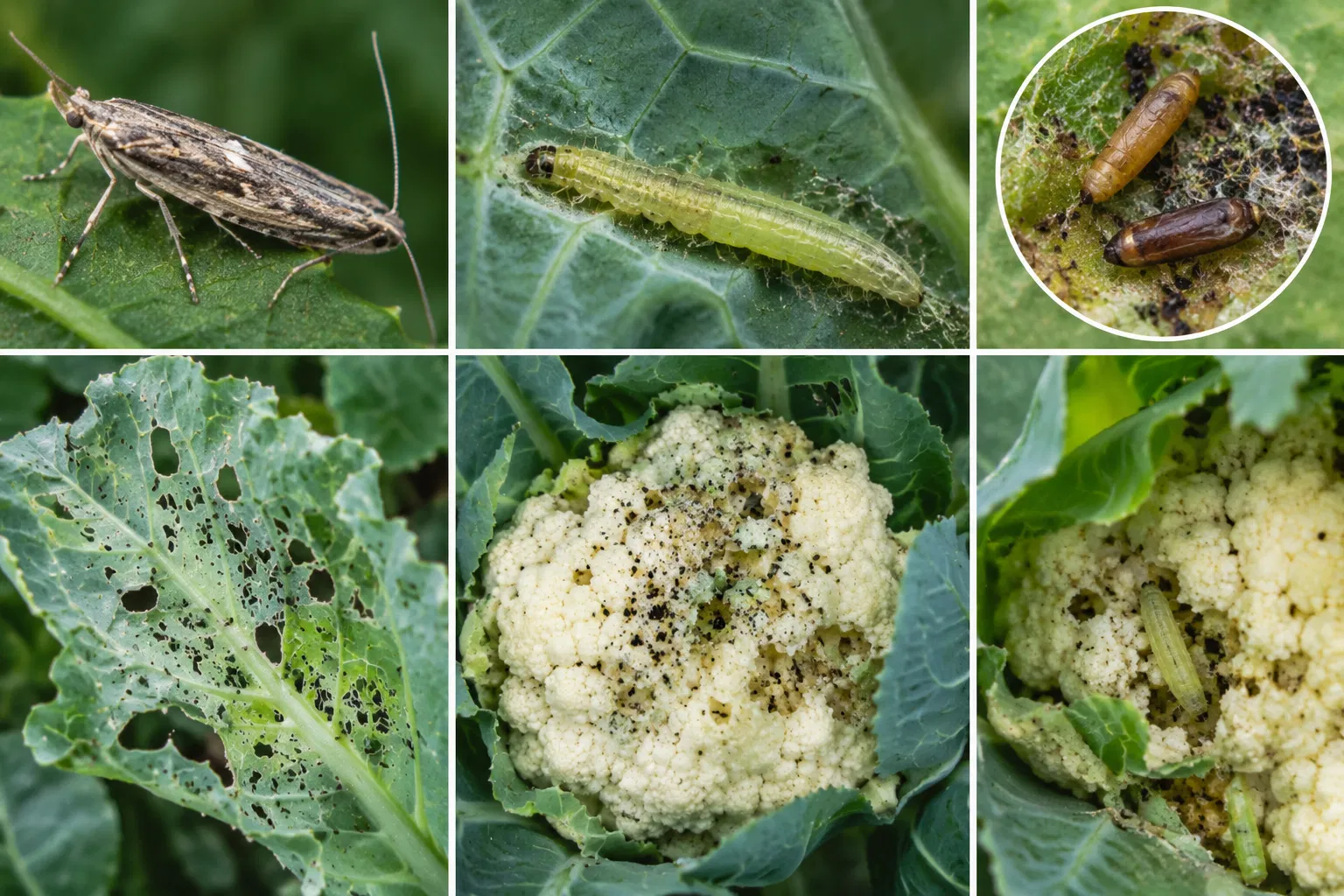
Diamondback moth is the single most destructive pest of cauliflower and other cole crops in India, and the hardest one to keep down once it settles in a field. The larvae feed on the underside of leaves and on the developing curd, and because they are small, pale green and well hidden, growers often notice the problem only when leaves are already skeletonised or the curd is discoloured. The pest also completes a generation in as little as two to three weeks in warm weather, so populations rebuild quickly between sprays. Early scouting and a planned rotation of insecticide groups matter more here than the strength of any single spray.
Symptoms
- Small, pale, papery “window” patches on leaves, where young larvae have scraped away the lower surface and left the upper membrane intact
- Irregular shot-holes on leaves as larvae grow, progressing to skeletonised leaves with only veins and midribs left in heavy attacks
- Larvae and frass in the growing point and inside the developing curd, leading to deformed, discoloured or unmarketable heads
- Small, light green, spindle-shaped caterpillars on leaf undersides that wriggle backwards violently and drop on a silken thread when disturbed
- Loose, net-like silken cocoons holding green-yellow pupae, usually stuck to the underside of leaves or on the stem
Causes
- Warm, dry weather during the vegetative and curd-initiation stages, when generations overlap and moth activity peaks; heavy rain physically knocks larvae off plants and suppresses the pest
- Continuous or staggered cole crop planting in the same block, which gives the moth an uninterrupted host supply through the year
- Repeated use of the same insecticide group, which has made Plutella xylostella the most resistance-prone field pest in the world; it has developed resistance to almost every chemical class deployed against it
- Broad-spectrum sprays that wipe out the parasitoids Diadegma semiclausum and Cotesia plutellae, which otherwise account for a large share of natural larval mortality
- Cruciferous weeds, volunteer brassicas and unharvested crop residue near the field carrying populations between seasons
- Excess nitrogen, which produces soft, succulent foliage that moths prefer for egg-laying
How to Identify
Turn over leaves and look at the underside — this is where eggs, larvae and pupae are found, and where surface sprays most often fail to reach. A full-grown larva is about 10 to 12 mm long, pale green, tapered at both ends, with a distinctly forked tail. The giveaway is behavioural: tap or lift an infested leaf and the larvae thrash backwards and drop on silk threads rather than staying put.
The adult is a small greyish-brown moth, roughly 8 to 10 mm long. When it rests with its wings folded, three pale triangular marks along the back line up to form the diamond pattern the pest is named after. Moths fly at dusk and are difficult to spot by day, so use pheromone traps at 4 to 5 per acre to track adult activity and time your first spray, and scout 10 plants at 5 random spots per acre twice a week from transplanting onwards.
Control Methods
Chemical Control
1. Spinosad 2.50% SC
Spinosad is a fermentation product of the soil actinomycete Saccharopolyspora spinosa. It acts by both contact and ingestion, overstimulating nicotinic acetylcholine and GABA receptors in the larva, which causes tremors, paralysis and death. Feeding stops within hours, and it is comparatively soft on pollinators and parasitoids at label dose, which makes it a good fit in an IPM programme. It belongs to IRAC Group 5.
Product Recommendation
2. Lufenuron 5.40% EC
Lufenuron is a benzoylurea insect growth regulator that blocks chitin synthesis. Larvae that ingest treated foliage cannot form a new cuticle and die at the next moult, and the molecule also has strong ovicidal action, so eggs laid on treated leaves often fail to hatch. Kill is deliberate rather than instant, typically over one to four days, so it is best applied at the first sign of egg-laying rather than at peak damage. It belongs to IRAC Group 15 and is a useful resistance-breaking rotation partner.
Product Recommendation
3. Fenvalerate 20% EC
Fenvalerate is a synthetic pyrethroid that modulates sodium channels in the insect nervous system, giving quick knockdown through contact and stomach action on a broad range of chewing and sucking pests. It is registered for diamondback moth in cauliflower and is the most economical option on this list.
Product Recommendation
One caution worth passing on to growers: diamondback moth populations in many Indian cole-crop belts carry well-documented pyrethroid resistance, and repeated pyrethroid sprays also suppress the parasitoids that hold the pest in check, which can trigger a worse outbreak later in the season. Use fenvalerate as an occasional rotation partner rather than a routine spray, and never back-to-back.
Biological Control
1. Bacillus thuringiensis var. kurstaki (Btk)
Bacillus thuringiensis var. kurstaki is a stomach poison specific to caterpillars. Once swallowed, the Cry protein crystals dissolve in the larva’s alkaline midgut, rupture the gut wall and paralyse feeding within a couple of hours; death follows in three to five days. It is most effective against first and second instar larvae, so timing against early infestation matters. Btk has no cross-resistance with chemical groups, is harmless to parasitoids and pollinators, and carries a zero-day pre-harvest interval, making it well suited to cauliflower nearing curd maturity and to export or residue-sensitive production. Spray in the evening, since sunlight degrades the spores, and ensure thorough coverage of leaf undersides.
Product Recommendation
- Margo Delfin WG Bio Insecticide
- Katyayani Bt Bio Larvicide Powder
- Katyayani Organic Larvicide
- Varsha VBT
- Ekotrump BT Bio Insecticide
- Sun Bio BT
2. Azadirachtin 5% EC (50,000 ppm)
Azadirachtin, extracted from neem (Azadirachta indica) seed kernel, works through several routes at once rather than by straight toxicity. It deters feeding, disrupts moulting hormones so larvae fail to develop, and discourages moths from laying eggs on treated foliage. It will not clear a heavy infestation on its own, but used prophylactically or at the first sign of the pest it holds populations down, fits organic and residue-sensitive production, and spares natural enemies.
Product Recommendation
Cultural Control
- Rotate out of cauliflower, cabbage and other crucifers for at least one season where diamondback moth pressure has been high, and avoid staggered brassica plantings in adjacent blocks that give the pest a continuous host bridge
- Sow mustard as a trap crop, two rows for every 25 rows of cauliflower, with the first sowing 15 days before transplanting and a second 25 days after, then destroy the trap rows once colonised
- Remove cruciferous weeds from bunds and field borders, and plough in or destroy crop residue immediately after harvest to break the pupal carryover
- Keep nitrogen at the recommended dose and split it, since excess nitrogen produces the soft growth that attracts egg-laying moths
- Where feasible, use sprinkler or overhead irrigation, which dislodges larvae and consistently records lower diamondback moth counts than drip or furrow irrigation
- Protect natural enemies by avoiding unnecessary broad-spectrum sprays; Diadegma semiclausum and Cotesia plutellae can parasitise a large proportion of larvae when left undisturbed
Mechanical Control
Pheromone traps release a synthetic copy of the female moth’s sex pheromone to draw in males. At 4 to 5 traps per acre they give an early warning of moth build-up so the first spray can be timed correctly; at 15 to 20 traps per acre they also reduce mating success and suppress the next generation. Raise seedlings under 40 to 50 mesh insect-proof net in the nursery so transplants go into the field clean, use yellow sticky traps and light traps to pull down adult numbers, and in small holdings hand-pick and destroy larvae and pupae from leaf undersides during routine scouting.
Conclusion
Diamondback moth cannot be managed by chemistry alone, because the pest develops resistance faster than any new molecule reaches the market. The practical approach for cauliflower growers is to scout twice a week from transplanting, start with Bt or neem while larval counts are low, bring in Spinosad or Lufenuron when pressure builds, and rotate between IRAC groups rather than repeating the same product. Combine that with a mustard trap crop, clean field borders, pheromone traps and protection of natural parasitoids, and the pest stays below damaging levels right through curd formation.
Disclaimer: Always confirm current label registration, approved dosage, water volume, and pre-harvest interval (PHI) for your state before using any product, since labels are periodically revised by regulatory authorities.
This guide is a general advisory. Do your own research and verification before using any product. Always confirm suitability for your crop stage, region, and field conditions before making any purchase, spray, or crop-management decision.