Damping-off is the disease that decides whether a chilli crop starts well or has to be sown again. It strikes in the nursery, where seedlings are at their most vulnerable, and it can clear a bed in three or four days once conditions turn in its favour. What makes it costly is not just the seedlings lost but the delay: a failed nursery pushes transplanting back by three to four weeks and throws the entire season off schedule. The disease is also far easier to prevent than to cure, since by the time seedlings start toppling the fungus is already established throughout the bed.
Symptoms
- Patchy, uneven germination with bare gaps in the bed, caused by seeds and sprouts rotting before they break the soil surface
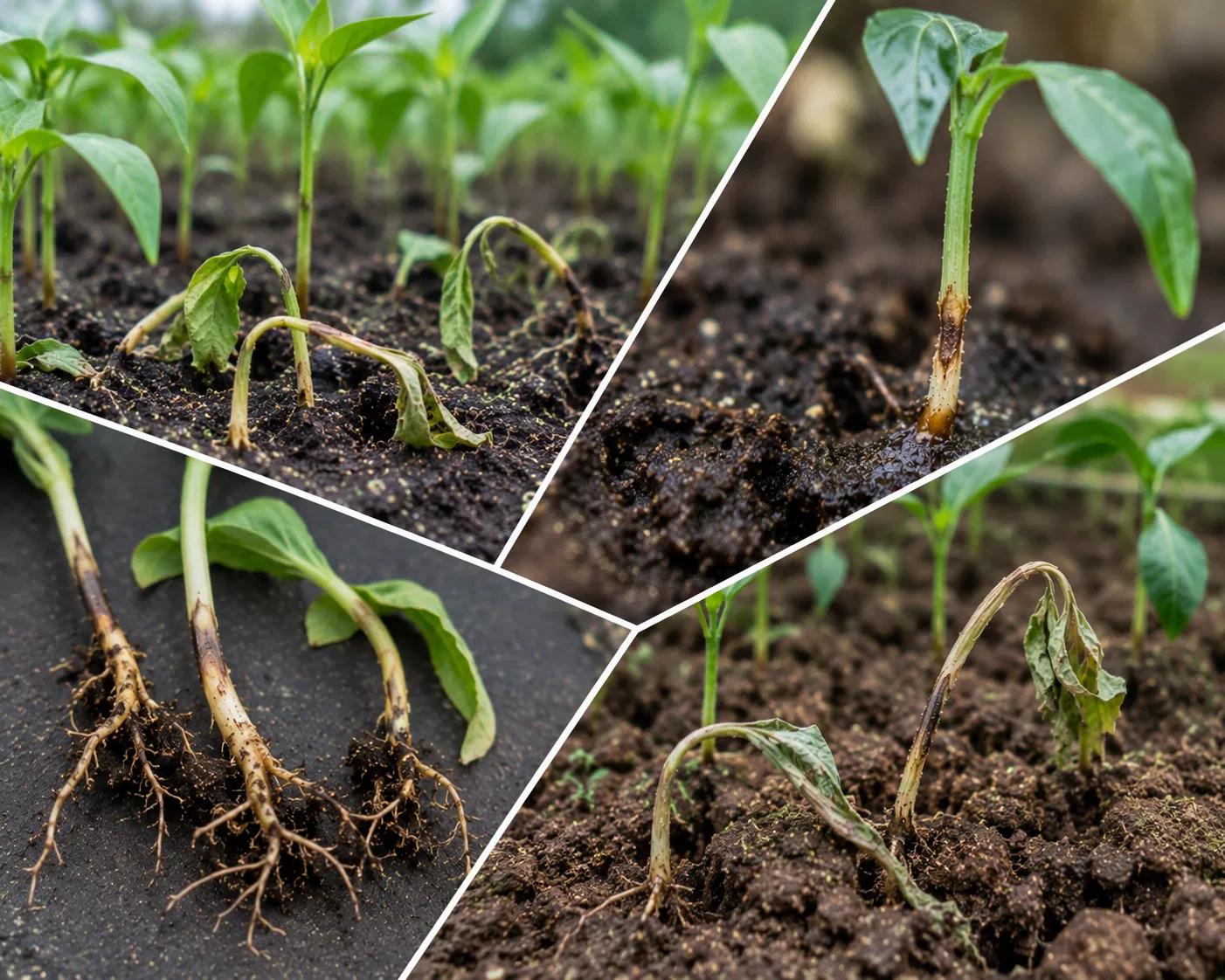
- A water-soaked, brown, constricted lesion at the collar region, right at soil level, on seedlings that have already emerged
- Seedlings toppling over while their leaves are still green and turgid, which is the single most recognisable sign of the disease
- Stems shrivelled and thread-like at the base, with seedlings lifting out easily because the roots have rotted away
- Circular patches of collapsed seedlings that widen outward day by day, usually beginning where water stagnates in the bed
- White cottony fungal growth on the soil surface and around the collar when humidity stays high
Causes
- Soil-borne fungi that survive in soil and crop debris between seasons, chiefly Pythium aphanidermatum, Rhizoctonia solani, Fusarium species and Phytophthora species
- Excess soil moisture from heavy or frequent irrigation, flat beds and poor drainage, which is the single biggest driver of the disease
- High humidity with moderate temperatures and long cloudy spells, conditions that let the pathogens multiply faster than the seedlings can harden
- Thick, broadcast sowing that crowds the bed, blocks air movement and keeps the surface permanently damp
- Untreated seed carrying infection into an otherwise clean bed
- Raising the nursery on the same plot season after season, which lets inoculum accumulate in the soil
- Heavy clay soils, undecomposed organic matter and excess nitrogen, all of which produce soft seedlings in wet soil
- Deep sowing, which delays emergence and leaves the seedling exposed to infection for longer
How to Identify
The confirming test is to pull up a collapsed seedling and look at the base. In damping-off the collar is brown, water-soaked and pinched in, the tissue is soft, and most of the root has rotted away, yet the leaves above are still green. That combination separates it from moisture stress, where a wilted seedling recovers by evening, and from nutrient deficiency, where the foliage discolours first and the stem stays firm.
For the pre-emergence phase there is nothing above ground to inspect, so dig into the bare gaps and examine the seed itself. Seed that has rotted will be soft, brown and decayed rather than simply ungerminated. Also watch how the damage is laid out: damping-off spreads outward from a focal point in widening circular patches and follows the path of water across the bed, so check the low spots and the poorly drained ends first. Inspect the nursery daily from sowing until transplanting, because the gap between the first few collapsed seedlings and a ruined bed is measured in days, not weeks.
Control Methods
Chemical Control
1. Metalaxyl-M 4% + Mancozeb 64% WP
This combination pairs a systemic and a contact fungicide. Metalaxyl-M belongs to the acylalanine group and blocks ribosomal RNA synthesis in the pathogen, and it is specifically effective against the water moulds such as Pythium and Phytophthora that cause most damping-off in wet nursery beds. Mancozeb is a multisite dithiocarbamate that forms a protective layer and stops spore germination on contact. Applied as a soil drench at sowing and again if symptoms appear, it gives both surface protection and internal uptake through the roots.
Product Recommendation
2. Carbendazim 50% WP
Carbendazim is a systemic benzimidazole fungicide that disrupts cell division in the pathogen by interfering with spindle formation, halting germ tube development and mycelial growth. It is used both as a seed treatment before sowing and as a nursery bed drench, and it gives protective as well as curative action against Rhizoctonia and Fusarium infections.
Product Recommendation
One point worth knowing before choosing it: carbendazim has no activity against Pythium and Phytophthora, because those water moulds lack the cell structure it acts on. Where the bed is waterlogged and the collapse is spreading fast, the pathogen is usually one of those two, and a metalaxyl-based drench is the more reliable choice.
3. Mancozeb 75% WP
Mancozeb is a broad-spectrum contact fungicide with multisite action, which means it attacks several processes in the pathogen at once and carries a very low risk of resistance developing even with repeated use. It is applied as a seed treatment and as a nursery bed drench, forming a protective barrier around the seed and seedling collar. Because it is purely protective, it has to go on before infection sets in rather than after seedlings start collapsing.
Product Recommendation
Biological Control
1. Trichoderma viride
Trichoderma viride is an antagonistic fungus that controls damping-off by living in the same root zone as the pathogen and outcompeting it. It coils around pathogenic hyphae and dissolves their cell walls with chitinase and glucanase enzymes, takes up the nutrients and space the pathogen needs, and triggers the seedling's own defence response. Used as a seed treatment before sowing, mixed into well-decomposed farmyard manure applied to the nursery bed, or as a seedling root dip, it establishes protection from the first day. It is preventive rather than curative, so it has to go in at sowing, not after the collapse starts.
Product Recommendation
- Katyayani Tyson Bio Fungicide
- Pioneer Agro Trichoderma Viride
- Margo Ecoderma
- Ekotrump Triko Bio Fungicide
2. Pseudomonas fluorescens
Pseudomonas fluorescens is a beneficial bacterium that colonises the root surface and defends it on several fronts. It produces antifungal compounds and siderophores that lock away the iron pathogens need, occupies the root zone before the pathogen can establish, and induces systemic resistance so the seedling responds faster to infection. It is applied as a seed treatment and as a nursery bed or soil application, carries no pre-harvest interval, and fits organic and residue-sensitive production. It also pairs well with Trichoderma, since the two occupy different niches around the root.
Product Recommendation
Cultural Control
- Raise nursery beds 15 to 20 cm above ground level with clear drainage channels between them, so water never stands around the seedling collar
- Irrigate lightly and only when the bed needs it, and water in the morning rather than the evening so the surface dries before nightfall
- Sow in lines with proper spacing instead of broadcasting, which keeps air moving through the bed and the surface drier
- Sow shallow so seedlings emerge quickly and spend less time in the stage where they are most susceptible
- Change the nursery site each season rather than raising seedlings on the same plot repeatedly, which lets inoculum build up
- Use only well-decomposed farmyard manure and keep nitrogen moderate, since soft growth in wet soil is exactly what the pathogen exploits
- Remove collapsed seedlings along with the soil around them as soon as they appear, and destroy them away from the nursery
- Keep shade light and temporary; heavy shade holds humidity in the bed and slows the drying the seedlings need
Physical Control
Soil solarization is the most effective preventive step available for a nursery bed. Moisten the prepared bed, cover it tightly with transparent polythene sheet of 200 to 250 gauge, and leave it sealed for three to six weeks during the hot months; the trapped heat kills most soil-borne pathogens in the top layer before sowing. Burning a layer of dry trash or paddy straw over the bed surface achieves a similar effect on a smaller scale where solarization is not practical. The most reliable option of all is to shift the nursery into pro-trays filled with sterile coco peat, which removes field soil from the equation entirely and gives complete control over drainage. Wherever field beds are used, laying proper drainage channels around them does more to stop damping-off than any single spray.
Conclusion
Damping-off rewards preparation and punishes reaction. Almost everything that reliably works happens before or at sowing: solarized or sterile growing medium, treated seed, raised well-drained beds, thin line sowing and a biological agent such as Trichoderma viride or Pseudomonas fluorescens established in the root zone from day one. Keep a metalaxyl-based drench ready for the moment collapse starts spreading, inspect the bed daily, and pull out affected seedlings with their soil as soon as you see them. A nursery managed this way costs very little extra and removes the biggest single risk to the chilli season.
Disclaimer: Always confirm current label registration, approved dosage, water volume, and pre-harvest interval (PHI) for your state before using any product, since labels are periodically revised by regulatory authorities.
This guide is a general advisory. Do your own research and verification before using any product. Always confirm suitability for your crop stage, region, and field conditions before making any purchase, spray, or crop-management decision.