The hardest thing about citrus butterfly is that by the time you notice the damage, the caterpillar has already done most of it. A single grown larva eats several tender leaves a day, and because every larva feeds only on the newest flush, the loss falls on exactly the growth the tree was counting on. On a mature, well-canopied tree this is cosmetic. On a two-year-old plant or a nursery block, four or five larvae can leave nothing but bare green sticks in under a week and a young tree that loses its flush twice in a season loses a year of frame-building.
The good news is that this pest hides in plain sight. The larvae are large, slow and sit openly on the upper surface of leaves. Once you know what the young stage looks like, a walk through the block finds them before they are big enough to matter.
Symptoms
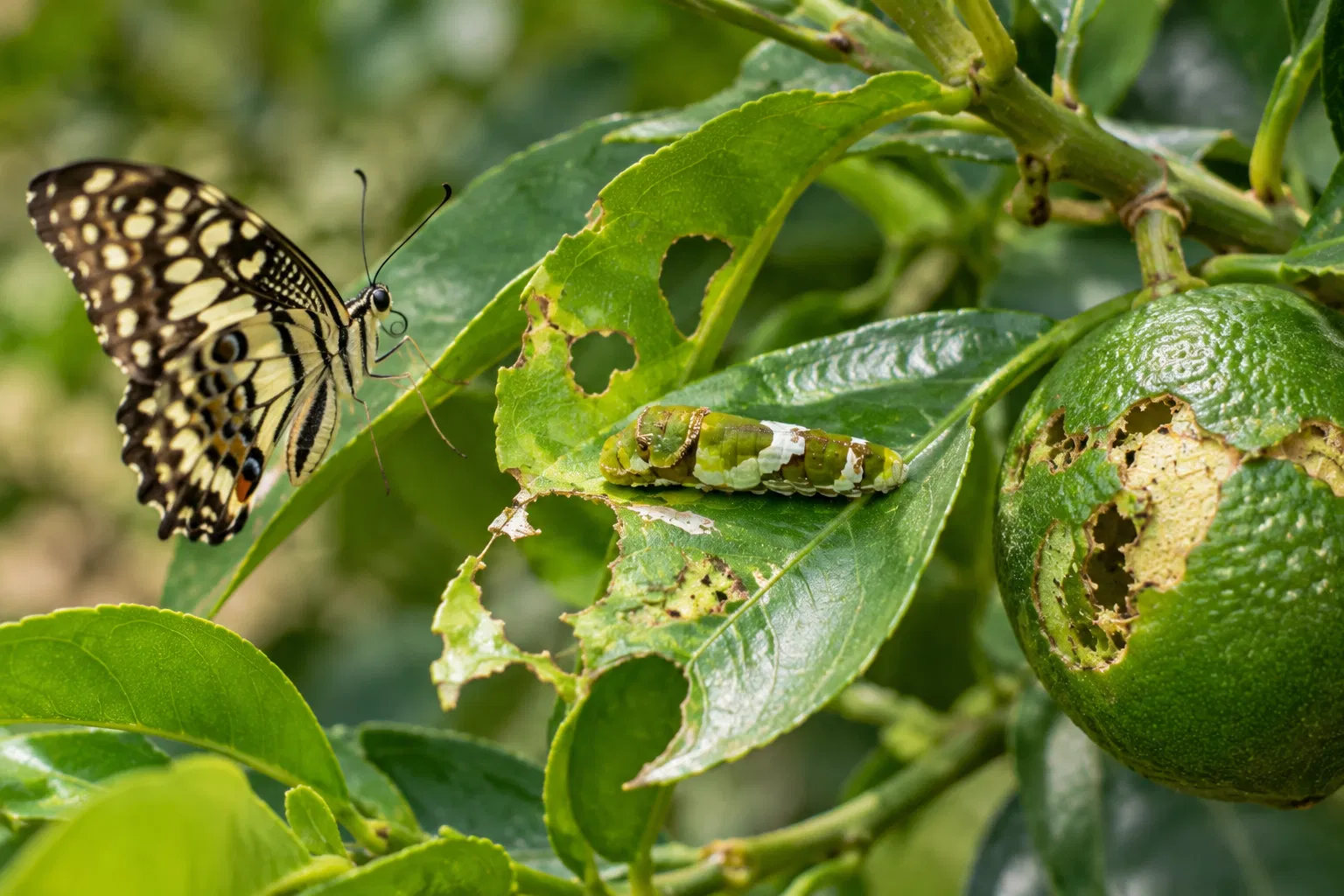
- Tender young leaves on the newest flush eaten from the edges inward, leaving ragged, irregular margins rather than neat holes.
- Whole leaflets reduced to the midrib, with the midrib left standing like a thin green wire.
- Damage concentrated on the top and outer edges of the canopy, where the soft flush is, not on hardened older leaves.
- Small, dark, rounded droppings collected on lower leaves and on the soil below a feeding larva often the first thing you see.
- On grafted and nursery plants, complete defoliation of the new shoots, with the shoot tip left thin and stalled.
- Bare, whip-like shoots on young trees after repeated attack, and a visibly slowed rate of new growth.
- Green, thumb-sized caterpillars resting openly along the midrib of a leaf or on the shoot, usually one or two per shoot rather than in clusters.
Causes
- The pest is the citrus butterfly, or lemon butterfly, Papilio demoleus, a large swallowtail whose caterpillars feed only on citrus and a few related hosts. The related Papilio polytes also attacks citrus in many regions and behaves the same way in the field.
- The adult is a striking black butterfly with pale yellow and cream bands across the wings. It does no damage itself — it only lays eggs, so seeing adults in the orchard is a warning, not the problem.
- Eggs are laid singly, one to a leaf, on the softest new leaves and shoot tips. A single female spreads eggs across many plants rather than concentrating them, which is why the damage appears scattered.
- The flush is the trigger. Every new flush after irrigation, rain or pruning brings a fresh wave of egg-laying, so the pest tracks your own crop calendar.
- Young trees, newly grafted plants and nursery beds are hit hardest because almost all of their leaf area is soft new growth, and they have no reserve canopy to lose.
- Warm, humid weather after the monsoon shortens the life cycle, so generations overlap and all stages appear together on the same tree.
- Broad-spectrum sprays applied repeatedly for other pests remove the parasitic wasps and predators that normally destroy a large share of the eggs and young larvae, which lets populations build faster than they otherwise would.
How to Identify
The larva changes appearance completely as it grows, and this is where most misidentification happens. The young larva is a convincing imitation of a bird dropping: dark brown or olive, with a rough, shiny surface and an irregular white or cream saddle across the middle of its back. It sits still in the open on the upper leaf surface, and nine growers out of ten will look straight past it. If you are scouting for this pest and see nothing, look again specifically for bird droppings that are sitting on top of leaves rather than splashed across them.
The grown larva is unmistakable once seen: two to four centimetres long, smooth, plump and bright green, with a pale oblique band on each side and a pair of dark eye-like spots on the swollen front segments that give it a small snake-like look. Touch it or disturb it and it everts a fleshy, forked orange organ from just behind the head the osmeterium which releases a sharp citrus-like smell. Nothing else on citrus does this, so it is a definitive check.
The pupa is a brown or green angular chrysalis attached upright to a twig or the shoot by a silk girdle, easy to mistake for a dried curl of bark. Leave these alone where you can: a proportion of them will be parasitized, and the wasps emerging from them work for you.
Against lookalikes: leaf-eating caterpillars from other groups usually feed in groups, spin silk webs or roll leaves, none of which citrus butterfly does. Damage from grasshoppers and beetles takes irregular bites out of the middle of hardened leaves as readily as soft ones, while citrus butterfly works from the leaf edge inward and stays on the tender flush. If new leaves are curled, silvered or blistered with winding tunnels rather than eaten away, the problem is citrus leaf miner, not this pest, and needs entirely different treatment. And crucially, if you find chewed leaves with no caterpillar and no fresh droppings, the larvae have already pupated spraying at that point achieves nothing.
Control Methods
Chemical Control
1. Quinalphos 25% EC
Quinalphos is an organophosphate that works by blocking the enzyme acetylcholinesterase in the insect's nervous system, causing rapid loss of coordination and death. Its usefulness against citrus butterfly comes from the fact that the larvae are large, exposed feeders that sit on the outside of the leaf and consume a lot of leaf tissue, so a spray that wets the upper canopy delivers the dose both through direct contact and through the treated leaf surface the larva keeps eating. It has enough contact activity to knock down the grown larvae that a gentler product would only slow down, and enough vapour action to reach a larva tucked along a shoot. Direct the spray at the new flush and the upper outer canopy, which is where the eggs and larvae are; drenching the hardened interior leaves wastes product and adds residue for no benefit.
Product Recommendation
Spray the Small Larvae, Not the Big Ones
This is the single decision that determines whether a spray works. Young larvae in the bird-dropping stage die readily; grown green larvae are far harder to kill, and by the time they are that size they have already eaten most of what they are going to eat. Killing a four-centimetre larva feels satisfying and saves almost no leaf. So the spray is worth making when scouting shows fresh eggs and small dark larvae on the flush, and it is largely wasted once the population is dominated by large green ones. Walk the block weekly during every flush and act on the first sign, rather than waiting for damage visible from the road.
Spray the Flush, Not the Calendar
Because egg-laying follows the flush, a fixed spray schedule either misses the wave or sprays when there is nothing to hit. Tie the decision to the crop instead: when a new flush pushes out after irrigation, rain or pruning, that is when scouting matters and when a spray, if needed, will pay. Between flushes, when growth has hardened off, the pest has nowhere to lay and nothing needs doing.
Match the Effort to the Tree's Age
A bearing tree with a full canopy can lose a surprising amount of new leaf without any effect on yield, and routine spraying of mature orchards for this pest is usually not justified, it costs money and removes the natural enemies that keep the pest in check. Nursery beds, newly planted saplings and trees in their first three years are the opposite case: their whole canopy is the flush, they have no reserve to draw on, and here even a light infestation deserves immediate attention. If you are deciding where to spend a limited spray budget, spend it on the young blocks.
Observe the Pre-Harvest Interval
Quinalphos is a broad-spectrum organophosphate with a meaningful waiting period between the last spray and harvest. On bearing trees, confirm the pre-harvest interval on the label for your state and respect it, this matters especially for fruit going to fresh market or export, where residue limits are checked. On nursery and non-bearing plants this constraint does not apply, which is another reason chemical control fits young plantings better than fruiting ones. Spray in the cooler part of the day, wear the protective equipment named on the label, and keep the spray off flowering panicles to protect pollinators.
Cultural Control
- Synchronize flush across the block. Uniform irrigation and pruning so that the whole orchard flushes together gives the pest one narrow window instead of a continuous supply of tender leaves, and lets one well-timed round of scouting cover everything.
- Protect the natural enemies. Parasitic wasps attack citrus butterfly eggs and larvae heavily, and spiders, ants and predatory wasps take a steady toll on young larvae. In most mature orchards these are the reason the pest never becomes serious, so avoid unnecessary broad-spectrum sprays that clear them out.
- Keep nursery plants under net. Nursery beds and grafted plants raised under insect-proof netting or a shade structure are simply not available for egg-laying, which removes the problem entirely at the stage the crop is most vulnerable.
- Inspect planting material before it enters the field. A batch of nursery plants can arrive carrying eggs or small larvae; a few minutes of checking the flush on arrival prevents an introduced infestation.
- Remove alternate citrus hosts around the block. Volunteer citrus seedlings, neglected lemon bushes and curry leaf plants in and around the orchard carry the pest between your flushes and act as a reservoir.
- Keep young trees growing steadily. A well-fed, well-watered sapling replaces lost leaf quickly and recovers from an attack that would stall a stressed plant. Adequate nutrition is part of pest management here, not separate from it.
- Do not over-apply nitrogen. Heavy nitrogen pushes soft, extended flush repeatedly through the season, which is exactly the tissue the butterfly seeks out and lays on.
Mechanical Control
Hand-picking is unusually effective against this pest, and on small holdings and in nurseries it is often all that is needed. The larvae are large, brightly visible once you know the stages, slow-moving, solitary and sitting in the open on the upper leaf surface, no digging through the canopy, no silk, no rolled leaves to open. Walk the block during every flush, collect the eggs, the dark bird-dropping-stage larvae and the big green ones by hand, and destroy them away from the trees rather than dropping them on the ground, where they will simply climb back up. On a nursery bed of a few hundred plants, two people can clear an infestation in a morning without any chemical at all.
Leave the pupae you find attached to twigs unless the infestation is heavy. Many will be parasitized, and the wasps that emerge from them are working on your next generation of larvae destroying them removes free control. If the infestation is severe enough that pupae are numerous, collect them, but keep the collected pupae in a covered container with a fine mesh so that emerging parasitoids can escape and any emerging butterflies cannot.
Clipping is also worth considering on nursery plants. Where a single shoot carries several larvae and is already stripped, cutting and destroying that shoot removes the pest and the damaged growth in one step, and the plant pushes a cleaner flush in its place.
Conclusion
Citrus butterfly is a pest you manage by looking, not by spraying on a schedule. The larvae are conspicuous and easy to remove by hand once you can recognize the bird-dropping stage, the damage window is tied to your own flush rather than to the calendar, and mature trees mostly do not need treatment at all. Where it genuinely bites is in nurseries and on trees in their first few years, and there the answer is a weekly walk through the block during every flush, hand-collection of what you find, netting where the plants are small enough to cover, and a targeted quinalphos spray on the flush when small larvae are numerous enough that picking cannot keep up. Catch the population while the larvae are still dark and small, and you keep the flush that builds the tree.
Disclaimer: Always confirm current label registration, approved dosage, water volume, and pre-harvest interval (PHI) for your state before using any product, since labels are periodically revised by regulatory authorities.
This guide is a general advisory. Do your own research and verification before using any product. Always confirm suitability for your crop stage, region, and field conditions before making any purchase, spray, or crop-management decision.