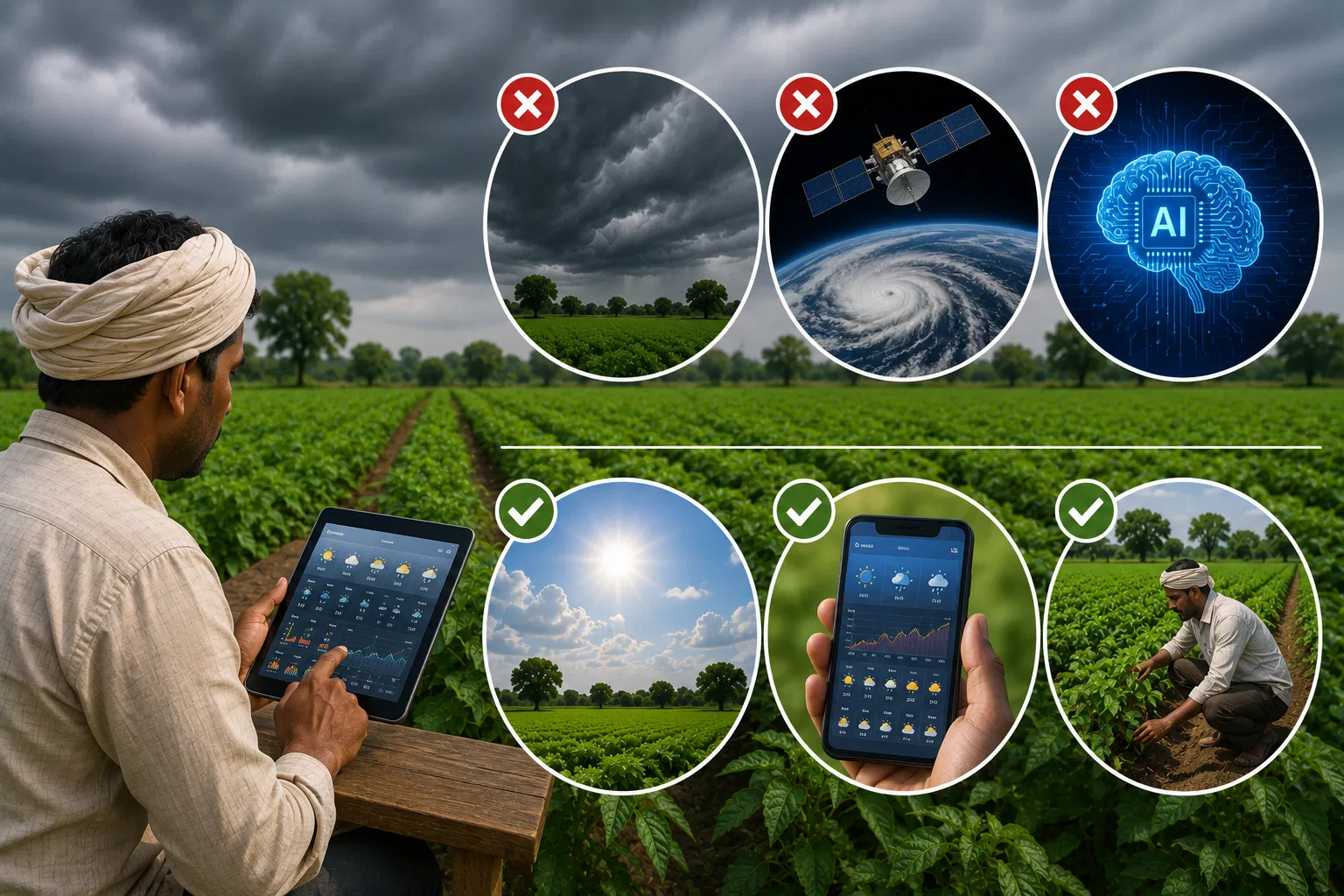
For farmers, weather is never just a conversation topic. It determines when to plant, irrigate, spray, harvest, and protect crops from damage. A few hours of inaccurate forecasting can result in lower yields, wasted inputs, or significant financial losses. This raises an important question: can artificial intelligence predict weather for farmers accurately enough to improve farm decisions?
The answer is yes. Artificial intelligence (AI) is making weather forecasting smarter, faster, and more localized than traditional forecasting alone. While AI does not replace meteorologists or weather stations, it analyzes massive amounts of weather and farm data to generate more accurate predictions that support agricultural decision-making.
How Artificial Intelligence Improves Weather Prediction
Traditional weather forecasting relies on satellites, radar, atmospheric models, and meteorological expertise. AI enhances these systems by identifying patterns within large datasets that conventional models may overlook.
AI systems can process information from:
- Weather stations
- Satellite imagery
- Soil moisture sensors
- Historical rainfall records
- Temperature and humidity data
- Wind speed and direction
- Crop and field-level observations
By combining these data sources, AI-powered forecasting tools generate highly localized weather predictions. This is particularly valuable because weather conditions often vary significantly between neighboring farms or even individual fields.
Why Farmers Need More Accurate Weather Forecasts
Modern agriculture depends on precise timing. More accurate forecasts help farmers answer important operational questions such as:
- When is the best time to plant?
- Will rainfall affect spraying or fertilizer application?
- Is frost likely overnight?
- Should irrigation schedules be adjusted?
- When is the safest harvest window?
Improved forecasts reduce uncertainty, lower production costs, and help farmers plan timely crop protection operations.
What AI Can Predict for Farmers
1. Rainfall Probability
AI estimates when rainfall is likely to occur, expected intensity, and duration. This allows farmers to better schedule spraying, irrigation, and harvesting operations.
2. Temperature Changes
AI forecasting can identify sudden heat waves, cold spells, and frost events before they occur, allowing growers to prepare sensitive crops.
3. Humidity and Disease Risk
Humidity strongly influences disease development. AI systems can identify weather conditions that increase the likelihood of fungal diseases and other crop health issues, helping farmers plan preventive fungicides applications where appropriate.
4. Wind Conditions
Wind affects spraying, pollination, and soil erosion. AI forecasts help identify suitable spray windows and reduce the risk of off-target drift.
5. Soil Moisture Trends
By combining rainfall forecasts with field sensor data, AI can estimate future soil moisture conditions and support more efficient irrigation planning.
Benefits of AI Weather Prediction for Agriculture
AI-powered forecasting provides several practical advantages:
- Better decision-making: Farmers can respond proactively instead of reactively.
- Reduced input costs: More efficient use of water, fertilizers, and crop protection products.
- Improved crop protection: Early warnings for frost, storms, and disease-favorable conditions.
- Higher operational efficiency: Better scheduling of labor and machinery.
- Greater yield potential: Timely field operations improve crop performance.
How AI Weather Tools Work on the Farm
Most AI weather platforms use machine learning models that continuously improve as they process additional data.
- Collect weather, crop, and soil information.
- Analyze historical and real-time patterns.
- Generate localized weather predictions.
- Provide alerts and management recommendations.
- Continuously update forecasts as new information becomes available.
Many modern systems also integrate with mobile applications, farm management software, and IoT sensors for real-time decision support.
Can AI Replace Traditional Weather Forecasting?
No. AI works best alongside traditional meteorological forecasting rather than replacing it.
Large-scale atmospheric forecasting remains essential, while AI improves forecast accuracy by adapting predictions to local field conditions and learning from historical outcomes.
AI does not replace weather science—it makes weather information more useful for practical farming decisions.
Limitations Farmers Should Know
Despite its advantages, AI weather forecasting has several limitations.
- Forecast accuracy depends on data quality.
- Rapidly changing microclimates remain difficult to predict perfectly.
- Digital infrastructure and sensor availability vary between farms.
- Machine learning models require continual updates as weather patterns evolve.
Even with these limitations, AI generally provides more farm-specific guidance than broad regional forecasts alone.
Real-World Applications of AI Weather Forecasting
Across agriculture, AI already supports:
- Planning planting windows.
- Scheduling irrigation.
- Choosing suitable spray timings.
- Predicting disease-favorable weather.
- Preparing for frost, drought, storms, and heat waves.
As precision agriculture expands, AI weather forecasting is becoming an increasingly important management tool.
Choosing an AI Weather Forecasting Platform
Farmers should look for solutions that provide:
- Field-level weather forecasts.
- Real-time updates.
- Actionable alerts.
- Integration with sensors and farm software.
- Historical weather analysis.
The best AI platforms not only predict weather but also help farmers make better management decisions using that information.
Conclusion
Artificial intelligence is transforming weather forecasting for agriculture by delivering more localized, timely, and actionable predictions. Although AI cannot eliminate weather uncertainty, it helps farmers make better decisions regarding planting, irrigation, harvesting, and crop protection.
As AI technologies continue to evolve, weather forecasting will become even more accurate and valuable, helping farmers reduce risk, improve resource efficiency, and increase farm productivity.