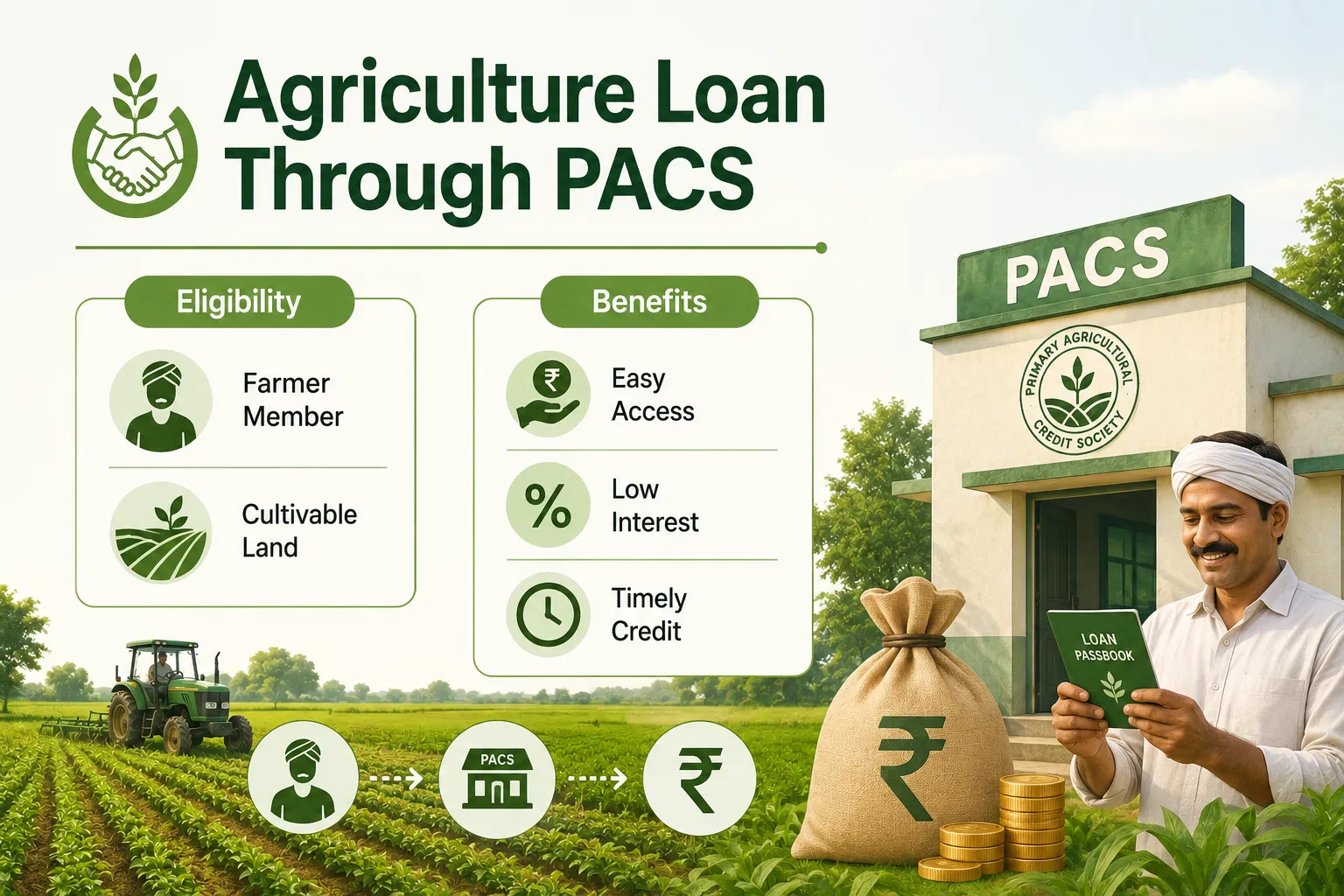
Primary Agricultural Credit Societies (PACS) were set up under the Cooperative Credit Societies Act of 1904 to bring institutional credit directly to village-level farmers, replacing dependence on private moneylenders. They are administered by the Ministry of Cooperation and regulated under state Cooperative Societies Acts, with NABARD acting as the key refinancing and development agency. PACS remain the grassroots-most link in India's rural credit system, sitting below District Central Cooperative Banks (DCCBs) and State Cooperative Banks (StCBs), and they continue to be one of the simplest ways for small and marginal farmers to access short-term agricultural credit close to home.
PACS Agriculture Loan Overview
- Scheme/Institution Name – Primary Agricultural Credit Societies (PACS), part of the short-term cooperative credit structure
- Recent Modification – Centrally Sponsored Project for Computerisation of PACS, approved 29 June 2022, running from 2022-23 to 2026-27, to bring PACS onto a common ERP system linked with NABARD
- Fund Allocated – ₹2,516 crore for the PACS computerisation project, shared between the Government of India, State Governments, and NABARD; benefiting around 63,000 PACS
- Type of Scheme – Cooperative institution, jointly overseen by State Governments (registration and administration) and NABARD (refinancing), with policy support from the Ministry of Cooperation
- Helpline No – Kisan Call Centre, 1800-180-1551 (toll-free); for PACS-specific queries, farmers can contact their local PACS office, DCCB, or State Cooperative Bank branch
- States Covered – All-India; PACS exist in nearly every gram panchayat, with over 1 lakh societies functioning across the country
Objectives of PACS Lending
- Deliver short-term and medium-term agricultural credit at the village level
- Reduce farmers' reliance on informal and high-interest moneylenders
- Support timely access to inputs like seeds, fertilisers, and equipment
- Strengthen rural financial inclusion for small and marginal farmers
- Modernise cooperative credit delivery through digitisation and better transparency
Key Features of PACS Loans
- PACS forms the base of a three-tier structure: PACS at the village level, DCCBs at the district level, and StCBs at the state level, refinanced by NABARD
- A PACS can be formed by a group of ten or more people from a village, registered under the state Cooperative Societies Act
- Loans are extended mainly for crop production, purchase of agricultural inputs, and allied activities
- Loans are commonly linked to the Kisan Credit Card (KCC), making borrowers eligible for interest subvention under schemes like MISS
- Interest rates on PACS crop loans are typically lower than commercial bank rates, and can fall further with government interest subvention
- PACS working capital comes from members' share capital, membership fees, deposits, and borrowings from DCCBs
- Many PACS also handle input distribution, storage, and marketing support alongside lending
PACS Loan Eligibility
- Farmers, agricultural labourers, and rural residents within the PACS's village or area of operation
- Applicant must become a member by purchasing a share in the society (share values are generally kept low and affordable)
- Both landowning and tenant farmers, oral lessees, and sharecroppers can typically join, subject to the society's bylaws
- A Kisan Credit Card is generally required to access interest-subvented crop loans through PACS
- Applicant must reside in or cultivate land within the PACS's designated operational area
Benefits to Farmers
- Credit available close to home at the village level, cutting down travel and paperwork compared to commercial banks
- Interest rates significantly lower than private moneylenders, and further reduced when linked to KCC-based subvention schemes
- Simple, low-cost membership process open even to small and marginal farmers
- Access to inputs like seeds and fertilisers, often bundled with the credit facility
- Faster, more transparent loan processing as PACS move to a common digital ERP platform under the ongoing computerisation project
- Additional non-credit support such as storage facilities and market linkage in many PACS
Limitations of PACS Loans
- Loan amounts and terms vary by state and by individual PACS, since each society operates under its own bylaws
- Members carry a degree of shared liability in the cooperative structure, which varies by state rules
- Many PACS are still transitioning to digital systems, so processing speed can differ between computerised and non-computerised societies
- Loan sanctioning depends on the PACS's own financial health and borrowing capacity from its DCCB
- Coverage and service quality can be uneven across states depending on how active the local cooperative structure is
Documents Required
- Aadhaar Card
- Proof of land ownership, tenancy, or cultivation rights
- PACS membership/share purchase receipt
- Bank/PACS account passbook
- Kisan Credit Card application form (where the loan is KCC-linked)
- Passport-size photograph
How to Apply for an Agriculture Loan Through PACS
- Locate the PACS operating in your village or gram panchayat area; most villages are covered by one.
- Apply for membership by purchasing the required share as per the society's bylaws.
- Submit Aadhaar, land records, and other requested documents to the PACS office.
- Apply for a Kisan Credit Card through the PACS if you don't already have one, to access subsidised interest rates.
- Once membership and documentation are verified, the PACS management committee sanctions the loan based on your land holding and crop plan.
- Repay on time to maintain your credit standing with the society and remain eligible for future loans and incentives.
Conclusion
PACS continue to be the most accessible entry point into formal agricultural credit for millions of small and marginal farmers across India. With the ongoing computerisation drive linking PACS to NABARD through a common digital platform, loan processing is becoming faster and more transparent. For farmers looking for low-cost, nearby credit without the paperwork load of a commercial bank, joining the local PACS and applying for a KCC-linked loan remains one of the most practical options available.
Disclaimer: This article is for informational purposes only. Scheme details, interest rates, and subvention amounts are subject to periodic revision by the Government of India, RBI, and NABARD. Farmers are advised to verify the latest terms and eligibility criteria with their bank, NABARD, or official government sources before applying.